
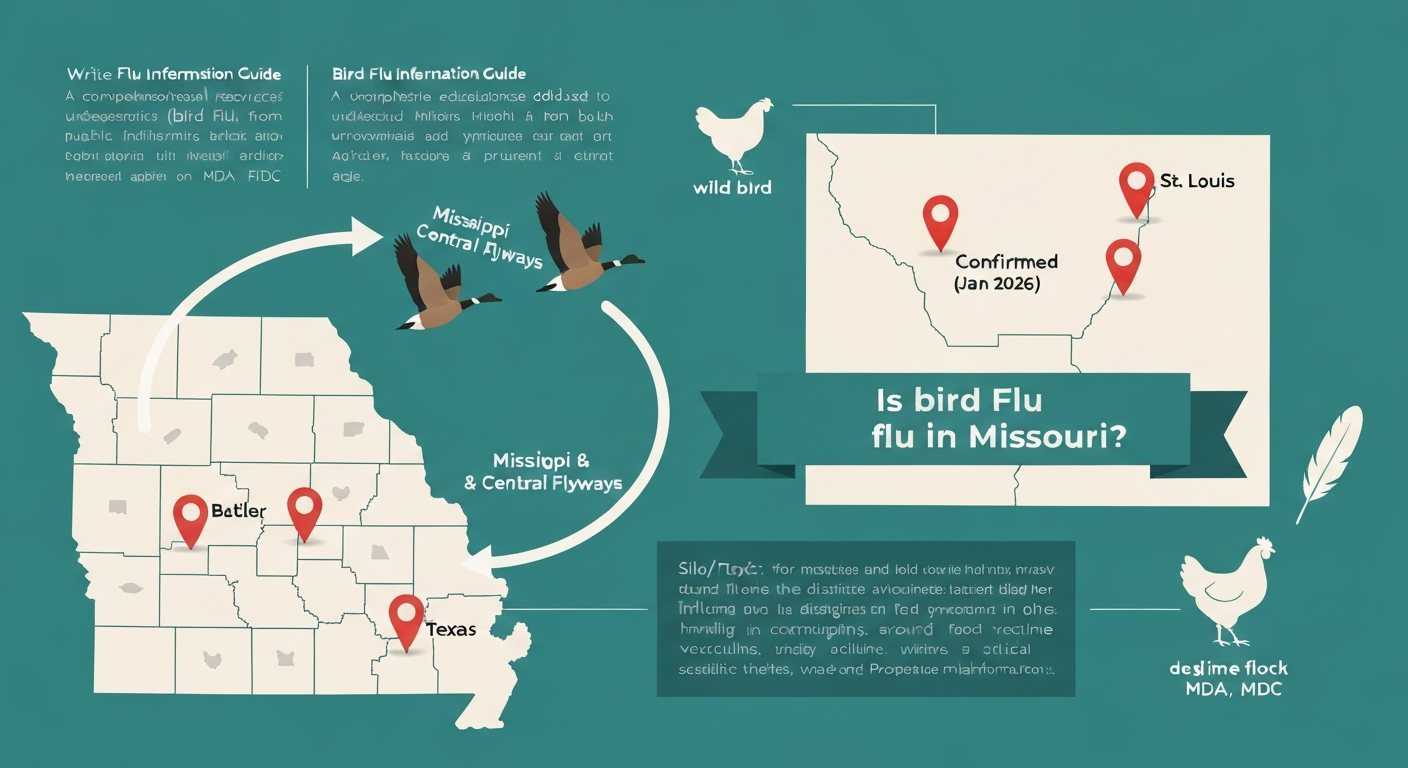
Yes, bird flu has been confirmed in Missouri. As of early 2026, Missouri had confirmed HPAI (Highly Pathogenic Avian Influenza) detections in wild birds across multiple counties, including St. Louis, Clay, Jackson, Knox, Butler, and Texas County, and two domestic poultry premises were confirmed positive in January 2026: a 10-bird backyard flock in Butler County and a commercial flock of roughly 6,000 birds in Texas County. Whether new cases have been confirmed since then depends on the current USDA APHIS dashboard and the Missouri Department of Agriculture's outbreak notices, both of which update in near real-time.
Is Bird Flu in Missouri? Current Status, Risks & Actions

Sarah Chen
13 Jul 2026
The fastest way to confirm current Missouri bird flu status
The single most reliable method is to check two federal USDA APHIS dashboards and one state agency page, all of which are publicly accessible and updated as new confirmations come in. Here is exactly what to look at and what each source tells you.
- USDA APHIS 'Confirmations of HPAI in Commercial and Backyard Flocks': This table lists every confirmed domestic poultry premises by state, county, detection date, and flock type (commercial vs. backyard). Filter or search for Missouri to see the most current poultry premises detections.
- USDA APHIS 'Detections of Highly Pathogenic Avian Influenza in Wild Birds': A companion dashboard covering confirmed wild-bird HPAI events by state and species. Missouri wild-bird detections appear here as they are laboratory-confirmed.
- Missouri Department of Agriculture (MDA) Avian Influenza page: The MDA posts outbreak news items and maintains contact information for the Animal Health Division. If a new premise is confirmed in Missouri, an MDA press release typically accompanies the APHIS posting.
- Missouri Department of Conservation (MDC) HPAI page: The MDC maintains a county-level table and map of wild-bird detections in Missouri specifically, which is useful if you are a hunter, birder, or backyard flock owner who wants county-specific wild-bird data.
Bookmarking those four pages gives you a complete real-time picture. The APHIS dashboards are the gold standard because they reflect NVSL (National Veterinary Services Laboratories) confirmatory testing, which is the official federal standard for H5/H7 classification in domestic flocks. State agency pages tend to add local context and contact information that the federal dashboards do not include.
Where to find official outbreak maps and notices
Three agencies publish authoritative, publicly accessible HPAI data covering Missouri at different levels of detail. Understanding what each one covers helps you pull the right information quickly.
| Agency | What they publish | Update frequency | Best for |
|---|---|---|---|
| USDA APHIS | Confirmed commercial and backyard flock cases; wild-bird detections; interactive maps | Within days of NVSL confirmation | Definitive flock and species-level confirmation data |
| Missouri Dept. of Agriculture (MDA) | State press releases, outbreak news, Animal Health Division contact: (573) 751-3377 | As outbreaks are confirmed | Reporting sick domestic birds; local response guidance |
| Missouri Dept. of Conservation (MDC) | County-level wild-bird detection table and map | Updated with new MDC/lab-confirmed cases | Hunters, birders, and backyard flock owners tracking wild-bird risk |
| CDC | Human exposure guidance, case counts in people, risk assessments | Ongoing | Anyone who has had direct contact with infected birds |
| WOAH/WAHIS | International situation reports; U.S. HPAI notifications to trading partners | Periodic situation reports | Understanding global spread and U.S. official WOAH notifications |
It is worth noting that Missouri's HPAI detections were among those formally reported to the World Organisation for Animal Health (WOAH) for the period covering December 29, 2025 through January 13, 2026, which means the outbreaks are documented in the international animal-health surveillance record as well as in domestic databases.
Why neighboring states matter: checking Wisconsin, Oklahoma, Arkansas, Iowa, and Kansas
Missouri sits at the intersection of the Mississippi and Central migratory flyways, two of the four major routes used by wild waterfowl moving between Canada and the Gulf of Mexico. That geography means what happens in neighboring states is a direct leading indicator for Missouri. When HPAI is circulating in wild birds in Iowa or Kansas, those same birds are likely passing through Missouri. Is bird flu in Iowa? Check the latest Iowa confirmations to see whether nearby wild-bird detections could affect Missouri. Tracking neighboring-state confirmations is not paranoia; it is practical biosecurity planning.
Here is what the regional picture looked like heading into mid-2026. Wisconsin confirmed a backyard flock case in Dane County on March 2, 2026. Iowa's Department of Agriculture and Land Stewardship announced H5N1 HPAI in a multi-species backyard flock in Washington County on March 3, 2026, which was Iowa's fifth detection in 2026 alone. Kansas maintains an active HPAI guidance page through the Kansas Department of Agriculture covering both poultry and dairy livestock detections. For up-to-date confirmation in that state, see Is bird flu in Kansas for current Kansas detections and guidance. Arkansas, which shares Missouri's southern border and part of the Mississippi Flyway corridor, has also had documented HPAI activity worth monitoring. Oklahoma rounds out the southern neighboring-state picture. For current confirmation on whether bird flu is in Oklahoma, check the Oklahoma Department of Agriculture and the USDA APHIS outbreak dashboards is bird flu in Oklahoma.
The practical takeaway: if you are a poultry keeper in Missouri and you see confirmed active detections in Iowa (north), Kansas (west), Arkansas (south), or along the Mississippi Flyway, treat that as a prompt to review your biosecurity measures now, not after a local confirmation. USGS National Wildlife Health Center data confirm that HPAI continues to affect wild birds across all four U.S. flyways, so the risk to domestic flocks is a function of wild-bird activity in the broader region, not just county-level reports.
What HPAI actually is and how it differs from seasonal flu
HPAI stands for Highly Pathogenic Avian Influenza. The 'pathogenicity' rating describes how damaging the virus is specifically in poultry (chickens in particular), not directly in humans. A strain is classified as highly pathogenic based on laboratory tests showing it causes severe systemic disease or very high mortality in experimentally infected chickens. The contrasting category, LPAI (Low Pathogenic Avian Influenza), causes mild or inapparent illness in poultry. The classification tells you about poultry outcomes; it does not automatically predict how dangerous a strain is for humans.
The strain currently circulating in the United States and confirmed in Missouri is H5N1 clade 2.3.4.4b. The H and N numbers refer to hemagglutinin and neuraminidase proteins on the virus surface. This clade has been responsible for enormous poultry losses worldwide and is being monitored closely for its zoonotic (animal-to-human) potential. It is an influenza A virus, just like seasonal human flu, but it is genetically very different from the H1N1 and H3N2 strains in annual human flu vaccines. Seasonal flu vaccines provide no meaningful protection against H5N1.
Seasonal human influenza is efficiently transmitted human-to-human, which is why it causes widespread annual epidemics. HPAI H5N1, by contrast, does not currently spread efficiently from person to person. Human cases to date have almost exclusively involved people with direct, close contact with infected birds or contaminated environments. That distinction matters enormously when assessing real-world risk.
How avian influenza spreads
Wild birds and migratory flyways
Wild waterfowl, especially dabbling ducks and shorebirds, are the natural reservoir hosts for avian influenza viruses. They shed the virus in feces, saliva, and respiratory secretions, often without showing obvious illness themselves. See the Missouri Department of Conservation guidance, 'Highly Pathogenic Avian Influenza (HPAI), Missouri Department of Conservation (transmission & flyway guidance),' which explains that wild waterfowl shed HPAI in feces, saliva, and respiratory secretions and that migration along flyways drives geographic spread Highly Pathogenic Avian Influenza (HPAI) — Missouri Department of Conservation (transmission & flyway guidance). Because Missouri lies along two major flyways, wild-bird populations moving through the state can contaminate surface water, soil, and anything that waterfowl contact, including the perimeter of poultry facilities or backyard pens with outdoor access.
Spillover to domestic poultry
Domestic chickens, turkeys, and other poultry are highly susceptible to HPAI. Spillover typically happens when wild birds share water sources with domestic flocks, when contaminated feces or mud is tracked into a poultry area on boots or equipment, or when domestic birds have any outdoor exposure during periods of high wild-bird activity. Backyard flocks with free-range access are at higher risk than fully indoor commercial operations during active wild-bird migration periods.
Fomites and human movement
Fomites are inanimate objects that can carry and transfer infectious material. In the context of HPAI, fomites include boots, clothing, vehicle tires, shared equipment, egg flats, and feed bags. People do not spread HPAI to other people the way they spread seasonal flu, but a person can mechanically carry contaminated material from an infected premises to a clean one if they do not follow decontamination protocols between farm visits. This is why the USDA's biosecurity guidance emphasizes cleaning and disinfecting footwear and equipment at the farm gate.
How to read an outbreak report: confirmed vs. presumptive, wild bird vs. domestic, flocks vs. birds
Outbreak reports use specific language that matters. Misreading the terminology leads to both unnecessary panic and unwarranted complacency.
- Presumptive positive: A state or NAHLN (National Animal Health Laboratory Network) laboratory has detected the virus using approved PCR testing, but the USDA's National Veterinary Services Laboratories (NVSL) has not yet issued its official confirmation. Presumptive results are reported quickly and are taken seriously, but the case is not added to the official APHIS confirmed-case count until NVSL verifies it.
- Confirmed positive: NVSL has completed confirmatory testing and the H5/H7 subtype determination is official under federal laboratory rules (9 CFR § 145.14). This is the number on the APHIS dashboards.
- Wild bird detection vs. domestic premises: A wild-bird detection means a dead or sick wild bird tested positive. It does not mean any poultry farm has been affected. A domestic premises confirmation means an actual flock (backyard or commercial) has HPAI, triggering mandatory depopulation, quarantine zones, and reporting.
- Affected flock vs. affected birds: The APHIS tables typically count premises and the number of birds on that premises, not individual confirmed-positive birds. A 'flock of 6,000' means 6,000 birds were on that premises when HPAI was confirmed and the entire flock is subject to depopulation protocols, not that 6,000 birds tested positive individually.
- Depopulation: This is the term used for the culling of an infected flock to prevent further spread. It is a regulatory requirement, not a voluntary action, once HPAI is confirmed on a domestic premises.
Reading these distinctions correctly lets you assess whether a news headline represents a wild-bird surveillance finding (lower immediate risk to local farms), a backyard flock case (localized risk, quarantine zone established), or a large commercial confirmation (broader economic impact, larger quarantine zone). Missouri's January 2026 confirmations included both a small backyard case (10 birds, Butler County) and a commercial flock case (approximately 6,000 birds, Texas County), which represent meaningfully different scales of response.
Clinical signs of HPAI in poultry and wild birds
What to watch for in domestic poultry
HPAI in domestic poultry, especially chickens and turkeys, is often severe and fast-moving. Birds may die suddenly with little prior warning, or you may see a cluster of these signs in your flock:
- Sudden, unexplained death in multiple birds in a short time span
- Swollen or discolored head, comb, wattles, or eyelids (often purple or bluish)
- Discharge from the eyes or nostrils
- Coughing, sneezing, or labored breathing
- Diarrhea, often watery and greenish or white
- Dramatic drop in egg production, or soft-shelled and misshapen eggs
- Incoordination, tremors, or twisting of the neck (neurological signs)
- Sudden decrease in feed and water consumption
Any combination of these signs, especially sudden unexplained mortality involving multiple birds, is reason to contact the Missouri Department of Agriculture Animal Health Division immediately at (573) 751-3377. Do not wait for multiple deaths before making that call. Early reporting is critical because quarantine zones and movement restrictions are established based on the date of first suspicion, and faster containment protects neighboring farms.
Clinical signs in wild birds
Wild waterfowl infected with HPAI may show neurological signs (circling, inability to hold the head upright, loss of coordination) or may simply be found dead with no obvious prior illness. Raptors, including eagles and hawks, that feed on infected waterfowl can also develop HPAI and show severe neurological disease. If you find a dead wild bird, especially a waterfowl species like a goose, duck, or swan, or a raptor, do not handle it with bare hands. Report it to the Missouri Department of Conservation. The MDC coordinates wild-bird surveillance sampling, and a single dead bird is not necessarily cause for alarm, but clusters of dead birds of the same species in the same location warrant immediate reporting.
Human risk: what HPAI means for your health
Clinical signs in humans exposed to HPAI
Human infections with H5N1 can range from mild to severe. Reported signs in people who have been infected include fever, cough, sore throat, muscle aches, conjunctivitis (eye redness and discharge), and in more severe cases, pneumonia and respiratory failure. The CDC's interim guidance, updated from December 2024 onward, recommends that anyone who develops these symptoms within 10 days of exposure to infected or potentially infected birds seek medical evaluation promptly and inform their provider about the exposure history.
How health agencies assess the level of human risk
The CDC and WHO assess human risk from HPAI H5N1 as low for the general public. That assessment is based on the fact that the virus does not currently transmit efficiently from person to person, and virtually all human cases globally have involved direct contact with infected live or dead birds, contaminated environments, or in recent U.S. dairy-related cases, infected cattle and raw milk. The risk level is elevated for specific groups: commercial poultry workers, backyard flock owners who handle sick birds, wildlife biologists who handle dead waterfowl, and veterinarians and farm workers on premises with confirmed infections.
For those higher-risk groups, the CDC's interim recommendations outline specific protocols. Respiratory protection (at minimum an N95 respirator, fit-tested when possible), eye protection (goggles or face shield), gloves, and coveralls are recommended when entering infected premises or handling potentially infected birds. Antiviral chemoprophylaxis with oseltamivir (Tamiflu) is recommended for exposed individuals in certain circumstances, and testing and 10-day monitoring for symptoms is standard protocol after a known exposure. If you have had unprotected contact with birds from a confirmed HPAI premises in Missouri, contact your local or state health department for guidance on monitoring and testing.
Food safety: eggs and poultry
Properly cooked poultry and eggs remain safe to eat. HPAI is inactivated by standard cooking temperatures: poultry should be cooked to an internal temperature of 165 degrees Fahrenheit (74 degrees Celsius). Commercial eggs from USDA-inspected facilities are not sourced from flocks with confirmed HPAI, because infected flocks are depopulated and removed from the food supply. The risk from commercially purchased, properly cooked poultry and eggs is considered negligible by the CDC and WHO. Backyard flock owners should follow the same cooking guidance and should not consume eggs or poultry from a flock showing signs of illness or from a premises under investigation or quarantine.
Vaccine availability
As of mid-2026, no approved H5N1 vaccine is available to the general public in the United States. The U.S. government maintains stockpiles of candidate H5N1 vaccines that could be deployed in a pandemic scenario, and mRNA-based H5 vaccine candidates have been in clinical development. Seasonal flu vaccines do not protect against H5N1. Poultry vaccination policy in the U.S. has been a subject of ongoing discussion, with USDA weighing the trade implications of vaccinated flocks against the benefits of reducing spread, but no nationwide mandatory poultry vaccination program was in place as of the time of writing. The situation can evolve, so checking CDC and USDA guidance for the most current vaccine policy is worthwhile.
What to do if you find sick or dead birds, or if you've been exposed
- Do not handle sick or dead birds with bare hands. Use disposable gloves, a plastic bag, or a shovel to avoid direct contact.
- For dead wild birds: Contact the Missouri Department of Conservation to report the finding, especially if multiple birds are involved or if the bird is a waterfowl or raptor species.
- For sick or dead domestic poultry: Call the Missouri Department of Agriculture Animal Health Division at (573) 751-3377. Report promptly; do not wait to see if more birds die.
- Isolate sick birds from the rest of the flock immediately if you can do so safely, to reduce exposure within the flock while awaiting guidance.
- Do not move birds, equipment, or manure from the suspected premises until you have spoken with MDA or USDA APHIS. Movement restrictions may apply.
- If you have had unprotected contact with a confirmed or suspected HPAI bird: Contact your local or state health department and your physician. Describe the exposure, including the date, nature of contact, and protective equipment you used.
- Monitor yourself for symptoms (fever, cough, sore throat, eye discharge, muscle aches) for 10 days after the exposure date. Seek medical evaluation promptly if symptoms develop and tell your provider about the bird exposure.
Key contacts and resources at a glance
| Agency | What they handle | Contact / Resource |
|---|---|---|
| Missouri Dept. of Agriculture (MDA) | Sick or dead domestic poultry; flock testing; quarantine coordination | (573) 751-3377 | mda.mo.gov |
| Missouri Dept. of Conservation (MDC) | Sick or dead wild birds; wild-bird HPAI county map | mdc.mo.gov HPAI page |
| USDA APHIS | National confirmed flock and wild-bird case dashboards; biosecurity guidance | aphis.usda.gov/bird-flu |
| CDC | Human exposure guidance; PPE and antiviral recommendations; human case tracking | cdc.gov/bird-flu |
| Missouri Dept. of Health (DHSS) | Human exposure monitoring and testing coordination | health.mo.gov |
| USGS National Wildlife Health Center | Wild-bird mortality events; WHISPers reporting system | nwhc.usgs.gov |
The most important thing to take away from all of this is that the information infrastructure around HPAI in the United States is genuinely good. Federal and state agencies publish confirmed data quickly, testing protocols are standardized, and the reporting chain from a farm to a national dashboard is well established. That means you do not have to rely on news headlines or social media to understand what is happening in Missouri. The APHIS dashboards and MDA notices give you the verified picture. Detections of Highly Pathogenic Avian Influenza in Wild Birds, USDA APHIS provides a real‑time dashboard and tables listing confirmed HPAI events by state and county Detections of Highly Pathogenic Avian Influenza in Wild Birds — USDA APHIS. Checking those sources, keeping an eye on the neighboring-state activity in Iowa, Kansas, Arkansas, Wisconsin, and Oklahoma, and following basic biosecurity if you keep poultry puts you well ahead of any outbreak risk.
FAQ
Is bird flu in Missouri right now?
Yes. As of early 2026 Missouri has confirmed highly pathogenic avian influenza (HPAI) detections in wild birds across multiple counties and confirmed HPAI on at least two domestic premises (a Butler County backyard flock and a Texas County commercial flock). For the current, county‑level status check USDA APHIS and Missouri state pages listed below.
Where can I find up‑to‑date maps and official case lists for Missouri and nearby states?
Primary sources are: USDA APHIS dashboards for wild birds and for commercial/backyard flock confirmations; Missouri Department of Agriculture (MDA) avian influenza page and Missouri Department of Conservation HPAI page. For neighboring states check each state agriculture or animal health department (e.g., Iowa, Kansas, Wisconsin, Arkansas, Oklahoma). These official pages are updated with confirmed results and dates.
How are HPAI cases tested and reported in the U.S.?
Specimens are first tested by veterinary diagnostic labs in the National Animal Health Laboratory Network (NAHLN). Confirmatory testing for H5/H7 subtypes is performed at USDA’s National Veterinary Services Laboratories (NVSL). USDA APHIS posts confirmed events on its dashboards. State animal health agencies coordinate investigations and public notices.
What is HPAI and how is it different from seasonal influenza?
HPAI (highly pathogenic avian influenza) refers to bird influenza virus strains that cause high mortality in poultry. It is genetically and epidemiologically distinct from human seasonal flu strains. HPAI primarily infects birds; occasional zoonotic infections can occur but human‑to‑human transmission is rare. Pathogenicity labels refer to effects in poultry, not necessarily human disease severity.
How does avian influenza spread to domestic flocks?
The main routes are direct contact with infected wild birds (especially waterfowl), contact with contaminated feces, water, feed, equipment, people, vehicles, or fomites that carry virus from infected birds or environments. Migration patterns and flyways drive geographic spread of infected wild birds.
What signs should I watch for in poultry?
Infected birds may show sudden death, decreased egg production, swollen combs/wattles, respiratory signs (coughing, sneezing), lethargy, decreased appetite, diarrhea, and nervous signs. HPAI can cause rapid, high mortality in flocks. Any unusual illness or sudden deaths should be reported to state animal health authorities.
Next Articles

Is Bird Flu in Europe Now? Risk, Symptoms, Safety Steps
Find out if bird flu is in Europe now, current risk, symptoms, food safety, and exact steps for handling exposure safely
What Is Being Done About Bird Flu: Response, Vaccines, Safety
How agencies detect, contain and treat bird flu, plus biosecurity, vaccines, human steps, and safe egg and poultry guida
What Countries Have Bird Flu Now: Updated List and How to Check
Updated list of countries with bird flu, how to verify current reports, and what to do for poultry and travel.