The 1918 Spanish flu was not a bird flu in the strict sense, but avian genes almost certainly played a major role in its origin. The virus was H1N1 influenza A, and its genome shows clear signs of avian ancestry, but current evidence suggests it arrived in humans through a complex process involving at least partial adaptation from bird-like viral ancestors rather than a direct, single jump from a wild bird population. Think of it less as 'bird flu crossed into humans' and more as 'a virus whose ancestors were largely avian, but had already been reshaping themselves for mammalian hosts before the pandemic struck.'
Was the Spanish Flu a Bird Flu? Evidence on 1918 H1N1 Origins

Sarah Chen
8 Aug 2026
What the 1918 virus actually was: H1N1 influenza A in plain terms
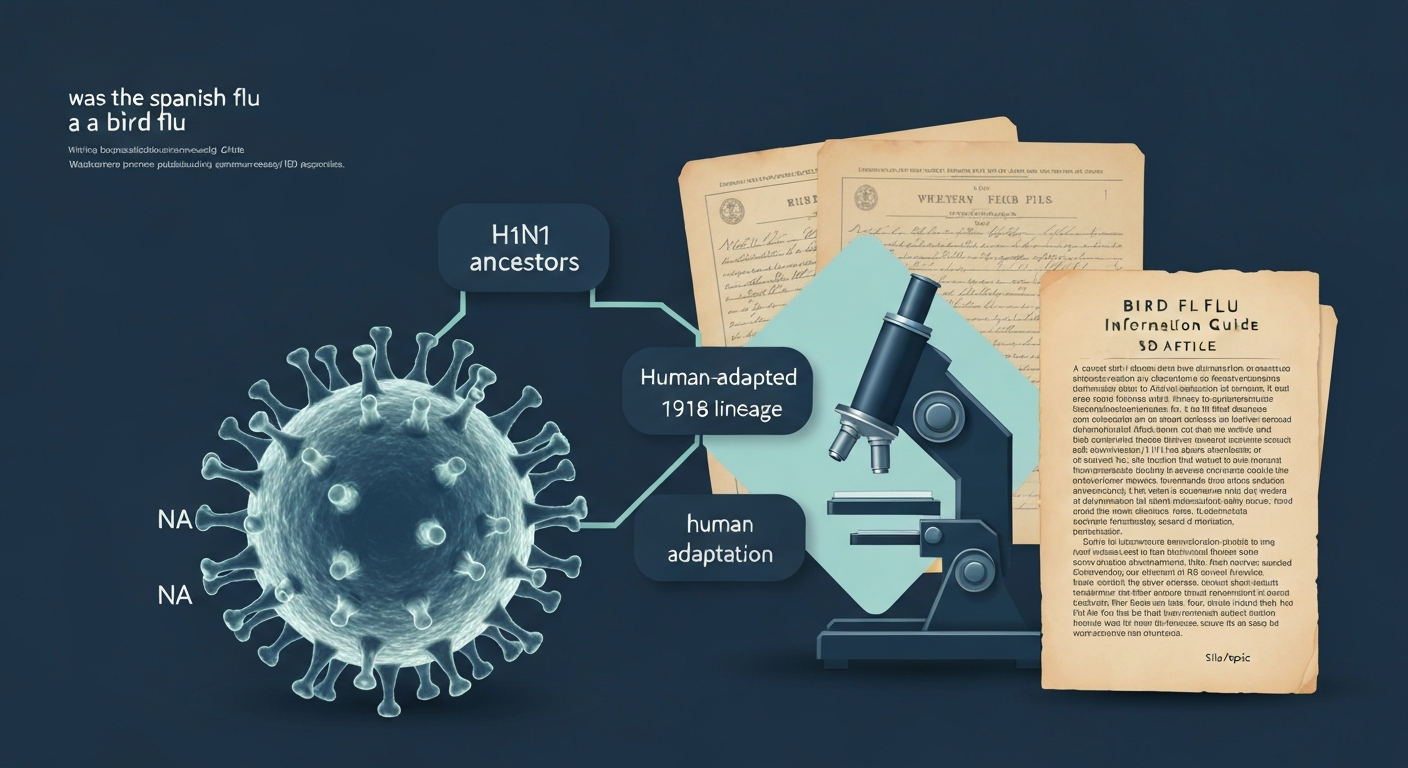
The 1918 pandemic virus is classified as influenza A, subtype H1N1. Influenza A viruses are named by two surface proteins: hemagglutinin (H or HA), which the virus uses to latch onto host cells, and neuraminidase (N or NA), which helps new virus particles escape after replication. The 1918 strain carried the H1 hemagglutinin and the N1 neuraminidase, placing it in the H1N1 subtype family. That same subtype designation, H1N1, also applies to the 2009 pandemic virus and to seasonal human flu strains that circulated for much of the 20th century, though as I will explain, those later H1N1 viruses have quite different origins.
Scientists could not study the 1918 virus directly for decades because no live samples survived. That changed in the 1990s and early 2000s when researchers recovered and sequenced influenza A RNA from preserved 1918 autopsy tissues: frozen permafrost samples from Alaska and formalin-fixed lung tissues stored in pathology archives. The first complete hemagglutinin coding sequence was published in 1999, and by 2005, Taubenberger and colleagues had reconstructed all eight genome segments and published a full genomic characterization in Nature. Characterization of the 1918 influenza virus polymerase genes (Taubenberger et al., Nature 2005) reported reconstruction and phylogenetic analysis of the polymerase segments as part of the full-genome characterization. In parallel, Tumpey and colleagues used reverse genetics to actually rebuild an infectious 1918 H1N1 virus in the lab, confirming that the reconstructed genome encodes genuinely high virulence in mouse and human airway models.
Why most scientists lean toward an avian origin
When Taubenberger's team compared the 1918 polymerase genes to known influenza lineages, they found the overall genomic pattern looked more like an avian-adapted virus that had recently crossed into and adapted to human hosts than like a long-circulating human flu strain. The key lines of evidence pointing toward avian ancestry are worth knowing concisely.
- Phylogenetic placement: the 1918 gene sequences, especially the polymerase genes, cluster closer to avian influenza lineages than to the human influenza strains that circulated before 1918, suggesting the viral ancestors lived in birds.
- Structural similarity to avian viruses: the overall genome architecture of the 1918 virus resembles that of avian influenza viruses more than it does classic human strains of the same era.
- PB2-627K mammalian adaptation marker: position 627 of the PB2 polymerase subunit is a well-documented host-range marker. Avian viruses typically carry a glutamic acid (E) at that position; mammalian-adapted strains typically carry a lysine (K). The 1918 reference sequences carry the human-type 627K signature, indicating the polymerase had already adapted to replicate efficiently in mammalian respiratory tracts.
- Hemagglutinin receptor-binding specificity: bird flu viruses preferentially bind to α2,3 sialic acid receptors (abundant in avian intestinal tracts), while human-adapted flu binds α2,6 receptors (dominant in human upper airways). Several 1918 isolates, including A/South Carolina/1/1918, show residues consistent with preferential α2,6 (human-type) binding, suggesting the HA had at least partly shifted toward human adaptation.
- Reconstructed virulence in animal models: the rebuilt 1918 virus replicates efficiently in human airway cells and causes high mortality in mice, consistent with a virus carrying unusual combinations of genes that do not appear in standard seasonal human flu.
A 2014 PNAS study by Worobey, Han, and Rambaut added important nuance using host-specific molecular clocks. Their analysis suggested the pandemic lineage arose via reassortment: a pre-existing human H1 hemagglutinin lineage that likely emerged before around 1907 combined with avian N1 and internal genes shortly before 1918. In other words, different segments of the 1918 virus may have had different histories, some tracing back to humans, others to birds, rather than the whole virus arriving in one dramatic jump from a wild bird. This is a critical distinction because it means 'avian origin' applies most cleanly to certain segments (notably the internal genes and neuraminidase) rather than necessarily to the entire constellation.
What we still do not know: the real limits of the evidence
I want to be honest about the uncertainty here, because I see a lot of confident claims in both directions online. The evidence is genuinely incomplete, and the scientific debate has been explicit and substantive. Gibbs and Gibbs published a critique in Nature in 2006 questioning the interpretation that the 1918 virus was wholly avian-derived, and Taubenberger's group replied in the same journal, highlighting that phylogenetic conclusions are sensitive to the methods and reference sequences used. That kind of open disagreement among top researchers is healthy science, but it does mean the popular shorthand of 'the Spanish flu was a bird flu' oversimplifies the picture.
- Sample scarcity: only a handful of complete 1918 genomes exist. Most published analyses are built around two reference strains, A/Brevig Mission/1/1918 and A/South Carolina/1/1918, plus a small number of other isolates. Even a 2023 mBio study using next-generation sequencing on archival lung tissues added new reconstructions, but the total pool remains tiny compared to what you would want for confident geographic or evolutionary inference.
- RNA degradation and technical artifacts: century-old tissues suffer RNA fragmentation, formalin-fixation chemical damage, and contamination risks. These issues can introduce errors in reconstructed sequences and increase uncertainty in downstream phylogenetic analyses.
- No animal reservoir samples from 1918: we have human isolates, but no confirmed avian or swine samples from the same period. That makes it impossible to directly identify the animal source population.
- Phylogenetic model sensitivity: conclusions about timing and evolutionary direction can shift depending on which molecular clock model, substitution rate, or reference sequences are used. Different reasonable analytical choices produce meaningfully different results.
- Intermediate host question: it remains unresolved whether the virus adapted directly in humans, via swine as an intermediate host, or through some combination. Swine were proposed as a mixing vessel as early as the 1990s, but hard evidence of the exact pathway is lacking.
The bottom line on uncertainty: the broad conclusion that avian genes played a major role in the 1918 pandemic lineage's ancestry is well supported and accepted by most influenza researchers. The precise pathway, whether a direct bird-to-human jump, a reassortment event, or gradual adaptation through an intermediate host, remains genuinely unresolved. That nuance matters for mechanistic understanding, for pandemic preparedness planning, and for avoiding misleading analogies to modern avian flu outbreaks.
How influenza A subtypes are named: what H and N actually mean
Influenza A viruses are classified by their two surface proteins: hemagglutinin (H, numbered H1 through H18) and neuraminidase (N, numbered N1 through N11). The H protein is the key the virus uses to enter host cells, and the N protein is the enzyme that allows newly made virus particles to detach and spread. Different combinations of H and N give us different subtypes: H1N1, H5N1, H7N9, H3N2, and so on. All influenza A viruses ultimately trace their genetic diversity to avian reservoirs, particularly wild aquatic birds, which host an enormous variety of H and N combinations. That does not mean every influenza A virus is a 'bird flu' in practical terms, though; the term 'avian influenza' or 'bird flu' is specifically used for strains that primarily circulate in birds and that pose distinct challenges when they occasionally infect humans.
The notation 'A/H1N1' simply means influenza A, subtype H1N1. When you see 'influenza A H1N1' on a lab report or public health bulletin, it tells you the subtype but not the origin or the specific strain. A seasonal human flu strain, the 1918 pandemic virus, and the 2009 pandemic virus are all technically influenza A H1N1, but they are not the same virus. This is a common source of confusion, and it is worth keeping that distinction in mind whenever you read headlines about H-numbered flu strains.
How bird flu differs from swine-adapted and human-adapted flu strains
The term 'avian influenza' or 'bird flu' refers to influenza A strains that have adapted to replicate and spread efficiently in birds, especially poultry and wild waterfowl. These viruses bind preferentially to α2,3 sialic acid receptors, which are abundant in avian intestinal and respiratory tracts. Human-adapted strains, by contrast, have evolved to bind α2,6 receptors found in the human upper respiratory tract. Swine-adapted strains sit somewhere in between: pig respiratory tracts carry both receptor types, which is why pigs have historically been considered potential 'mixing vessels' where avian and human flu genes can recombine.
Highly pathogenic avian influenza (HPAI) strains like H5N1 and H7N9 can infect humans who have close, direct contact with infected birds, but they do not spread easily between people because they have not yet fully adapted to human receptor binding and transmission. That barrier is exactly what makes pandemic preparedness around avian flu so important: if an avian strain were to acquire the mutations needed for efficient human-to-human transmission while retaining high pathogenicity, it could pose a serious public health threat. The 1918 experience is, in part, what makes researchers so attentive to that possibility.
Clearing up common confusions: H1N1, bird flu, H3 subtypes, and A/H1N1 naming
One question I see frequently is whether H1N1 is the same as bird flu. The short answer is no, not in the way most people mean it. H1N1 is a subtype designation, not an origin label. Is H1N1 the same as bird flu? Not necessarily, H1N1 names a subtype (H and N proteins), and whether an H1N1 virus is 'bird flu' depends on its specific lineage and host adaptations rather than the subtype label alone. If you're wondering 'is h1n1 bird or swine flu', the short answer is that H1N1 is a subtype name and can refer to viruses with avian, swine, or human origins depending on the specific strain. For a clear, concise comparison of H1N1 and avian (bird) flu, see h1n1 vs bird flu. For clarity, the claim that 'H1N1 is also known as bird flu' is misleading, H1N1 denotes a subtype, not a bird-origin label; see the linked explanation for more detail. The 2009 H1N1 pandemic virus, sometimes called 'swine flu,' was a multi-way reassortant with segments from North American triple-reassortant swine lineages and Eurasian avian-like swine lineages. It was not a direct bird flu at all; it emerged from pigs. The 1918 H1N1 had avian-related ancestry but had already substantially adapted to humans by the time it caused the pandemic. Seasonal H1N1 human flu strains that circulated from the 1950s onward were descendants of the 1918 lineage, progressively more human-adapted with each passing decade.
H3 subtypes add another layer of complexity. Influenza A H3N2 is the dominant seasonal human flu subtype today, and it has no meaningful relationship to avian H3 strains currently circulating in birds. The H3N2 human lineage has been circulating in people since the 1968 Hong Kong pandemic and has evolved substantially over more than 50 years. Meanwhile, avian H3 viruses in poultry represent entirely separate evolutionary lineages. The fact that both share the 'H3' designation reflects protein family classification, not shared recent ancestry or equivalent risk. Questions about whether specific subtypes like H3 qualify as bird flu are worth exploring in their own right, since the answer depends heavily on which specific strain and host context you are asking about. For a concise discussion on whether H3 strains are considered avian influenza, see is influenza a h3 bird flu.
Comparing 1918 H1N1 to modern avian strains and the 2009 pandemic virus
| Feature | 1918 H1N1 (Spanish flu) | H5N1 (modern HPAI) | H7N9 (avian) | 2009 H1N1 (swine-origin) |
|---|---|---|---|---|
| Subtype | H1N1 | H5N1 | H7N9 | H1N1 |
| Primary reservoir | Avian ancestry, adapted to humans by 1918 | Wild birds, poultry | Wild birds, poultry (China) | Swine (multiple lineages) |
| Receptor binding | Mostly α2,6 (human-type) in several isolates | Primarily α2,3 (avian-type) | Primarily α2,3 (avian-type) | α2,6 (human-type) |
| Human-to-human transmission | Highly efficient (pandemic) | Very limited | Very limited | Efficient (pandemic) |
| PB2-627 marker | 627K (mammalian-adapted) | Often 627E in birds; 627K in some human cases | 627K acquired in some human cases | Acquired mammalian-adaptation markers |
| Case fatality in humans | Estimated 2–3% overall (extraordinary for flu) | Approximately 60% in confirmed cases (but severe underascertainment) | Approximately 39% in confirmed cases | Below 0.02% overall |
| Pandemic status | 1918 pandemic (global) | No sustained human spread as of 2026 | No sustained human spread; outbreak wound down after 2017 | 2009 pandemic (global) |
| Cross-protection from H1 immunity | Partial with 2009 H1N1 antigens | Not reliably protected by H1 immunity | Not reliably protected by H1 immunity | Partial with 1918 H1-like antigens |
| Vaccine availability | Historical; not applicable | Pre-pandemic H5N1 vaccines exist; limited stockpiles | Research vaccines; limited deployment | Included in seasonal flu vaccines since 2010 |
A few things stand out in this comparison. First, the case fatality rates for modern avian strains like H5N1 look alarming on paper, but they reflect confirmed cases involving direct bird contact, typically in settings with limited healthcare, and almost certainly miss enormous numbers of mild or asymptomatic infections. They are not directly comparable to population-level pandemic mortality estimates. Second, the 2009 H1N1 and the 1918 H1N1 share a subtype designation and some partial antigenic cross-reactivity, which is why older people who had been exposed to 1918-lineage H1N1 viruses earlier in life showed some protection against the 2009 pandemic strain. That cross-reactive immunity is a real phenomenon documented in antibody studies of 1918 survivors and older adults. Third, and importantly for farmers and agricultural workers: the fact that 1918 had avian-related ancestry does not mean modern avian strains like H5N1 or H7N9 would behave anything like 1918 if they adapted to humans. They are antigenically very different, and H1-based immunity or H1 vaccines would not protect against H5 or H7 avian strains.
The genetic features that made 1918 so dangerous: a plain-language summary
Several specific molecular features of the 1918 virus contributed to its severity. You do not need to be a virologist to understand what they did in practice.
- Hemagglutinin adapted for human airways: the 1918 HA protein had shifted, at least in key isolates, toward binding α2,6 receptors in the human upper respiratory tract. This allowed efficient infection of the nose, throat, and upper airway cells that human flu needs to spread person to person.
- Polymerase adapted for mammalian temperature: avian flu viruses replicate at the higher temperatures found in bird intestines and have trouble in the cooler human upper airway. The 1918 polymerase, with its 627K PB2 signature and other adaptations, had overcome this barrier, allowing efficient replication in human respiratory tissue.
- No pre-existing population immunity: the 1918 H1N1 was antigenically novel to the human immune system. No one alive had meaningful protective antibodies against it, meaning the virus encountered an almost entirely susceptible global population.
- Unusual age distribution of severe disease: unlike typical flu, which kills mainly the very old, the 1918 pandemic showed a striking W-shaped mortality curve, with severe deaths among young adults aged roughly 20 to 40. Multiple hypotheses exist for this pattern, including a possible immune-enhancement effect from prior exposure to older flu strains, but it remains incompletely explained.
- Gene constellation effects: experimental work with the reconstructed 1918 virus shows that the specific combination of all eight gene segments working together produced higher virulence than any single gene alone. This kind of gene-constellation effect is why surveillance agencies monitor reassortment events in animals so carefully today.
What this means for public health, farmers, and food safety today
Understanding the 1918 pandemic's avian-linked origins is not just historical curiosity. It directly shapes how we think about modern avian influenza surveillance and why organizations like WHO, FAO, and WOAH (the World Organisation for Animal Health) coordinate so closely on flu monitoring through systems like WHO GISRS and WOAH WAHIS. For up-to-date outbreak and surveillance data, see WOAH (OIE) disease pages & situation reports on avian influenza / H5Nx (WOAH WAHIS). The core lesson from 1918 is that influenza viruses circulating in bird populations carry pandemic potential if they acquire the right combination of adaptations for human transmission and pathogenicity.
For people concerned about personal risk
The avian flu strains currently circulating in poultry and wild birds, most notably the H5N1 clade 2.3.4.4b that has driven large outbreaks in poultry and wild birds globally through 2025 and into 2026, do not spread efficiently between people. Your personal risk from casual exposure is low unless you have direct, unprotected contact with infected birds or their droppings. Annual seasonal flu vaccination remains the most practical protective step you can take for currently circulating human flu strains, though it does not protect against antigenically distinct avian subtypes. Stockpiles of H5N1-targeted pre-pandemic vaccines exist and are being updated, but they are not currently part of routine public immunization programs.
For farmers and agricultural workers
If you work with poultry or have backyard flocks, biosecurity is your primary practical tool. The following steps reduce both the risk to your birds and, critically, the risk that your farm becomes a site where an avian virus might encounter a mammal host and gain adaptation opportunities.
- Limit wild bird access to poultry housing, feed, and water sources, since wild waterfowl are the primary reservoir for avian influenza A viruses.
- Use personal protective equipment (PPE) including gloves, eye protection, and respiratory protection when handling sick or dead birds or cleaning contaminated areas.
- Report unusual illness or death in flocks promptly to your state veterinarian or USDA APHIS; early detection and response are the most effective tools for limiting outbreak spread.
- Clean and disinfect equipment, footwear, and clothing before and after entering poultry areas, and restrict visitor access during outbreak periods.
- Follow occupational health guidance: farm workers with direct bird contact are advised to get seasonal flu vaccination not because it protects against avian H5 strains, but to reduce the theoretical risk of co-infection by two flu strains in the same person, which could theoretically facilitate reassortment.
- Be aware of symptoms in yourself and your workers: fever, respiratory illness, and conjunctivitis (eye inflammation) after bird contact should prompt medical evaluation and disclosure of occupational exposure to your healthcare provider.
Food safety: eggs and poultry products
Properly cooked poultry and eggs are safe to eat. Influenza A viruses, including avian strains, are inactivated by cooking to an internal temperature of 74°C (165°F) or higher. There is no credible evidence that properly handled and cooked poultry or egg products transmit avian influenza to consumers. The food safety concern in HPAI outbreaks is primarily about handling raw, infected carcasses without protection, not about consuming cooked food from the regulated commercial supply.
The big picture: avian flu's role in past and future pandemics
The 1918 Spanish flu most likely had avian-origin genes at its core, even if the exact evolutionary path from bird reservoir to pandemic human strain remains incompletely mapped. What the genomic evidence firmly establishes is that avian influenza gene pools can and do contribute to pandemic viruses, sometimes dramatically. The 1918 event, the 1957 H2N2 pandemic (which involved avian-origin HA and NA), the 1968 H3N2 pandemic (avian-origin HA), and the ongoing monitoring of H5N1 and H7N9 all follow the same logic: wild birds carry an enormous diversity of influenza A gene segments, and when the right combination of genetic changes allows an avian strain to replicate and spread in humans, the consequences can be severe. That is why surveillance, rapid response infrastructure, and biosecurity at the animal-human interface matter so much, not as reasons for panic, but as the practical tools that give us a fighting chance at early warning.
FAQ
Was the 1918 “Spanish” influenza virus a bird (avian) flu?
Short answer: not simply. The 1918 pandemic virus was influenza A H1N1 and its genome has been recovered from archival human tissues. Genetic and experimental data show the virus carried several avian‑like genes and traits, but analyses disagree on whether the entire virus came directly from birds or whether some segments came from an existing human H1 lineage and others (including internal genes or N1) from avian sources. In practice, most experts conclude avian viruses played a major role in the ancestry of the 1918 virus, while the precise pathway (direct avian→human jump vs. reassortment with a human lineage) remains unresolved (Taubenberger et al. 2005; Worobey et al. 2014).
What is the primary genetic evidence that links the 1918 virus to birds?
Key evidence: sequences recovered from 1918 autopsy tissues show many segments are phylogenetically 'avian‑like' compared with later human influenza lineages; experimental reconstructions demonstrate avian‑origin genes in the 1918 constellation can produce a highly virulent virus in mammals. Multiple peer‑reviewed papers (e.g., Reid et al. 1999; Taubenberger et al. 2005; Tumpey et al. 2005) present these data and public GenBank reference sequences are available for comparative study.
What evidence suggests human adaptation had already occurred in 1918 isolates?
Functional and sequence markers of mammalian adaptation are present in reconstructed 1918 genomes. For example, the polymerase PB2 residue 627K — a well‑known mammalian‑adaptation marker — is found in canonical 1918 sequences, and some HA receptor‑binding residues in 1918 isolates show preference for human‑type (α2,6) receptors. Laboratory reconstructions of the 1918 genome replicated efficiently in human cells and caused severe disease in animal models, indicating substantial human adaptation at the time of the pandemic (Subbarao et al.; Tumpey et al.).
Why do scientists disagree about whether the virus came directly from birds?
Disagreement stems from limited and degraded century‑old samples, small numbers of complete 1918 genomes, sensitivity of phylogenetic methods to model choice and rate variation across hosts, and the biological possibility of reassortment (mixing of segments) between influenza viruses. Different phylogenetic analyses have yielded different scenarios: some infer a predominantly avian origin for most segments, while others propose a reassortment history with a human H1 HA lineage acquiring avian N1/internal genes shortly before 1918 (Worobey et al. 2014). Methodological limits increase uncertainty about directionality and timing.
How many complete 1918 genomes exist and how reliable are they?
Only a small number of high‑quality 1918 genomes have been reconstructed (notably A/Brevig Mission/1/1918 and A/South Carolina/1/1918), and more recent next‑generation sequencing studies have added a few additional genomes. RNA degradation, formalin‑fixation artifacts, sample scarcity and potential contamination are real challenges, so while the available sequences are highly informative, they do not fully remove phylogenetic uncertainty (mBio 2023; methodological reviews).
How does the 1918 H1N1 compare to modern avian strains like H5N1 or H7N9?
They are different subtypes: 1918 was H1N1, whereas current high‑risk poultry strains are often H5Nx or H7Nx. Antigenically and genetically these subtypes differ substantially, so prior exposure or vaccines for H1 viruses do not reliably protect against H5/H7. Shared themes exist — e.g., recurring mammalian‑adaptation markers such as PB2‑627K — but subtype and antigenic differences determine immune protection and vaccine design (WOAH/WHO guidance).
Next Article
Is H1N1 Bird Flu? Key Differences, Risks, and Next Steps
Find out if H1N1 is bird flu, how the risks differ, symptoms, and what to do after exposure.