
Bird flu is not currently a pandemic, and in most parts of the world it does not meet the strict definition of a human epidemic either. Epidemiological data of an influenza A/H5N1 outbreak in elephant seals in Argentina indicates mammal‑to‑mammal transmission, Nature Communications (2024) notes that Documented mammal‑to‑mammal transmission events of clade 2.3.4.4b H5N1 have occurred in wildlife (e.g., elephant seals, Nature Communications 2024) and mass mortality events in seals (New England, 2023); these events demonstrate host‑range expansion and provide genomic evidence of mammalian‑adaptive mutations in some mammal‑derived viruses Epidemiological data of an influenza A/H5N1 outbreak in elephant seals in Argentina indicates mammal‑to‑mammal transmission — Nature Communications (2024). As of WHO's weekly update from 3 July 2026, there is still no evidence of sustained human-to-human transmission of any avian influenza strain. What we do have is an ongoing, widespread epizootic (an epidemic in animals) driven by the H5N1 clade 2.3.4.4b lineage, which has spread across wild bird populations on every continent, spilled into poultry and an expanding range of mammals including U.S. dairy cattle, and caused sporadic human infections in people with direct animal contact. That is a serious animal-health and occupational-health situation, but it is not the same as a human epidemic.
Is Bird Flu an Epidemic? Current Risks, Outlook, and Safety.

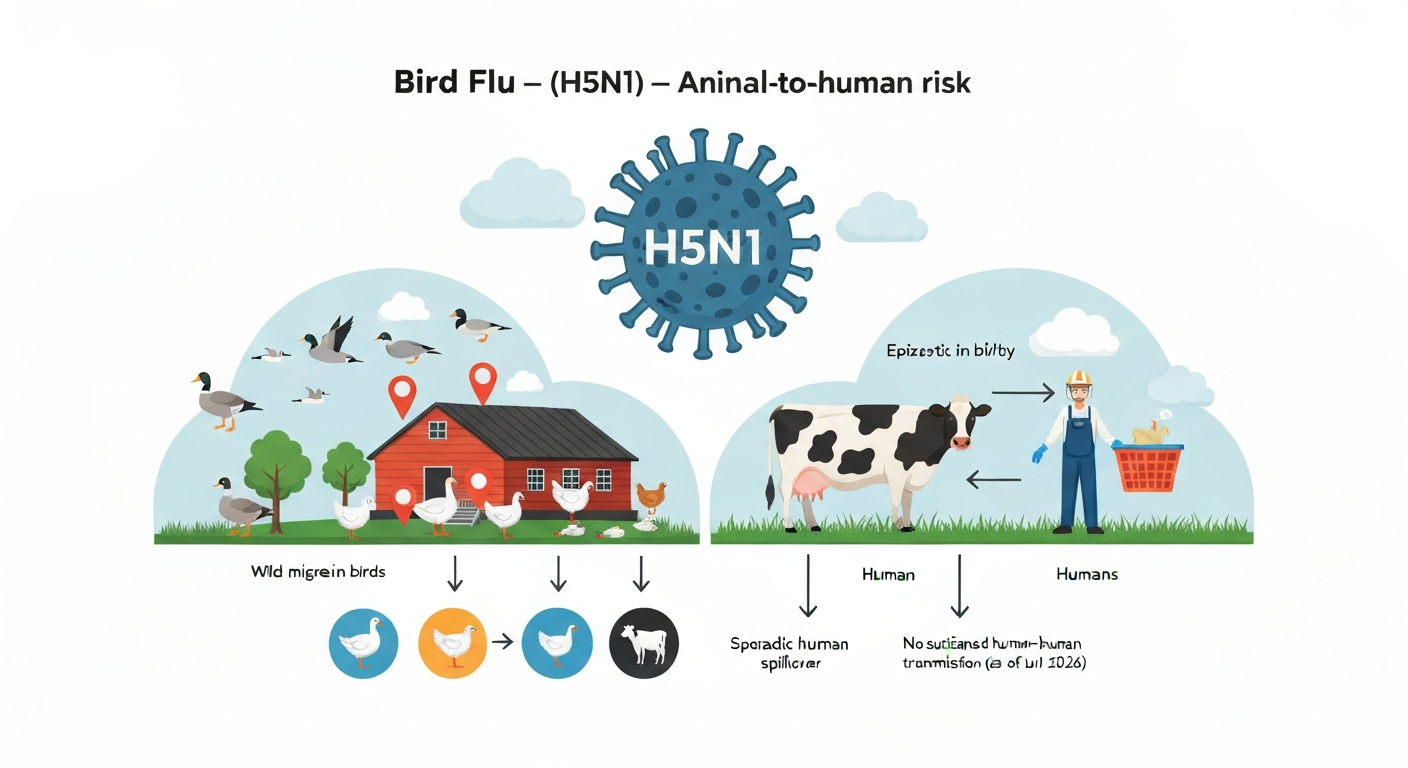
Is bird flu currently an epidemic? The direct answer
Whether bird flu qualifies as an epidemic depends entirely on which species you are asking about. In birds, the answer is unambiguously yes: HPAI (Highly Pathogenic Avian Influenza) H5N1 is causing widespread, sustained outbreaks across wild and domestic bird populations globally. WOAH's HPAI Situation Report No. 81 (May 2026) documents ongoing detections across multiple continents, making this one of the largest avian influenza epizootics ever recorded.
In humans, the picture is very different. Since systematic tracking began in 2003, WHO's global reporting summary dated 8 May 2026 counted just 1,000 laboratory-confirmed human cases of A(H5N1) over more than two decades, with 479 deaths. That is an overall case fatality ratio (CFR) of 47.9%, which sounds alarming, but those numbers reflect only the most severe cases caught by surveillance systems, not the full range of exposures and mild infections. For human-to-human spread, which is the defining feature of a human epidemic, every available assessment from WHO, FAO, and WOAH continues to find no evidence that any currently circulating avian influenza strain has acquired that capability.
Epidemic vs pandemic: what these words actually mean
These terms get used interchangeably in news coverage, but they have specific public-health meanings that matter when you are trying to assess real risk.
- Outbreak: a cluster of cases in a specific place and time, above what is normally expected.
- Epidemic: sustained, widespread transmission of a disease within a defined population or region, significantly exceeding baseline rates.
- Epizootic: the animal equivalent of an epidemic, which is exactly what HPAI H5N1 currently is among birds and some mammal populations.
- Pandemic: an epidemic that has spread across multiple countries or continents, involving sustained community-level human-to-human transmission.
WHO's operational framework for assessing whether a novel influenza virus could cause a pandemic is called TIPRA (Tool for Influenza Pandemic Risk Assessment). Under TIPRA, the critical threshold is sustained human-to-human transmission with widespread community spread globally. A virus that only infects people who have direct contact with infected animals is still serious, but it does not meet that threshold. Separately, under the International Health Regulations (IHR 2005), any State Party that detects a novel influenza strain or an unusual human influenza event is required to notify WHO, which is precisely why you keep seeing official updates: the reporting machinery is working as designed, not because a pandemic has begun.
A brief history of avian influenza outbreaks in humans
Understanding where we are today requires a quick look at how we got here. H5N1 first infected humans in Hong Kong in 1997, killing 6 of the 18 confirmed cases. After those poultry flocks were culled, the immediate threat subsided, but the virus was never fully eliminated from bird populations. It re-emerged in 2003 and spread into Southeast Asia, the Middle East, Africa, and Europe over the following years, producing the sustained but sporadic human case series that now totals 1,000 confirmed infections over two decades.
H7N9 emerged in China in 2013 and caused a separate wave of human infections, primarily in people exposed at live poultry markets, ultimately infecting over 1,500 people across multiple seasonal waves before a targeted poultry vaccination program in China dramatically reduced detections. H5N6 and H5N8 also produced scattered human cases. The current dominant strain, H5N1 clade 2.3.4.4b, represents a new chapter: it began spreading explosively in wild birds around 2021, reached the Americas (previously largely spared) by 2022, and by 2024 had crossed into U.S. dairy cattle herds, producing a novel occupational exposure route for farmworkers.
What is happening right now and where to find current data
The most significant development of the past two years has been the detection of H5N1 clade 2.3.4.4b in U.S. dairy cattle, confirmed in 2024. National milk-testing surveillance and occupational serologic surveys documented multiple human infections among dairy farmworkers, most presenting with mild illness (particularly conjunctivitis and respiratory symptoms) rather than the severe pneumonia seen in historical Southeast Asian cases. As of mid-2026, those U.S. cases remain the largest single cluster of occupationally acquired human H5N1 infections in a non-poultry setting.
For tracking the situation in real time, the most reliable sources are WHO's weekly Avian Influenza updates (the series that produced blank" rel="noopener noreferrer">Update Number 1051 on 3 July 2026), CDC's Current Situation page for H5 in people, and WOAH's HPAI Situation Reports. For genomic data on circulating strains, GISAID's EpiFlu database is where public-health and veterinary labs share influenza sequences globally, enabling rapid detection of genetic changes that might signal increased human adaptability.
| Resource | What it tracks | Update frequency |
|---|---|---|
| WHO Avian Influenza Weekly Update | Global human cases and risk assessment | Weekly |
| CDC H5N1 Current Situation | U.S. human cases, dairy cattle, guidance | As needed / ongoing |
| WOAH HPAI Situation Reports | Animal outbreaks in poultry, wildlife, mammals | Monthly or periodic |
| FAO/WHO/WOAH Joint Assessments | Pandemic risk and zoonotic event analysis | Periodic (major events) |
| GISAID EpiFlu | Influenza genome sequences for surveillance | Continuous submissions |
How avian influenza actually spreads
Wild migratory waterbirds (ducks, geese, shorebirds) are the natural reservoir for avian influenza viruses. They generally carry low-pathogenic strains without becoming ill themselves, but when H5N1 spread into wild bird populations at scale, it began killing wild birds too, an unusual and concerning change from historical patterns. From wild birds, the virus spreads to domestic poultry through contact with contaminated feces, water, soil, or infected wild birds entering farm environments.
On farms and in markets, fomites (contaminated surfaces, equipment, clothing, and vehicles) are a major transmission route. The virus can survive in cool, moist environments for days to weeks, which is why biosecurity measures like controlled access, disinfection stations, and separated equipment matter so much on poultry and livestock operations. The jump into U.S. dairy cattle is thought to have involved contaminated milking equipment and farm worker movement between herds, though airborne spread within barns has not been ruled out.
How bird flu jumps to people (and why it has not spread between people)
Human infections to date have almost exclusively involved direct or close contact with infected animals or heavily contaminated environments. Poultry farmers, live-market workers, dairy farmworkers, and people who handle sick or dead wild birds are the groups most commonly affected. The virus can enter through the respiratory tract (inhaled virus-laden droplets or dust), the eyes (conjunctival exposure), or the mouth, but it does not efficiently bind to receptors in the human upper respiratory tract, which is the main reason it has not spread person-to-person.
Influenza viruses bind to host cells using hemagglutinin (HA), the protein spike on the virus surface. Human-adapted influenza strains preferentially bind to sialic acid receptors in the alpha-2,6 configuration, which dominate in the human upper airway. Avian strains bind preferentially to alpha-2,3 receptors, which are more common in the human lower respiratory tract and in birds. This receptor mismatch is one of the main barriers to efficient human-to-human spread.
Scientists track specific genetic mutations that indicate the virus is adapting toward mammalian hosts. In the PB2 gene (which encodes part of the viral polymerase), substitutions like E627K and D701N increase replication efficiency at mammalian body temperatures. In the HA gene, changes in the 190 and 220 loops (such as Q226L and G228S) can shift receptor binding preference toward human-type receptors. The joint FAO/WHO/WOAH assessment of 18 May 2026 noted that some clade 2.3.4.4b sequences contain genetic markers linked experimentally to mammalian adaptation, but concluded that currently circulating viruses have not acquired efficient human-to-human transmissibility. Experimental ferret transmission studies (Nature, 2024) have shown limited transmission under controlled lab conditions, but this has not translated into field evidence of sustained human spread.
Symptoms and clinical progression in infected people
Human illness from avian influenza covers a wide spectrum. At the milder end, many U.S. dairy-farm associated cases presented with conjunctivitis (eye redness and discharge) or mild respiratory symptoms. At the severe end, historically documented H5N1 cases in Southeast Asia often progressed to viral pneumonia, acute respiratory distress syndrome (ARDS), and multi-organ failure. This range likely reflects both viral and host factors, including the dose of exposure, the route of entry, and the immune status of the person infected.
The typical timeline for severe H5N1 illness has been initial flu-like symptoms (fever, cough, body aches) appearing 2 to 5 days after exposure, followed by rapid respiratory deterioration within a week in the most severe cases. The incubation period is generally 2 to 8 days, somewhat longer than seasonal flu. High-risk groups for severe outcomes include people over 60, those with underlying respiratory or cardiovascular conditions, immunocompromised individuals, and pregnant women. However, historical H5N1 data also showed high mortality in previously healthy young adults, which complicates risk stratification.
| Symptom category | Examples | Severity association |
|---|---|---|
| Ocular | Conjunctivitis, eye redness, discharge | Mild (common in dairy farm cases) |
| Upper respiratory | Sore throat, runny nose, mild cough | Mild to moderate |
| Systemic | High fever, severe fatigue, myalgia (muscle aches) | Moderate to severe |
| Lower respiratory | Pneumonia, difficulty breathing, low oxygen | Severe |
| Critical | ARDS, multi-organ failure, septic shock | Life-threatening |
WHO and CDC clinical guidance emphasizes starting antiviral treatment as early as possible if avian influenza is suspected. Neuraminidase inhibitors, primarily oseltamivir (Tamiflu) and zanamivir, are the first-line antivirals. Treatment within 48 hours of symptom onset produces the best outcomes, though later treatment may still provide benefit in severe cases. Clinicians are also instructed to test for antiviral resistance markers (such as the NA-H275Y mutation) given the consequences of treatment failure in a severe case.
High-risk groups: who needs to be most alert
- Poultry farmers, workers at live bird markets, and slaughterhouse employees with direct bird contact.
- Dairy farmworkers in regions with confirmed H5N1 cattle infections, particularly those involved in milking or handling unpasteurized milk.
- Veterinarians and wildlife biologists who handle sick or dead birds and mammals.
- People who handle raw poultry extensively without protective equipment.
- Travelers to regions with active outbreaks who visit live animal markets.
- Immunocompromised individuals, pregnant women, and those with serious underlying lung or heart conditions, if any exposure occurs.
Could bird flu become a pandemic? The honest assessment
This is the question that underlies most of the public anxiety around bird flu, and it deserves a straight answer: it is possible, but there is no evidence it is imminent. For community perspectives and layperson questions, see the Reddit discussion titled 'what if bird flu jump to humans'. See the Reddit discussion 'Will bird flu become a pandemic' for examples of public questions and concerns about this topic Reddit discussion: 'Will bird flu become a pandemic'. The same WHO weekly update from 3 July 2026 that reported 1,000 cumulative human H5N1 cases explicitly stated that pandemic risk had not changed compared to previous assessments and that no sustained human-to-human transmission had been detected. For a focused discussion, see Will bird flu become a pandemic Will bird flu become a pandemic?.
For a pandemic to occur, H5N1 would need to acquire or reassort to gain the ability to transmit efficiently between humans while retaining its capacity to cause serious illness. This could theoretically happen through gradual mutation, or through reassortment (a mixing of genetic segments if a person or pig is simultaneously infected with avian and human influenza strains). Pigs are considered particularly important mixing vessels because their respiratory tracts contain both alpha-2,3 and alpha-2,6 sialic acid receptors.
The key factors scientists watch under the TIPRA framework include: how easily the virus infects humans from animal contact (currently: difficult, requiring close direct exposure); how severe illness is in confirmed human cases (currently: variable, from mild to fatal); whether there is any evidence of human-to-human chains (currently: none beyond very limited, unconfirmed household clusters); and which genetic markers are present in circulating strains (currently: some mammalian-adaptive mutations are present in some isolates, but the full set needed for efficient human transmission has not emerged together in one strain).
The expansion into U.S. dairy cattle is the development that has most shifted the scientific conversation. It created a large, persistent animal reservoir in close contact with humans, increasing the number of spillover opportunities. More exposures mean more chances for the virus to encounter the right host environment for an adaptive mutation to arise. That is why surveillance intensity has increased markedly since 2024, and why this situation warrants serious attention even in the absence of human-to-human spread. For a deeper look at the pandemic scenarios and worst-case modeling, the question of how serious a bird flu pandemic could actually be involves its own set of considerations around healthcare capacity and global preparedness. For a deeper look at pandemic scenarios and worst-case modeling, see our article on how bad a bird flu pandemic would be.
Why it has not become a pandemic despite decades of circulation
H5N1 has been infecting people sporadically for nearly 30 years. The reason it has not triggered a pandemic is that the same properties that make it so lethal in birds (and in some human cases) appear to work against efficient airborne human-to-human spread. For more detail on the factors that have so far prevented a pandemic, see the explainer "why hasn't the bird flu become a pandemic.". High-pathogenicity viruses that destroy lung tissue rapidly may be poor transmitters precisely because the window of contagious shedding before severe illness is narrow. In contrast, pandemic influenza strains like the 2009 H1N1 were highly transmissible partly because they caused milder illness that allowed continued social activity and viral shedding. There is an inherent (though not guaranteed) tension between high virulence and transmissibility in respiratory viruses.
Prevention: practical steps for farms and households
For poultry and livestock farmers, biosecurity is the primary defense. This means controlling access to farm premises, disinfecting vehicles and equipment at entry points, using personal protective equipment (PPE) when handling birds or cattle showing illness, keeping wild birds away from domestic flocks where possible, and reporting unusual mortality or illness in animals promptly to veterinary authorities. Workers on farms with confirmed or suspected H5N1 should wear N95 respirators, eye protection, and gloves when in contact with animals or contaminated materials.
For the general public, the practical risk is very low. Thoroughly cooked poultry and eggs are safe: the virus is inactivated at standard cooking temperatures (74°C / 165°F internal temperature). Pasteurized milk is also safe. Avoiding unpasteurized (raw) milk is particularly important given the U.S. dairy cattle situation, as H5N1 has been detected at high concentrations in raw milk from infected cows. If you find a sick or dead wild bird, do not handle it with bare hands. Contact your local wildlife or agricultural authority instead.
- Cook all poultry and eggs to an internal temperature of at least 74°C (165°F).
- Drink only pasteurized dairy products.
- Wash hands thoroughly after any contact with live birds, poultry products, or farm animals.
- Wear gloves when cleaning poultry coops or handling raw poultry.
- Do not touch sick or dead wild birds with bare hands; report unusual wildlife mortality to authorities.
- Farmworkers with occupational exposure should use appropriate PPE and report any flu-like or eye symptoms to a healthcare provider promptly.
- If you develop symptoms after animal exposure, inform your doctor about the exposure so appropriate testing can be arranged quickly.
Vaccines and antivirals: where things stand
Candidate H5N1 vaccines exist and several countries hold stockpiles, but no broadly deployed public vaccination program is currently in place for the general population. The U.S. government has pre-positioned H5N1 vaccine candidates and the FDA has previously approved one H5N1 vaccine for at-risk adults. In 2024 and 2025, CDC's IRAT (Influenza Risk Assessment Tool) evaluations of U.S. H5N1 isolates continued to flag the strain as a high-priority pandemic concern, which shapes preparedness investments. Seasonal flu vaccines do not protect against H5N1, though vaccination against seasonal flu remains important for reducing the chance of co-infection that could enable reassortment.
On the treatment side, oseltamivir and zanamivir are effective against current H5N1 strains when given early. Baloxavir marboxil is another antiviral with a different mechanism of action and is being evaluated for avian influenza. Antiviral prophylaxis (taking oseltamivir preventively) is recommended by CDC and WHO for people with high-risk occupational exposures following local guidance. The key message from clinical guidelines is clear: if you are exposed and develop symptoms, tell your doctor about the exposure immediately so antiviral treatment is not delayed.
The bottom line: concern without panic
Bird flu is a genuine animal-health emergency and a legitimate occupational-health concern for people who work directly with poultry, dairy cattle, and wildlife. It is not a current human epidemic and it is not a pandemic. The surveillance systems designed to detect early pandemic signals are active and functioning. WHO, CDC, FAO, and WOAH are producing regular, transparent updates. The genetic markers that would indicate a pandemic-capable strain have not assembled in a single circulating virus. None of this means complacency is warranted, particularly given the unprecedented spread into U.S. dairy cattle and the expanding mammalian host range. But the gap between the current situation and a pandemic scenario is real and well-documented. Staying informed through official sources, following food-safety basics, and supporting robust agricultural biosecurity are the most useful things most people can do right now. For community perspectives and informal Q&A, see Reddit discussions titled "how serious is bird flu reddit.". For more on whether bird flu could prompt public measures such as lockdowns, see our explainer titled “will bird flu cause a lockdown.”. For community perspectives and personal experiences, see the Reddit thread titled "should i be worried about bird flu reddit".
FAQ
Is bird flu (avian influenza) currently an epidemic in humans?
No — as of the latest global assessments, avian influenza (notably A(H5N1) clade 2.3.4.4b) causes widespread outbreaks in birds and sporadic human infections but has not produced sustained human‑to‑human transmission or widespread community transmission in people. Public‑health authorities (WHO/FAO/WOAH) report continued zoonotic cases but classify the current situation as bird outbreaks with occasional spillover to humans rather than a human epidemic or pandemic (WHO weekly updates and joint FAO/WOAH/WHO assessments).
What is the difference between an epidemic and a pandemic for influenza?
An epidemic is an increase in disease cases above expected levels in a specific population or area. A pandemic is worldwide, sustained community transmission of a novel influenza A virus in humans across multiple countries and regions. WHO’s TIPRA framework is used to assess pandemic potential; the International Health Regulations require reporting unusual influenza events that might become a Public Health Emergency of International Concern. (WHO TIPRA; IHR 2005).
How many human A(H5N1) cases and deaths have been reported recently?
Global reporting through May–July 2026 shows about 1,000 laboratory‑confirmed A(H5N1) human cases (2003–8 May 2026) with roughly 479 reported deaths (WHO reporting summary cited July 2026). These counts reflect confirmed reported cases and include many severe detected cases; surveillance likely undercounts mild or asymptomatic infections. (WHO situation updates).
How does bird flu usually spread to people?
Most human infections come from direct or close contact with infected birds (wild or domestic poultry), contaminated environments (bird secretions, droppings), or occupational exposures (poultry workers, farmworkers, veterinarians). Foodborne infection from properly cooked poultry or eggs is not a risk; handling infected raw poultry without hygiene precautions can pose risk. Sustained human‑to‑human transmission has not been documented for currently circulating strains. (WHO/FAO/WOAH guidance).
Can bird flu spread from person to person?
Sporadic limited human‑to‑human transmission has been reported historically for some avian influenza strains, but currently circulating A(H5) viruses have not shown sustained human‑to‑human transmission. Scientific surveillance and genomic analyses continue to monitor for changes linked to transmissibility; experimental animal studies show some viruses can transmit between mammals in laboratory settings, but field evidence of sustained spread among humans is absent. (FAO/WOAH/WHO assessment; peer‑reviewed studies).
What are the symptoms and clinical severity in humans?
Human illness ranges from mild symptoms (fever, cough, sore throat, conjunctivitis) to severe disease (pneumonia, acute respiratory distress syndrome, multi‑organ failure). Reported case‑fatality ratios for A(H5N1) are high in detected case series, but these figures are biased toward severe cases identified by surveillance. Early antiviral treatment improves outcomes. (Clinical reviews; WHO guidance).