
Yes, bird flu has been confirmed in Arkansas, and active surveillance is ongoing. HPAI H5N1 (Highly Pathogenic Avian Influenza, clade 2.3.4.4b) has been detected in Arkansas commercial and backyard poultry flocks in multiple outbreak waves, with the first documented commercial detection on October 7, 2022, subsequent detections in late 2024, and University of Arkansas Extension confirming continued local activity as recently as January 2026. Wild bird detections in the state have also been recorded. The risk to the general public remains low, but poultry farmers, backyard flock owners, hunters, and anyone with direct contact with infected birds face a higher exposure risk and need to act accordingly.
Is Bird Flu in Arkansas? Current Status, Risks & Actions

Sarah Chen
10 Aug 2026
Current outbreak status in Arkansas
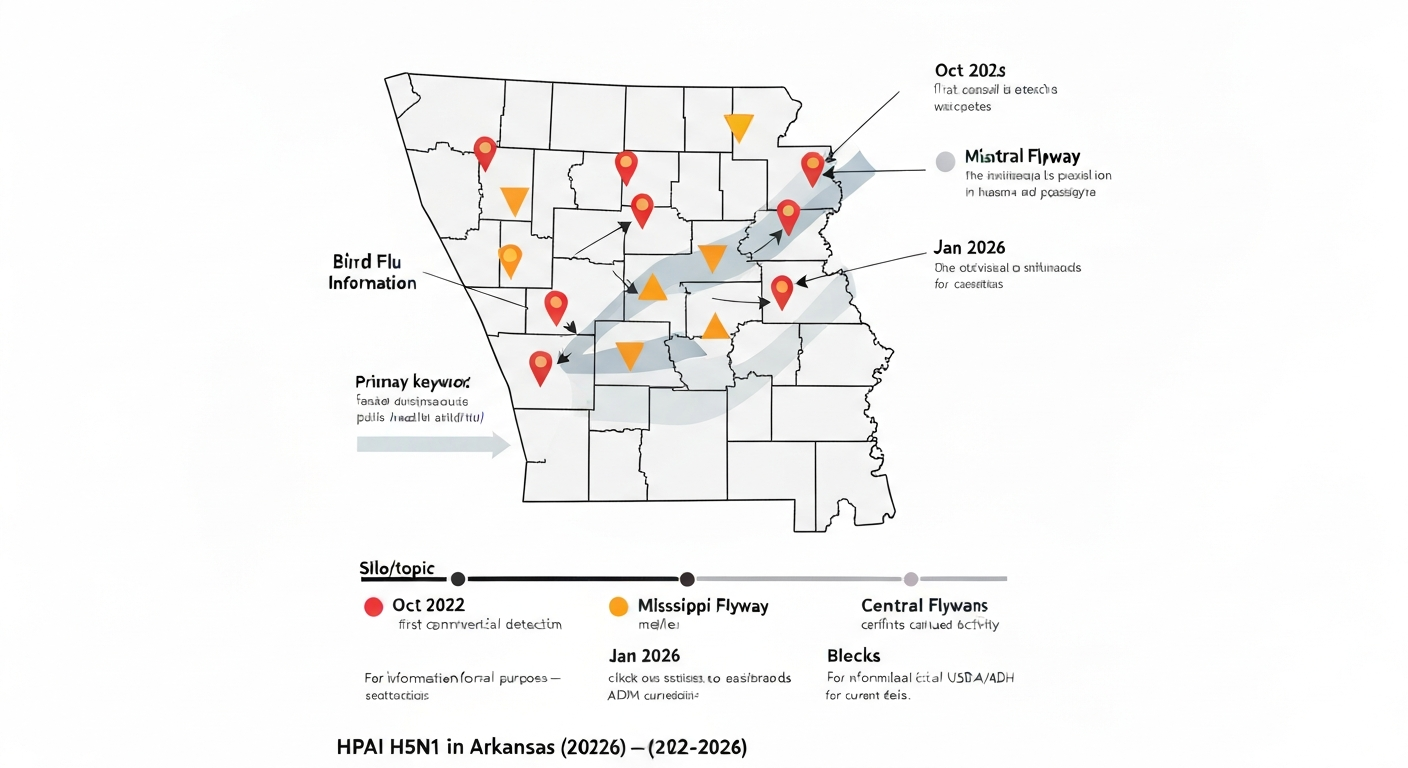
Arkansas has experienced HPAI detections across multiple waves of the ongoing national outbreak. The first confirmed commercial poultry premises detection in the state was reported on October 7, 2022. Further detections followed in the December 2024 reporting period, consistent with the broader national surge that hit the central flyway states hard. In January 2026, the University of Arkansas System Division of Agriculture (UAEX) issued guidance confirming that H5N1 continues to infect poultry in Arkansas and across the country, and launched a webinar series specifically for backyard flock owners dealing with the threat.
On the livestock side, the Arkansas Department of Agriculture's Livestock and Poultry Division issued a notice on April 5, 2024, stating that no cases of HPAI had been reported in Arkansas dairy cattle at that time, while simultaneously implementing strict entry permitting requirements for dairy cattle arriving from affected states. As of the latest available reporting data, HPAI in Arkansas has been concentrated in poultry and wild bird populations. Because outbreak status changes frequently, checking the official dashboards described below is the only way to get a current, date-stamped picture.
How to verify real-time outbreak data
Outbreak data moves fast, and news coverage often lags behind official reporting. Here are the primary dashboards and contacts you should bookmark and check regularly, especially if you own birds, work with livestock, or spend time in wetland or agricultural areas. For a quick state-specific update, see is bird flu in Wisconsin for current detections and guidance.
- USDA APHIS Confirmations of HPAI in Commercial and Backyard Flocks: This is the authoritative federal source for confirmed poultry premises detections, broken down by state and county with date-stamped entries. Look for the downloadable dashboard view, which shows the most granular data.
- USDA APHIS Detections of HPAI in Wild Birds: Updated regularly (page header shows July 31, 2026 as the last modification date), this page includes a downloadable table and county-level maps with 'Date Detected' as reported by the National Veterinary Services Laboratories (NVSL). Wild bird detections often precede poultry outbreaks nearby.
- USDA APHIS HPAI Confirmed Cases in Livestock: Centralizes national livestock, poultry, and mammal detections and links out to the full premises lists and cumulative counts.
- Arkansas Department of Health (ADH): For human exposure and clinical guidance, visit the ADH website and look for the Avian Influenza Packet and the Human Avian Influenza A (H5N1) Quicksheet. Clinician and public reporting: adh.zoonotic@arkansas.gov or 501-280-4136; after-hours via the Emergency Communications Center at 1-800-554-5738.
- Arkansas Livestock and Poultry Commission (ALPC) / Arkansas Department of Agriculture: Contact the State Veterinarian's office for livestock and poultry quarantine status, entry requirements, and permitted movement notices.
- CDC Bird Flu Situation Summary: Provides a national-level snapshot of human cases, confirmed animal detections by species and state, and clinical guidance updates.
When checking any of these dashboards, note the 'last updated' or 'date detected' field carefully. A premises may appear on the list weeks after the actual detection event, and detections that occurred months ago do not necessarily mean active circulation right now at that location. Cross-reference at least two sources before drawing conclusions about current local risk.
Regional context: what's happening in neighboring states
Arkansas sits at the intersection of the Mississippi and Central flyways, two of the most heavily traveled migratory bird corridors in North America. That geography makes cross-border spread a genuine and ongoing concern. For current information on detections in Kansas, see the resource titled "Is bird flu in Kansas.". Missouri to the north, Oklahoma to the west, Kansas further northwest, Iowa to the north (a major commercial poultry and egg state), and Tennessee and Mississippi to the east have all experienced HPAI detections during the current outbreak cycle. Missouri and Oklahoma in particular share significant wild bird habitat and commercial poultry infrastructure with Arkansas, meaning a detection just across the state line carries real implications for Arkansas producers. For information about detections in Iowa, see is bird flu in iowa for state-specific updates and reporting. For up-to-date information on detections in neighboring states, see the internal page titled Is bird flu in Oklahoma.
Wild waterfowl, including dabbling ducks, diving ducks, snow geese, and Canada geese that stage in Arkansas river bottoms and wetlands during migration, are the primary reservoir for H5N1 clade 2.3.4.4b. Birds do not respect state lines, so a spike in wild bird detections in any neighboring state is an early warning signal worth monitoring. If you farm poultry near the Missouri or Oklahoma border, or hunt wetlands in the Arkansas delta, the outbreak profile in those neighboring states is directly relevant to your biosecurity planning.
Avian influenza 101: HPAI vs LPAI, and what the subtypes actually mean
Not all avian influenza viruses are created equal, and the distinction matters enormously for how seriously a detection should be taken. Avian influenza viruses are classified by two surface proteins: hemagglutinin (H, numbered H1-H18) and neuraminidase (N, numbered N1-N11). The combination gives you the subtype, so H5N1 means hemagglutinin type 5 paired with neuraminidase type 1.
Beyond subtype, viruses are classified by pathogenicity: how sick they make birds. Low Pathogenic Avian Influenza (LPAI) strains cause mild or no symptoms in most poultry and are relatively common. Highly Pathogenic Avian Influenza (HPAI) strains cause severe, rapidly fatal disease in domestic poultry and are the ones triggering the mandatory depopulation responses you read about in the news. The current global and U.S. outbreak is driven by HPAI H5 clade 2.3.4.4b, which includes subtypes H5N1, H5N5, and H5N9. The clade designation (2.3.4.4b) tells virologists about the virus's evolutionary lineage and helps track spread across continents. This clade has shown a troubling ability to spill over into mammals, including cattle, foxes, seals, and occasional human cases, at rates higher than earlier strains.
For birds, the difference is stark: an LPAI H5 or H7 flock might show reduced egg production and mild respiratory signs, while an HPAI introduction can kill 90 to 100 percent of a commercial flock within days. For people, the current assessment from WHO, FAO, and WOAH (updated to March 2026) is that zoonotic risk remains low for the general public but is meaningfully higher for people with direct, prolonged exposure to infected animals or their environments.
How avian influenza spreads: birds, flocks, and the human risk
Among wild birds, HPAI spreads primarily through direct contact with infected birds and their feces, saliva, and respiratory secretions. Waterfowl are the natural reservoir and often shed virus without showing obvious illness, which is part of what makes surveillance so difficult. Shorebirds, raptors, and scavenging birds become infected when they contact contaminated water, carcasses, or prey.
Domestic flocks become infected through several routes: direct contact with infected wild birds (the most common pathway), contaminated equipment, vehicles, clothing, or footwear brought onto a farm (fomite transmission), contaminated water sources or feed, and in some documented cases, airborne spread from nearby infected premises. This is why biosecurity protocols focus so heavily on controlling what comes onto a farm, not just what leaves it.
Human infections are rare and have consistently required close, direct, unprotected contact with infected birds or heavily contaminated environments. There is no documented evidence of efficient human-to-human transmission of the current H5N1 clade 2.3.4.4b strain. CDC guidance recommends respiratory and eye protection (including goggles or face shields, not just a surgical mask) for anyone working directly with infected or suspected birds. The risk to someone who handles commercially processed poultry or eggs from a functioning supply chain is considered negligible.
What to look for: clinical signs in birds
Commercial and backyard poultry
HPAI in domestic poultry often presents with sudden, dramatic onset. A flock that appeared normal in the morning can show widespread mortality by evening. Watch for these signs in chickens, turkeys, ducks, and other domestic poultry:
- Sudden, unexplained death with little or no prior warning signs
- Severe drop in egg production (often 50 percent or greater within 24 to 48 hours)
- Swollen head, face, eyelids, comb, wattles, and hocks (edema)
- Purple-blue discoloration (cyanosis) of comb, wattles, and legs
- Nasal discharge, sneezing, coughing, or labored breathing
- Diarrhea (often greenish or watery)
- Neurological signs: incoordination, head tremors, torticollis (neck twisting)
- Sudden severe lethargy or birds found huddled and unresponsive
In backyard flocks, these signs are sometimes misread as other common poultry illnesses. The key differentiators are the speed of progression and the scale of mortality. If more than two or three birds die unexpectedly in a short period, or if you see a rapid combination of the signs above, treat it as a potential HPAI event until proven otherwise.
Wild birds
In wild birds, signs vary more widely because waterfowl (the primary reservoir) can carry and shed the virus while appearing healthy. However, HPAI causes obvious illness and death in many species, particularly raptors (eagles, hawks, owls), shorebirds, and colonial waterbirds. Signs to watch for include: birds found dead in groups, especially near water; live birds showing loss of coordination, inability to fly, head tremors, or apparent blindness; and unusual mortality events in waterfowl, particularly during spring and fall migration. If you find dead wild birds, especially raptors or waterfowl, report them to the Arkansas Game and Fish Commission rather than handling them directly.
Clinical signs in people: what H5N1 infection actually looks like
Human H5N1 infections reported globally have ranged from mild illness to severe respiratory disease, and the severity often correlates with the degree and duration of exposure. The incubation period (time from exposure to first symptoms) is typically 2 to 5 days but can extend up to 10 days, which is why the ADH monitors exposed persons for a full 10-day window after last exposure. ADH also published an 'Avian Influenza Packet, Arkansas Department of Health' for exposed persons that instructs exposed individuals to self-monitor for 10 days after last exposure and to report symptoms to ADH for evaluation and testing Avian Influenza Packet — Arkansas Department of Health.
Early symptoms are difficult to distinguish from seasonal flu: fever (often high, above 100.4°F), cough, sore throat, muscle aches, and fatigue. Eye symptoms, specifically conjunctivitis (red, watery, irritated eyes), have been reported in a notable subset of cases and should raise suspicion if combined with recent bird exposure. In more severe cases, illness can progress to pneumonia, acute respiratory distress, and other complications. Gastrointestinal symptoms including nausea, vomiting, and diarrhea have also been reported.
If you have had direct contact with sick or dead poultry or wild birds (or their environments) within the past 10 days and develop any of these symptoms, do not simply go to a walk-in clinic without calling ahead. Contact the Arkansas Department of Health at 501-280-4136 (after hours: 1-800-554-5738) or email adh.zoonotic@arkansas.gov. Clinicians need to know about potential exposure before you arrive so they can take appropriate precautions and initiate testing through the correct channels. USDA APHIS funds HPAI testing through the NAHLN (National Animal Health Laboratory Network), and the NVSL (National Veterinary Services Laboratories) handles confirmatory testing for animal samples. For human testing, the ADH coordinates with CDC.
On the treatment side, CDC recommends oseltamivir (Tamiflu) for suspected or confirmed human H5 infections and notes it may also be considered for post-exposure prophylaxis in some scenarios within the recommended treatment window. The key point is that antiviral treatment is most effective when started early, which means calling ADH promptly rather than waiting to see if symptoms worsen.
Quick reference: signs, situations, and what to do right now
| Who you are | What you're seeing or experiencing | Immediate action |
|---|---|---|
| Commercial poultry farmer | Sudden flock mortality or rapid drop in egg production | Isolate the flock, do not remove or move birds, call the Arkansas Livestock and Poultry Commission / State Veterinarian and USDA APHIS immediately. Document losses. |
| Backyard flock owner | Multiple unexplained bird deaths, swollen heads, cyanosis, neurological signs | Stop handling birds; call your veterinarian and the Arkansas Department of Agriculture. USDA APHIS may cover diagnostic testing costs through NAHLN. |
| Hunter or wildlife observer | Found dead raptors, waterfowl, or shorebirds (multiple or single) | Do not handle the birds bare-handed. Report to Arkansas Game and Fish Commission. Wash hands and any exposed skin thoroughly. |
| Person with bird exposure | Developing fever, cough, conjunctivitis, or flu-like symptoms within 10 days of direct contact with sick or dead birds | Call ADH at 501-280-4136 before visiting a clinic. After hours: 1-800-554-5738. Email: adh.zoonotic@arkansas.gov. |
| Clinician | Patient presenting with ILI plus history of poultry or wild bird exposure in the past 10 days | Consult the ADH Human Avian Influenza A (H5N1) Quicksheet. Report to ADH and initiate testing per protocol. Consider empiric oseltamivir per CDC guidance. |
| General public (no bird contact) | Reading news about local HPAI detections, concerned about food safety | No action needed beyond standard food safety practices (cook poultry to 165°F). Monitor USDA APHIS and ADH dashboards for updates. |
Biosecurity steps that actually make a difference
Whether you run a commercial operation with tens of thousands of birds or a backyard flock of a dozen hens, the core biosecurity principles are the same. The goal is to prevent wild birds and contaminated materials from ever reaching your birds.
- Restrict access: Limit who enters your poultry area. Post signs. Keep a log of all visitors and vehicles.
- Dedicated clothing and footwear: Anyone entering the poultry area should change into dedicated boots and coveralls that never leave the property. Foot baths with approved disinfectant at entry and exit points are a minimum standard.
- Prevent wild bird access: Use netting, closed housing, and covered feed and water stations to eliminate direct contact between wild birds and your flock. During high-risk migration periods, move outdoor flocks inside if possible.
- Clean and disinfect equipment: Any equipment that leaves and returns to the farm (crates, vehicles, feed augers) should be cleaned and disinfected before re-entry. Pay special attention to tires and undercarriages of vehicles.
- Secure water sources: Do not allow your flock to access open ponds or streams that wild waterfowl also use.
- Monitor flock daily: Know your baseline egg production and flock behavior. Unexplained changes are your earliest warning signal.
- Have a response plan: Know the ALPC and USDA APHIS contact numbers before you ever need them. The Arkansas Livestock and Poultry Commission and USDA APHIS have authority to quarantine premises and can also initiate compensation processes for affected producers under federal indemnity programs.
Guidance for hunters handling wild birds
Waterfowl hunting is a major part of Arkansas's outdoor culture, especially in the delta and Arkansas River corridor. The good news is that the risk of contracting H5N1 from hunting and properly handling game birds is considered low when basic precautions are followed. CDC and USDA guidance for hunters includes: wear rubber or disposable gloves when field-dressing birds; do not handle birds that appear sick or were found dead; wash hands thoroughly with soap and water after handling birds; do not eat, drink, or smoke while handling birds; cook all game bird meat thoroughly to an internal temperature of 165°F; do not use the same surfaces or utensils for raw wild bird meat that you use for other foods without thorough cleaning first.
If you find an unusual number of sick or dead waterfowl while hunting, report them to the Arkansas Game and Fish Commission. Do not collect carcasses or bring them home. Document the location, species if identifiable, and the number of birds involved.
Food safety: is it safe to eat poultry and eggs from Arkansas?
This is probably the question I hear most often from people who aren't farmers. The answer is yes, with normal cooking. HPAI is inactivated by standard cooking temperatures. Poultry meat cooked to an internal temperature of 165°F (74°C) and eggs that are fully cooked (no runny yolks, no raw preparations) are safe to eat. The commercial poultry supply chain in the U.S. includes mandatory surveillance, and flocks with confirmed HPAI are depopulated and removed from the food supply, not processed for sale. Eggs from commercial flocks are subject to ongoing monitoring. Buying commercially produced poultry and eggs from normal retail channels does not put you at risk of H5N1 infection.
Testing, compensation, and regulatory authority in Arkansas
If you suspect HPAI in your flock, the diagnostic pathway in Arkansas runs through two key institutions. The University of Arkansas System's Tollett Veterinary Diagnostic Laboratory and the Arkansas Department of Agriculture Veterinary Diagnostic Lab are both NAHLN-participating facilities, meaning they can perform initial HPAI screening. Non-negative samples are forwarded to NVSL for confirmatory testing and genetic sequencing. USDA APHIS covers testing costs for confirmed or suspect detections within this NAHLN workflow, so cost should not be a barrier to reporting.
Legally, the Arkansas Livestock and Poultry Commission and the State Veterinarian have broad authority under state administrative rules (2 CAR § 151-102 and related provisions) to quarantine suspected infected premises, require testing, order depopulation, and set post-depopulation cleaning and downtime requirements consistent with USDA APHIS standards. See 2 CAR § 151-102 in the Code of Arkansas Rules for the Arkansas Livestock and Poultry Commission’s authority over quarantine, testing, depopulation, and post-depopulation cleaning and downtime. Producers whose flocks are depopulated as part of an official response may be eligible for federal indemnity compensation through USDA APHIS. Document your flock numbers and values before any outbreak occurs, as this documentation is critical for indemnity claims.
Human vaccine and antiviral options: where things stand
There is no H5N1 vaccine currently approved and widely available for the general public in the United States. The federal government maintains candidate vaccine viruses and has stockpiled some pre-pandemic H5N1 vaccine doses for potential use in high-risk groups, but this has not translated into a public vaccination program as of 2026. Research and preparedness work continues under government oversight.
For treatment and post-exposure prophylaxis, the antiviral oseltamivir (Tamiflu) is the primary recommended option. CDC has issued Emergency Use Instructions for oseltamivir in H5N1 contexts, and CDC guidance supports its use for treatment of suspected or confirmed cases and for post-exposure prophylaxis in appropriate scenarios. Other neuraminidase inhibitors may also be considered. The critical point, again, is that treatment works best when started early: contact ADH immediately if you have had a high-risk exposure, not after symptoms have been present for several days.
Key contacts and resources at a glance
- Arkansas Department of Health (ADH), Zoonotic Disease: adh.zoonotic@arkansas.gov | 501-280-4136 | After-hours Emergency Communications Center: 1-800-554-5738
- Arkansas Livestock and Poultry Commission (ALPC) / State Veterinarian: Contact through the Arkansas Department of Agriculture for quarantine, movement permits, and producer guidance
- University of Arkansas Extension (UAEX): Provides backyard and commercial producer guidance, diagnostic referrals, and biosecurity webinars
- USDA APHIS HPAI Flock Confirmation Dashboard: Public, date-stamped, county-level confirmed premises data (commercial and backyard)
- USDA APHIS Wild Bird Detection Dashboard: County-level wild bird detection data, updated regularly
- CDC Bird Flu Clinical Guidance: Antiviral recommendations, PPE guidance, testing protocols, and national situation summary
FAQ
Is bird flu in Arkansas right now?
Current-status summary: Yes — highly pathogenic avian influenza (HPAI) H5 clade 2.3.4.4b (including H5N1 and related H5Nx variants) has been detected in Arkansas poultry and wild birds during recent outbreak waves. For the most up-to-date, date-stamped, county-level confirmations of detections in commercial and backyard flocks, consult the USDA APHIS Confirmations dashboard: https://www.aphis.usda.gov/livestock-poultry-disease/avian/avian-influenza/hpai-detections/commercial-backyard-flocks and the USDA APHIS wild-bird detections page: https://www.aphis.usda.gov/livestock-poultry-disease/avian/avian-influenza/hpai-detections/wild-birds. Local updates and outreach for Arkansas poultry owners are provided by the University of Arkansas Extension (UAEX): https://uaex.uada.edu/farm-ranch/biosecurity/avian-flu/ and the state posts situation notes such as UAEX’s Jan 7, 2026 announcement: https://www.uaex.uada.edu/media-resources/news/2026/january/01-07-2026-ark-hpai.aspx. Always verify with the APHIS dashboards for official, confirmed premises lists and dates.
How can I verify real-time outbreak data for Arkansas?
Where to check (step-by-step): 1) USDA APHIS commercial/backyard confirmations dashboard (state and county, downloadable): https://www.aphis.usda.gov/livestock-poultry-disease/avian/avian-influenza/hpai-detections/commercial-backyard-flocks 2) USDA APHIS wild-bird detections (maps and downloadable table): https://www.aphis.usda.gov/livestock-poultry-disease/avian/avian-influenza/hpai-detections/wild-birds 3) USDA APHIS HPAI resources and confirmed cases in livestock for national summaries: https://direct.aphis.usda.gov/livestock-poultry-disease/avian/avian-influenza/hpai-detections/hpai-confirmed-cases-livestock 4) Arkansas Department of Health clinician quicksheets and public materials: https://healthy.arkansas.gov (see Human Avian Influenza A (H5N1) Quicksheet PDF) 5) University of Arkansas Extension advisories: https://uaex.uada.edu/farm-ranch/biosecurity/avian-flu/ Tip: use APHIS dashboards as the federal, date-stamped authoritative source; cross-check state extension and state vet releases for local operational guidance.
What is the regional situation — are neighboring states affected and what does that mean for Arkansas?
Regional context: H5 clade 2.3.4.4b viruses have circulated across the U.S. with detections in neighboring states of Arkansas in recent years. Cross-border spread is common via migratory wild birds and through movement of poultry, equipment, or people. Implications for Arkansas: continued surveillance at state borders, movement permitting/restrictions for animals, heightened biosecurity on premises near affected counties, and prompt reporting of suspect illness. Check the APHIS dashboards for county-level detections in adjacent states and follow any interstate movement notices from the Arkansas Department of Agriculture and neighboring state animal-health agencies.
Which types of avian influenza are relevant and what is the human risk?
Virus types and human-risk summary: The current U.S. detections are predominantly from avian influenza A(H5) viruses in clade 2.3.4.4b (e.g., H5N1 and H5Nx variants). Animal-health agencies classify many of these as highly pathogenic avian influenza (HPAI) in birds. Public-health assessments from WHO/FAO/WOAH and CDC indicate zoonotic risk is low for the general public but elevated for people with close occupational exposure to infected birds (poultry workers, veterinarians, lab staff, hunters handling infected wild birds). Authoritative risk assessments: WOAH/WHO/FAO joint assessment (Mar 2026): https://www.woah.org/en/document/updated-joint-fao-who-woah-public-health-assessment-of-recent-high-pathogenicity-avian-influenza-ah5-virus-events-in-animals-and-people-based-on-data-as-of-1-march-2026/ and CDC bird flu info: https://www.cdc.gov/bird-flu/site.html.
How does avian influenza spread among birds and to people?
Transmission routes: - Among birds: direct contact with infected birds; contact with contaminated feces, feed, water, equipment, transport vehicles; contaminated people or clothing (fomites); wild birds (migratory species) are important reservoirs and vectors. - To humans: primarily through close, unprotected contact with infected birds, their secretions, or contaminated environments; rare but documented mammal spillover events increase surveillance importance. Respiratory and mucous-membrane exposure are main human risk routes. For sources on transmission and PPE guidance see CDC: https://www.cdc.gov/bird-flu/prevention/hpai-interim-recommendations.html and APHIS resources: https://www.aphis.usda.gov/animal-emergencies/hpai.
What signs should I watch for in poultry and in people?
Signs and actions (summary table): 1) Table (Signs vs. Actions): Column A = Signs observed; Column B = Recommended immediate action. - Poultry: sudden increase in deaths, drop in egg production, respiratory signs (coughing, sneezing), swollen eyelids/comb/wattle, lethargy, lack of coordination. Action: isolate flock, do not move birds/products, contact state vet/ALPC and UAEX, collect samples per state vet guidance, implement strict PPE/biosecurity. - Backyard flock (milder/mixed signs possible): decline in feed water uptake, reduced egg production, drop in activity. Action: same as poultry. - Wild birds: visible die-offs, abnormal behavior (e.g., inability to fly). Action: Do not touch; report to state wildlife agency/USDA APHIS wild-bird page. - People: fever, cough, shortness of breath, conjunctivitis, muscle aches; in exposed persons, report and seek evaluation. Action: If you had unprotected contact with sick/dead birds and develop symptoms within 10 days, contact Arkansas Department of Health (adh.zoonotic@arkansas.gov, 501-280-4136; after-hours ECC 1-800-554-5738) and seek clinical evaluation. Source: ADH H5N1 quicksheet: https://healthy.arkansas.gov/wp-content/uploads/7.11.2025_ADH-Human-Avian-Influenza-AH5N1-Quicksheet.pdf and CDC clinical guidance: https://www.cdc.gov/bird-flu/site.html