
Yes, bird flu is confirmed in Wisconsin. The state has recorded multiple confirmed detections of highly pathogenic avian influenza (HPAI) H5N1 in commercial poultry flocks, backyard flocks, and a dairy herd, plus one confirmed human case. Affected premises have been quarantined and birds depopulated. For most Wisconsin residents, the public health risk remains low, but poultry owners, farmworkers, and anyone with direct exposure to infected animals or their environments should take this seriously and follow the biosecurity and reporting steps outlined below.
Is Bird Flu in Wisconsin Now? Current Case Count & Guidance

Sarah Chen
20 Jul 2026
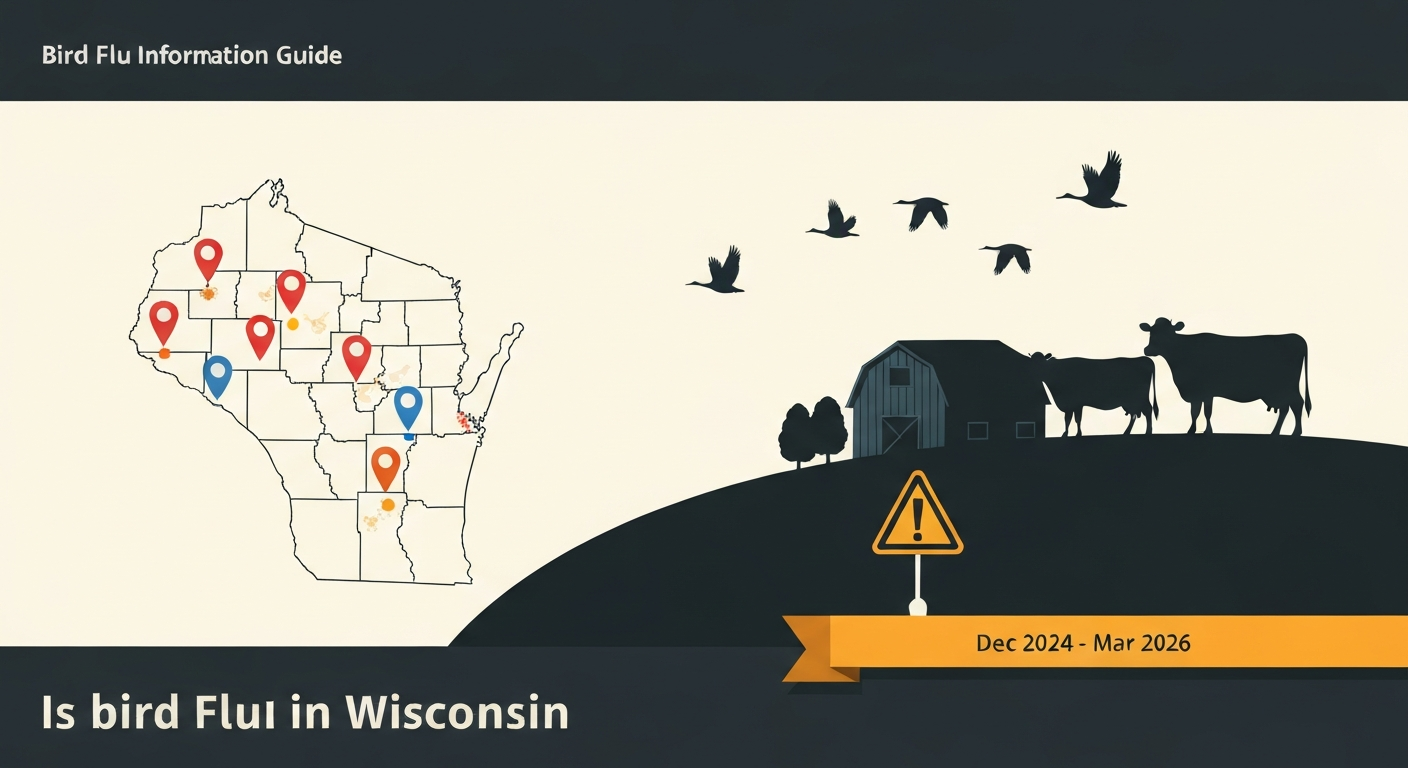
Quick summary: what Wisconsin residents need to know right now
Wisconsin has been dealing with HPAI H5N1 across multiple counties and flock types since at least late 2024. The virus detected belongs to clade 2.3.4.4b, genotype D1.1, the same lineage driving outbreaks across the rest of the country. One human case has been confirmed in the state, and several counties have reported infected poultry premises since December 2024 through at least early 2026. Each confirmed premise triggered quarantine, mandatory depopulation of the flock, and a 10-kilometer control zone with movement restrictions. Wisconsin DATCP (Department of Agriculture, Trade and Consumer Protection) and USDA APHIS are the lead agencies managing the agricultural response, while Wisconsin DHS (Department of Health Services) handles human surveillance. For most people with no contact with sick birds or contaminated environments, day-to-day life does not need to change. For poultry owners and farm workers, the picture is more urgent.
Current confirmed case counts in Wisconsin
Official case counts come from three authoritative sources: USDA APHIS for animal premises, Wisconsin DATCP for state-level animal health declarations, and CDC for confirmed human infections. Here is where things stood as of the July 20, 2026 retrieval of those sources.
| Category | Confirmed Count | Primary Source |
|---|---|---|
| Human cases (confirmed A(H5)) | 1 (Barron County, confirmed Dec 20, 2024) | CDC / Wisconsin DHS |
| Dairy herd detections | 1 (HPAI H5N1 clade 2.3.4.4b genotype D1.1, announced Dec 14, 2025) | USDA APHIS / NVSL |
| Commercial and backyard poultry premises | Multiple confirmed premises (ongoing; see APHIS dashboard for current total) | USDA APHIS / Wisconsin DATCP |
Because APHIS updates its official 'Confirmations of Highly Pathogenic Avian Influenza in Commercial and Backyard Flocks' dashboard continuously, the most accurate running total for Wisconsin poultry premises is always on that federal dashboard. The confirmed human case count at the national level includes Wisconsin as part of CDC's A(H5) human case line list. Always verify current numbers at CDC and APHIS directly, since detections can be reported weekly or even more frequently during active spread.
Who is affected: poultry, dairy cattle, wild birds, and people
It helps to be precise about categories here, because the word 'case' means something different depending on whether you're talking about a bird flock, a dairy herd, a wild bird, or a person.
Commercial and backyard poultry
A confirmed poultry premises means APHIS has laboratory-confirmed HPAI H5N1 in a flock at a specific location. Commercial operations (large-scale egg-laying, broiler, or turkey farms) and backyard flocks (smaller hobby or subsistence flocks) are both susceptible and both show up in Wisconsin's case history. Once a premises is confirmed, all birds on site are depopulated, meaning humanely destroyed to prevent further spread, and the site is cleaned and disinfected before any restocking is allowed.
Dairy cattle
HPAI H5N1 infecting dairy cattle was a relatively new development in U.S. agriculture, first confirmed nationally in early 2024. Wisconsin's December 2025 dairy herd detection confirmed the virus had reached Wisconsin's cattle industry. In dairy herds, the virus primarily affects milk production; cattle do not typically die from infection the way birds do, but infected milk is a potential exposure route for farmworkers and others in close contact with animals.
Wild birds
Wild birds, particularly waterfowl and shorebirds on migratory flyways, are the primary reservoir for HPAI H5N1. Wisconsin sits on major migratory routes and wild bird detections in the state are separate from domestic flock or herd counts. Wild bird detections are tracked by USDA Wildlife Services and state natural resources agencies. They matter to poultry owners primarily because infected wild birds can introduce the virus to premises through direct contact or contaminated water and soil.
Human cases
Wisconsin has one confirmed human HPAI A(H5) case. Wisconsin DHS reported the presumptive positive on December 18, 2024; CDC confirmed it on December 20, 2024. The case was in Barron County, which had also seen a poultry detection in December 2024, making the exposure link geographically consistent. The individual's specific exposure details are handled under patient privacy rules, but the case fits the pattern seen nationally: direct or close contact with infected animals or their environment.
Where in Wisconsin: geographic distribution by county
Confirmed HPAI detections in Wisconsin have spread across several counties and flock types over roughly 15 months. Based on DATCP press releases and APHIS records, here are the documented county-level detections with approximate dates and premise types.
| County | Approximate Detection Date | Premises Type | Response |
|---|---|---|---|
| Barron County | December 12, 2024 | Domestic birds (poultry premises) | Quarantine, depopulation |
| Marquette County | December 9, 2025 | Domestic birds (poultry premises) | Quarantine, depopulation |
| Jefferson County | February 27, 2026 | Commercial flock | Quarantine, depopulation |
| Dane County | March 2, 2026 | Backyard flock | Quarantine, depopulation |
| Walworth County | March 6, 2026 | Domestic birds (poultry premises) | Quarantine, depopulation |
| Undisclosed dairy premises | Announced December 14, 2025 | Dairy herd (HPAI H5N1 D1.1) | APHIS/NVSL confirmation, quarantine |
This list reflects confirmed, publicly announced detections. Additional premises may have been confirmed between the dates above and the time you're reading this. The APHIS interactive dashboard and DATCP's news release archive are the most reliable sources for a complete and current county-level list. The geographic spread from Barron County in northwest Wisconsin to Dane, Jefferson, and Walworth counties in the south-central and southeast parts of the state shows HPAI is not confined to a single region.
Timeline of detections and official responses in Wisconsin
- December 9–12, 2024: Barron County poultry premises confirmed HPAI-positive; Wisconsin DATCP issues press release December 12, 2024; premises quarantined and birds depopulated.
- December 18, 2024: Wisconsin DHS announces presumptive positive human HPAI A(H5) case in Barron County, the first confirmed human case in the state.
- December 20, 2024: CDC confirms the Barron County human case as HPAI A(H5); case entered into CDC national human case line list.
- December 9, 2025: Marquette County poultry premises confirmed; DATCP press release issued; quarantine and depopulation initiated.
- December 14, 2025: USDA APHIS announces HPAI H5N1 (clade 2.3.4.4b, genotype D1.1) confirmed in a Wisconsin dairy herd.
- December 17, 2025: USDA NVSL completes whole-genome sequencing of the dairy herd isolate, confirming D1.1 genotype.
- December 30, 2024 (federal): APHIS interim final rule updates to the HPAI indemnity program take effect, affecting compensation procedures for all affected producers including those in Wisconsin.
- February 27, 2026: Jefferson County commercial flock confirmed HPAI-positive; DATCP press release; quarantine and depopulation.
- March 2, 2026: Dane County backyard flock confirmed HPAI-positive; DATCP press release; quarantine and depopulation.
- March 6, 2026: Walworth County poultry premises confirmed HPAI-positive; DATCP press release; quarantine and depopulation.
The pattern here reflects what we see in neighboring states too. Activity spiked alongside fall and winter migratory bird movements, then continued into early 2026. Wisconsin is not an isolated case and sits in a region with significant ongoing activity. Neighboring Iowa, for example, has also seen HPAI detections in commercial poultry, and the same migratory pathways that bring birds through Wisconsin connect it to the broader regional outbreak picture. Is bird flu in Iowa? See the related Iowa outbreak summary for current detections and guidance.
How avian influenza is detected and confirmed
Understanding the testing pathway matters both for poultry owners who need to report sick birds and for the general public wondering how reliable these case counts are. The detection system is layered, starting at the flock level and running through state and federal labs.
Poultry and animal testing
When a producer or veterinarian notices signs consistent with HPAI (sudden mortality spikes, respiratory distress, neurologic signs), samples are collected from sick or dead birds and submitted to a National Animal Health Laboratory Network (NAHLN) lab or a state veterinary diagnostic lab. These labs run initial real-time reverse transcriptase polymerase chain reaction (rRT-PCR) tests, which detect influenza A genetic material and can flag H5 subtype. Presumptive positive results at the state level trigger immediate notification to USDA APHIS, and samples are sent to the USDA National Veterinary Services Laboratories (NVSL) in Ames, Iowa for official confirmation. NVSL performs virus isolation (results in roughly 5 to 10 days) and whole-genome sequencing (roughly 4 to 5 days) to characterize the strain precisely. The December 2025 Wisconsin dairy herd case followed exactly this pathway, with NVSL completing sequencing on December 17, three days after the initial announcement.
Human testing
For humans, CDC guidance directs clinicians to notify their state health department before testing anyone suspected of novel influenza A infection. See CDC's Collecting Specimens for Novel Influenza A Virus Testing, CDC Clinician Guidance for details on notifying state health departments before testing, recommended upper and lower respiratory specimens, and rRT‑PCR testing workflows Collecting Specimens for Novel Influenza A Virus Testing — CDC Clinician Guidance. Testing involves nasopharyngeal and oropharyngeal swabs as the primary specimens; for hospitalized or severe cases, lower respiratory tract specimens (endotracheal aspirate or bronchoalveolar lavage) significantly improve diagnostic yield because HPAI viruses replicate more readily in the lower respiratory tract. State public health labs run initial rRT-PCR. Positive or inconclusive results go to CDC for confirmatory subtyping and sequencing. That is exactly what happened with Wisconsin's Barron County case: DHS reported a presumptive positive on December 18, 2024, and CDC confirmed it two days later on December 20.
Who to contact if you suspect a case
- Poultry or livestock concerns: Wisconsin DATCP Animal Health hotline at (608) 224-4872 during business hours, or (800) 943-0003 after hours.
- Human health concerns: Contact your healthcare provider immediately and let them know about any exposure to birds or livestock; your provider will notify Wisconsin DHS.
- For media and communications questions about DATCP responses: Sam Go, Communications Director, (608) 334-0220.
- For NVSL referral testing questions: email NVSL.DVL.Teamleads@usda.gov.
Transmission routes and realistic human risk
Both CDC and Wisconsin DHS have been consistent in their risk assessment: the current public health risk to the general population is low. That does not mean zero risk for everyone, and it is worth being specific about what raises and lowers your individual risk.
How the virus spreads between birds
Bird-to-bird transmission is highly efficient. Infected birds shed the virus in respiratory secretions, saliva, and feces. The virus can survive in the environment, especially in water, mud, and on equipment, for varying periods depending on temperature. Wild waterfowl carry the virus without always showing signs, which is why contact between wild birds and domestic flocks (through shared water sources, open housing, or wild birds landing in feed areas) is a primary introduction pathway. Between farms, fomite transmission, meaning the movement of virus on contaminated clothing, vehicles, equipment, or footwear, is a well-documented risk.
How humans get infected
Every confirmed human case in the current U.S. outbreak, including Wisconsin's, has involved direct or very close contact with infected animals or heavily contaminated environments. The people at highest risk are poultry farmworkers who handle sick or dead birds, dairy farmworkers with unprotected exposure to infected cattle (particularly raw milk or respiratory secretions), and responders involved in depopulation activities. There is no confirmed sustained human-to-human transmission in the current U.S. outbreaks. General community spread is not occurring.
What this means for the average Wisconsin resident
If you do not work with poultry or livestock and do not handle wild birds, your risk from the current Wisconsin HPAI situation is genuinely low. Commercially processed poultry and eggs that are properly cooked are safe to eat; cooking poultry to an internal temperature of 165°F (74°C) and cooking eggs until both whites and yolks are firm inactivates influenza viruses. Pasteurized milk is also safe. The key risk factors to avoid are: touching sick or dead birds with bare hands, handling raw poultry without basic hygiene, or consuming raw or undercooked poultry products.
Clinical signs of avian influenza in birds
If you keep chickens, turkeys, ducks, or other domestic birds, knowing what HPAI looks like is essential because early reporting is the single most effective tool for limiting spread. HPAI in birds can progress extremely rapidly, sometimes killing an entire flock within days, so do not wait to see if things improve on their own.
Signs to watch for in your flock
- Sudden, unexplained increase in deaths, sometimes multiple birds dying within hours.
- Respiratory signs: coughing, sneezing, gasping, nasal discharge, or labored breathing.
- Neurologic signs: tremors, loss of coordination (ataxia), twisted necks (torticollis), circling, or inability to stand.
- Swelling of the head, neck, or eyes (periorbital edema).
- Bluish or purple discoloration of the comb, wattles, and legs (cyanosis), indicating poor circulation.
- Watery diarrhea and greenish or yellow feces.
- Sudden, sharp drop in egg production or eggs with soft or absent shells.
- Birds becoming unusually quiet, lethargic, or huddling together.
Not every sick bird means HPAI; many other diseases can cause respiratory or neurologic signs. But any combination of the above signs alongside sudden mortality in multiple birds should prompt an immediate call to DATCP. Do not move birds off your premises, do not bring in new birds, and limit visitor access to your flock while you wait for guidance. The DATCP Animal Health hotline (608-224-4872 during business hours; 800-943-0003 after hours) is your first call.
Biosecurity steps every Wisconsin poultry owner should be doing now
- Register your premises with DATCP so responders can reach you quickly and you receive outbreak alerts for your area.
- Keep domestic birds indoors or under covered housing as much as possible to minimize contact with wild birds.
- Restrict access to your property: require anyone entering bird areas to change footwear and use dedicated clothing.
- Disinfect vehicles, equipment, and tools that move between premises.
- Establish a 30-day quarantine for any new birds before introducing them to your existing flock.
- Provide only clean, uncontaminated water sources that wild birds cannot access.
- Wash hands thoroughly before and after handling birds.
- Request a free biosecurity assessment from DATCP or USDA APHIS if you haven't had one recently.
What happens after a confirmation: quarantine, depopulation, and compensation
Once APHIS confirms HPAI on a Wisconsin premises, the response is standardized and swift. The affected premises is placed under quarantine immediately, all birds are depopulated (humanely destroyed to contain spread), and a 10-kilometer control area is established around the site with movement restrictions on poultry, eggs, equipment, and vehicles. Cleaning and disinfection of the premises must be completed and verified before any restocking can be considered.
Producers who lose flocks to confirmed HPAI may be eligible for indemnity compensation through USDA APHIS. See USDA APHIS Indemnity Compensation – Resources & Guidance, USDA APHIS for details on eligibility, the D&D flat rate, and the Detailed Financial Plan Indemnity Compensation – Resources & Guidance — USDA APHIS. Two options exist: the D&D (Destruction and Disposal) Flat Rate, which provides a standardized payment per bird, and the Detailed Financial Plan, which provides more individualized compensation for larger or more complex operations. An interim final rule effective December 30, 2024 updated the indemnity program, so producers should confirm current rates and eligibility requirements directly with APHIS. Document everything: flock size, production records, and communications with state and federal officials all support your compensation claim.
Regional context: Wisconsin is not alone
The HPAI situation in Wisconsin reflects a much broader regional and national outbreak. For information on detections and current status in neighboring Kansas, see Is bird flu in Kansas. Neighboring states including Iowa, Illinois, and Minnesota have all recorded significant poultry losses from H5N1. The same migratory flyways that move wild birds through Wisconsin connect it directly to outbreak activity in states like Iowa (which has seen some of the country's largest commercial flock losses), as well as Missouri, Kansas, Oklahoma, and Arkansas further south. Readers in those states can find state-specific confirmed case information in related articles covering each state. If you're asking 'is bird flu in Arkansas', see our Arkansas state report for confirmed detections and guidance. For Missouri-specific updates, see our page titled "is bird flu in Missouri". The common thread is the same clade 2.3.4.4b H5N1 virus, the same transmission pathways, and the same biosecurity fundamentals that matter everywhere it appears.
Vaccine availability and human health guidance
There is currently no widely available HPAI H5N1 vaccine for the general public, though the U.S. government maintains candidate vaccines and has taken preparedness steps. Seasonal influenza vaccines do not protect against H5N1. For poultry, USDA has been evaluating HPAI vaccines for commercial flocks, but vaccination programs for birds in the U.S. remain under active regulatory review and are not in general use at the time of writing. If you are a healthcare provider who suspects HPAI A(H5) in a patient, CDC recommends beginning empirical antiviral treatment with oseltamivir (Tamiflu) as early as possible while confirmatory testing proceeds; do not wait for test results to initiate treatment in severe or high-exposure cases.
Where to check for live updates
- USDA APHIS 'Confirmations of HPAI in Commercial and Backyard Flocks' interactive dashboard: the authoritative federal source for current Wisconsin premises counts, updated as detections are confirmed.
- Wisconsin DATCP HPAI news releases page: county-level press releases for each confirmed Wisconsin premises with dates, response actions, and contact information.
- CDC 'A(H5) Bird Flu: Current Situation' page: national human case counts, state-by-state breakdowns, and updated public health risk assessments.
- Wisconsin DHS infectious disease surveillance page: state-level human case announcements and public health guidance.
- USDA APHIS HPAI Response Plan and NVSL diagnostic catalog: for veterinarians and lab professionals needing testing workflows and submission guidance.
FAQ
Is bird flu (avian influenza) currently in Wisconsin?
Yes. Wisconsin has had confirmed detections of highly pathogenic avian influenza (HPAI) in domestic animals and one confirmed human case. For the most recent federal confirmation of a HPAI detection in a Wisconsin dairy herd (sequencing completed Dec 17, 2025) see USDA APHIS: https://www.aphis.usda.gov/news/agency-announcements/update-genetic-sequencing-results-wisconsin-dairy-herd-detection-highly. For state-level poultry detections and press releases see Wisconsin DATCP: https://datcp.wi.gov/Pages/Programs_Services/HPAIWisconsin.aspx. For the CDC national situation and human-case tracking see: https://www.cdc.gov/bird-flu/situation-summary/index.html.
How many confirmed poultry and human cases are there in Wisconsin right now, and where were they reported?
Official counts change with new detections—check the primary sources below for live updates. As of the referenced official reports: Wisconsin has had multiple confirmed poultry premises across several counties (examples in DATCP press releases include Barron, Marquette, Jefferson, Dane, Walworth counties; each affected premise was quarantined and depopulated). Wisconsin DHS and CDC reported one confirmed human HPAI A(H5) case (Barron County, reported Dec 18–20, 2024). For authoritative, up‑to‑date poultry premises by county and date use the USDA APHIS HPAI commercial/backyard dashboard: https://www.aphis.usda.gov/livestock-poultry-disease/avian/avian-influenza/hpai-detections/commercial-backyard-flocks. For Wisconsin DATCP county press releases: https://datcp.wi.gov/Pages/Programs_Services/HPAIWisconsin.aspx. For the DHS release on the human presumptive case: https://www.dhs.wisconsin.gov/news/releases/121824.htm and CDC confirmation: https://www.cdc.gov/bird-flu/situation-summary/index.html.
What is the geographic distribution within Wisconsin of detections so far?
Detections have been reported in multiple counties (examples from state press releases include Barron County, Marquette County, Jefferson County, Dane County, Walworth County). Each confirmed poultry premise is listed in DATCP press releases and in the USDA APHIS commercial/backyard dashboard (use those official sources for the latest county-level map and dates): DATCP: https://datcp.wi.gov/Pages/Programs_Services/HPAIWisconsin.aspx and APHIS dashboard: https://www.aphis.usda.gov/livestock-poultry-disease/avian/avian-influenza/hpai-detections/commercial-backyard-flocks.
How are poultry and human cases detected and confirmed?
Poultry: state veterinary/NAHLN labs or private vets detect suspect cases; rRT‑PCR is used for screening and positive samples are sent to USDA NVSL for confirmation/subtyping and whole‑genome sequencing. Humans: clinicians notify state health departments before testing; recommended specimens include nasopharyngeal/oropharyngeal swabs and, for severe disease, lower respiratory specimens. Initial testing occurs at public-health labs with confirmatory testing/characterization at CDC. See CDC clinician/specimen guidance: https://www.cdc.gov/bird-flu/hcp/clinicians-evaluating-patients/specimen-collection.html, NAHLN/NVSL info and APHIS response plan (testing timelines): https://www.aphis.usda.gov/sites/default/files/hpai_response_plan.pdf and NVSL diagnostic catalog: https://www.aphis.usda.gov/sites/default/files/amesdiagnostictestingcatalog.pdf.
What are the typical transmission routes and how high is the risk to the general public?
Transmission routes: human infections to date have been associated with direct contact with infected animals (poultry, infected cattle in some detections) or contaminated environments and fomites (clothing, equipment). There is no evidence of sustained human‑to‑human transmission in current U.S. outbreaks. Public‑health risk: CDC and Wisconsin DHS state that the risk to the general public is low; risk is higher for occupational or direct‑exposure contacts (farm workers, veterinarians, cull crews). Source: CDC situation summary: https://www.cdc.gov/bird-flu/situation-summary/index.html.
What clinical signs should poultry owners watch for?
Signs in poultry can include sudden increased mortality, respiratory signs (difficulty breathing, coughing, nasal/ocular discharge), decreased feed intake, drop or change in egg production (soft, misshapen, or fewer eggs), neurologic signs (tremors, incoordination), diarrhea, and swelling of combs/feet. Severity varies by strain and species; any unusual mortality or combination of signs should be reported. OIE/WOAH fact sheet: https://www.woah.org/app/uploads/2021/03/hpai.pdf.
Next Articles
Is Bird Flu in Missouri? Current Status, Risks & Actions
Is bird flu in Missouri? Latest outbreak map, risk, reporting steps, biosecurity & what to do for sick birds.

Is Bird Flu in Europe Now? Risk, Symptoms, Safety Steps
Find out if bird flu is in Europe now, current risk, symptoms, food safety, and exact steps for handling exposure safely
What Is Being Done About Bird Flu: Response, Vaccines, Safety
How agencies detect, contain and treat bird flu, plus biosecurity, vaccines, human steps, and safe egg and poultry guida