
Bird flu did not originate in China in the way most people imagine, but China has been the site of several important and well-documented outbreaks. For a concise overview of where avian influenza originates, see where does bird flu come from. The deeper truth is that avian influenza viruses have circulated in wild birds on every continent for millions of years. What China contributed to the modern story of bird flu is not the virus itself, but several specific high-consequence strains that first came to scientific attention there, most notably the H5N1 lineage detected in farmed geese in Guangdong Province in 1996, and H7N9, first identified in humans in Shanghai in 2013. Understanding why China appears so often in these headlines requires separating the concept of a natural virus reservoir from the concept of a geographic first detection.
Did Bird Flu Come From China? Origins, Risks, and Advice

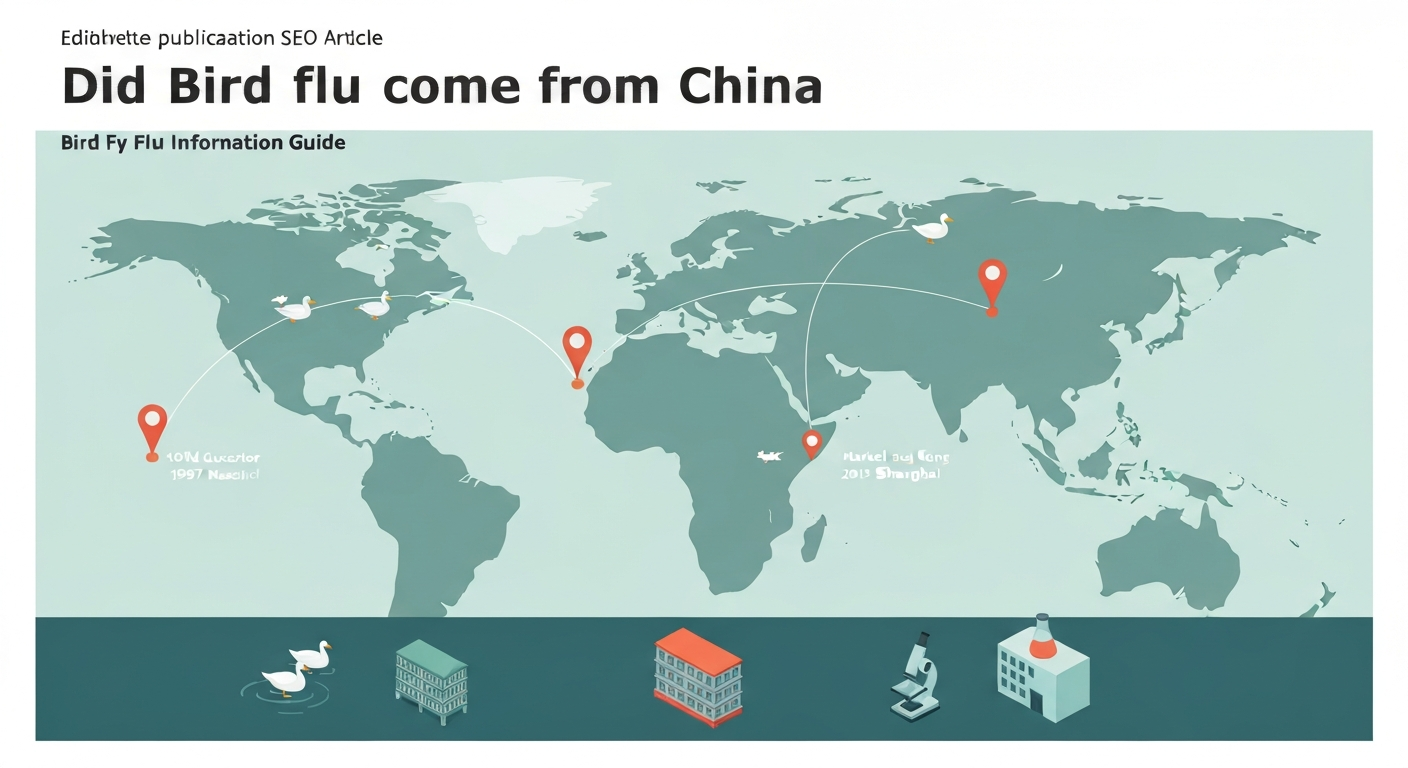
What 'origin' actually means here
When people ask whether bird flu came from China, they are usually conflating two very different things: where a virus lives in nature (its reservoir), and where a particular dangerous strain was first identified by scientists. These are not the same thing, and mixing them up leads to a lot of unnecessary confusion and misplaced blame.
The reservoir is the population of animals that maintains a virus over the long term, even between outbreaks in other species. For influenza A viruses, that reservoir is wild aquatic birds, specifically ducks, geese, swans, and many species of shorebirds and gulls. This reservoir is global. It is not Chinese. It exists on every flyway, in every country where wild waterfowl live. A 'first detection,' on the other hand, simply means this is where a particular variant was first recognized and formally reported. First detection is heavily influenced by where surveillance infrastructure exists and how actively a country is looking. It tells you where scientists noticed something, not necessarily where the virus assembled itself for the first time.
Phylogenetic analysis (the process of reconstructing a virus's family tree from its genetic sequence) has repeatedly shown that the gene segments making up zoonotic avian influenza strains come from wild bird populations spread across entire hemispheres. The virus that infects a chicken in one country may carry gene segments that spent the previous season in a wild duck in another country entirely. Keeping that distinction in mind makes everything else in this article much easier to follow.
Wild birds as the original source of all avian influenza
Wild waterfowl, particularly dabbling ducks, are the primary natural reservoir for influenza A viruses worldwide. These birds carry a remarkable diversity of low-pathogenic avian influenza (LPAI) subtypes, meaning strains that cause little or no disease in the birds themselves, and they shed the virus efficiently into water through their feces. Viruses circulate between wild bird populations along migratory flyways, and when those birds interact with domestic poultry, either directly or through shared water sources, they seed influenza viruses into farm environments.
The concern arises not in wild birds themselves, but in what can happen once an LPAI virus enters dense, intensively managed poultry flocks. In those conditions, the virus can mutate or exchange genetic material with other circulating strains, sometimes producing a highly pathogenic avian influenza (HPAI) variant, one capable of causing rapid, lethal disease in poultry and, in some cases, infection in humans. This process can happen anywhere domestic and wild birds interact at scale, though it has historically occurred most often in parts of East and Southeast Asia where these interfaces are particularly common.
How avian influenza viruses evolve and change
Influenza A viruses have two key properties that allow them to change faster than most other pathogens: mutation and reassortment. Mutation is straightforward: the virus copies its genetic material imperfectly, introducing small changes over time. Reassortment is more dramatic. Influenza A has a genome made up of eight separate segments of RNA. When two different influenza strains infect the same cell at the same time, those segments can mix and match, producing a new virus with a completely novel combination of properties. This is called a reassortant, and it can arise very quickly.
Reassortment is exactly how H7N9 emerged. Phylogenetic analysis published in Nature in 2013 showed that all eight gene segments of the H7N9 viruses infecting humans in China were of avian origin. The hemagglutinin (HA) surface protein, the H in H7N9, came from H7 viruses, the neuraminidase (NA), the N9, came from wild birds, and the internal genes were closely related to H9N2 viruses already circulating in Chinese poultry. The reassortment almost certainly happened in a mixed-species environment, most likely live poultry markets, where multiple strains had the opportunity to meet inside the same host cell.
The H5 lineage that emerged in Guangdong in 1996, formally designated A/Goose/Guangdong/1/1996, has gone on to be one of the most evolutionarily active influenza lineages ever documented. That original Gs/GD virus diversified into a range of H5Nx viruses (where N can be N1, N2, N6, N8, and others) by repeatedly picking up new NA segments from other avian strains. The clade 2.3.4.4 H5 viruses that swept through North American poultry in 2014-2015 and again more recently trace their HA gene directly back to that 1996 Guangdong goose isolate.
How bird flu moves between regions
There are two main engines of long-distance spread: migratory wild birds and human-driven movements of poultry, poultry products, and equipment. For a concise overview of how bird flu spread between regions, see how did bird flu spread. Both matter, and they operate on different timescales.
Wild bird migration is a natural dispersal route that preexists any human activity. Phylogenetic and epidemiological work published in 2015 demonstrated that H5N8 viruses from the Gs/GD lineage reached North America from Asia across the Beringia region, carried by migratory waterfowl moving along the East Asian-Australasian and Pacific flyways. This is not a failure of biosecurity; it is a biological process operating across hemispheres on timescales of weeks.
Human-driven spread is faster, more contained, and more controllable. Live poultry trade, movement of day-old chicks, shipments of hatching eggs, contaminated vehicles, crates, and equipment can all carry HPAI virus across borders and between farms. Live poultry markets, where birds of multiple species from multiple sources are concentrated and sold, have been identified as particularly important amplification and mixing points in several East Asian outbreaks. For more detail on the specific mechanisms by which the virus travels between farms, the farm-to-farm spread pathways are worth understanding in their own right. See how does bird flu spread from farm to farm for a focused overview of these farm-to-farm transmission pathways.
China's specific role in the history of bird flu outbreaks
China's repeated appearance in the origin stories of significant avian influenza strains is not coincidental. It reflects a genuine ecological and agricultural reality: parts of southern China, particularly Guangdong and surrounding provinces, have historically featured a high density of domestic ducks, geese, chickens, and other poultry raised in close proximity to wild waterfowl habitats, often alongside live animal markets where mixed-species contact is routine. This kind of interface between wild reservoirs and domestic animals is exactly the environment where new reassortant viruses are most likely to emerge and be amplified.
H5N1: the Guangdong goose virus and Hong Kong 1997
The virus designated A/Goose/Guangdong/1/1996 was detected in farmed geese in Guangdong Province in 1996. Its HA gene sequence is documented in GenBank (accession AF144305.1) and forms the founding node of the entire Gs/GD H5 lineage. The first recognized human infections with a virus from this lineage occurred the following year in Hong Kong: 18 people were infected and 6 died, making it the first confirmed instance of H5N1 causing human disease. Subsequent phylogenetic work confirmed the genetic link between the 1997 Hong Kong human cases and the 1996 Guangdong goose virus.
H7N9: live poultry markets and reassortment in eastern China
H7N9 was first identified in March 2013 in patients from Shanghai and Anhui provinces, China. Unlike H5N1, H7N9 caused little visible disease in poultry, which made it exceptionally difficult to detect through poultry surveillance alone. Environmental sampling of live poultry markets in eastern China found heavy contamination with H7N9 virus, and epidemiological studies confirmed that most human cases had direct or indirect exposure to live poultry or their environments. Modelling studies estimated that market closures reduced mean daily human infections by roughly 97-99% during initial outbreaks, which is a striking demonstration of how live poultry market systems can drive human exposure to novel avian viruses.
H5Nx clade 2.3.4.4: reassortment in China, spread worldwide
The clade 2.3.4.4 H5Nx viruses, including H5N8, H5N6, and H5N2, were phylogenetically traced to reassortment events in eastern China in late 2013. Phylogenetic and epidemiological analyses documented this reassortment and subsequent intercontinental movement in a study describing the intercontinental spread of Asian‑origin H5N8 to North America through Beringia by migratory birds (Intercontinental Spread of Asian‑Origin H5N8 to North America through Beringia by Migratory Birds (J Virol/2015)). From there they spread regionally and then intercontinentally via wild waterfowl migration and poultry movements during 2014 and 2015, reaching Europe, North America, and Africa. The H5N1 clade 2.3.4.4b variant responsible for the massive 2021-2024 global epizootic (outbreak across animal populations) in poultry and wild birds, including tens of millions of poultry culled in the United States, is a descendant of this same lineage.
China's surveillance and reporting capacity
It is worth being direct about something that often gets lost in political discussions: China has significantly expanded its influenza surveillance infrastructure over the past two decades. Following SARS in 2003 and the 2009 H1N1 pandemic, investments in laboratory capacity, sentinel hospital networks, and reporting systems grew substantially. By the early 2010s, China's National Influenza Surveillance Network comprised over 400 laboratories and more than 550 sentinel hospitals covering all provinces, and the Chinese National Influenza Center (CNIC) held a WHO Collaborating Centre designation. This expanded capacity is part of why novel strains like H7N9 were identified relatively quickly. Strong surveillance means more early detections, which means a country's name appears more often in origin stories. That is a feature, not a fault.
Key outbreak milestones at a glance
| Strain | Year first detected | Location | Key feature |
|---|---|---|---|
| H5N1 (Gs/GD lineage) | 1996 | Guangdong Province, China | Progenitor of all modern H5 HPAI lineages; first detected in farmed geese |
| H5N1 (human cases) | 1997 | Hong Kong | First confirmed human H5N1 infections; 18 cases, 6 deaths |
| H5Nx clade 2.3.4.4 | Late 2013 | Eastern China (reassortment) | Produced H5N8, H5N6, H5N2 variants; spread globally via wild birds |
| H7N9 | March 2013 | Shanghai and Anhui, China | Novel reassortant; >1,500 human cases over 5 waves 2013-2017; low pathogenicity in poultry made detection hard |
| H5N1 clade 2.3.4.4b | 2020 onward | Global (originated from Asia-origin lineage) | Largest HPAI epizootic on record; wild birds and poultry affected worldwide |
How bird flu spreads from farm to farm
Understanding specific farm-to-farm pathways is essential for anyone working in poultry production or living near poultry operations. HPAI virus can survive on contaminated surfaces and in cool, moist environments for days, which means the virus does not need a live animal to travel between premises.
- People: farm workers, veterinarians, and visitors can carry virus on boots, clothing, and hands if they move between infected and clean premises without proper decontamination
- Equipment and vehicles: shared catching equipment, crates, feed delivery trucks, and manure spreading equipment are established transmission routes; a single contaminated vehicle passing through multiple farms can seed an outbreak across a region
- Live bird movements: transferring birds between farms or to markets is one of the highest-risk activities during an active outbreak
- Fomites: inanimate objects including feed bags, pallets, tools, and even wild bird carcasses carried by dogs or foxes can act as mechanical vectors
- Water: shared water sources or drainage channels connecting premises can carry shed virus from infected to uninfected flocks
- Wild birds: direct contact between wild waterfowl and domestic poultry, particularly in outdoor or free-range systems, remains a significant entry route at the farm level
- Airborne particles: at very short distances, especially within or between adjacent buildings, aerosol transmission of virus-laden dust or droplets is possible
Effective biosecurity targets all of these pathways simultaneously. The farm-to-farm spread of avian influenza involves a combination of these routes working together, and closing off even a few of the most likely pathways can dramatically reduce risk during an active regional outbreak.
Human risk and symptoms: what you actually need to know
The risk to the general public from currently circulating avian influenza strains remains low. Human infections have almost always involved direct, close contact with infected birds or heavily contaminated environments, most often live poultry markets, backyard flocks, or occupational poultry handling. Person-to-person transmission has been rare and not sustained in any documented outbreak. That said, 'low risk' and 'no risk' are not the same thing, and certain groups face genuinely elevated exposure.
Who faces the highest risk
- Poultry farm workers and those involved in culling infected flocks
- Live poultry market workers with daily bird contact
- Hunters and wildlife handlers who come into contact with wild bird carcasses
- People in areas with active HPAI outbreaks who keep backyard poultry
- Travelers to regions with ongoing H5N1 or H7N9 activity who visit live animal markets
Symptoms to watch for
Human avian influenza infections typically present initially like severe seasonal flu: fever (often high, above 38°C or 100.4°F), cough, sore throat, and muscle aches. They can progress rapidly to lower respiratory symptoms including shortness of breath, pneumonia, and in the worst cases acute respiratory distress syndrome (ARDS). Some strains, particularly H5N1, have also caused neurological symptoms and gastrointestinal illness. Symptom onset typically occurs two to five days after exposure, though incubation can extend to ten days in some documented cases.
If you have had direct contact with sick or dead birds and develop a fever and respiratory symptoms within ten days of that exposure, you should seek medical care promptly and tell the clinician about the animal contact. Early antiviral treatment with oseltamivir (Tamiflu) significantly improves outcomes for confirmed avian influenza cases, but it needs to be started quickly. Do not wait to see if symptoms resolve on their own after a known high-risk exposure.
Food safety: is it safe to eat poultry and eggs?
Properly cooked poultry and eggs are safe to eat. Influenza viruses are inactivated by cooking to an internal temperature of 74°C (165°F), the standard safe temperature for poultry. There is no documented case of anyone contracting avian influenza from eating fully cooked poultry or eggs. The risk pathway for human infection is respiratory and mucous membrane exposure to live infected birds or their secretions, not consumption of well-cooked food. Avoid raw or undercooked poultry products during active outbreaks, practice good hand hygiene when handling raw meat, and do not consume eggs with runny whites or yolks from flocks with known or suspected infection.
Where to find current, reliable outbreak data
For anyone who wants to track current bird flu activity rather than rely on news headlines, three primary sources are most useful. The FAO's EMPRES-i (Emergency Prevention System for Animal Health) database contains georeferenced outbreak records for avian influenza in animals globally. WOAH's WAHIS (World Animal Health Information System) is the official platform for validated, member-country-reported animal disease events, with records going back to 2005. For human cases, the WHO publishes situation updates and risk assessments for zoonotic influenza including H5N1 and H7N9 on its influenza at the human-animal interface pages. These are the same databases that epidemiologists and veterinary authorities use, and they are publicly accessible.
Separating facts from the misconceptions
A few specific misconceptions tend to dominate internet searches on this topic and are worth addressing plainly.
| Common claim | What the evidence actually shows |
|---|---|
| Bird flu is a Chinese virus | Influenza A viruses circulate globally in wild birds on every continent. Specific dangerous strains were first detected in China, but the underlying reservoir is worldwide. |
| China created or engineered bird flu | No credible scientific evidence supports this. Phylogenetic analysis shows H5N1 and H7N9 emerged through natural mutation and reassortment in animal hosts. |
| You can get bird flu from eating chicken | Properly cooked poultry (internal temperature 74°C/165°F) poses no risk. Human infections come from direct contact with infected live birds, not cooked food. |
| Bird flu is easily spread between people | Human-to-human transmission has been rare and not sustained for any current avian influenza strain. It is not transmitting like seasonal flu. |
| First detection = geographic origin | First detection depends heavily on surveillance capacity. The gene segments of a virus may have circulated in wild birds across multiple continents before the virus was formally identified anywhere. |
Practical next steps depending on your situation
If you are a poultry farmer, the most impactful things you can do are maintaining strict farm biosecurity (controlling who and what enters your premises), keeping domestic birds separated from wild waterfowl where possible, and knowing your local agriculture authority's reporting line so you can act immediately if you observe unusual mortality or illness in your flock. Early reporting protects your neighbors as much as your own birds.
If you are a traveler to regions with active bird flu outbreaks, avoid live poultry markets and direct contact with birds. Follow standard hand hygiene. Eating well-cooked poultry at reputable establishments is not a meaningful risk. If you become ill with fever and respiratory symptoms within ten days of returning from an affected area and had any bird contact, mention the travel and exposure history to your doctor immediately.
If you are a concerned member of the public without direct bird contact, your personal risk from current avian influenza strains is very low. Monitor credible sources like WHO and your national public health authority for updates. The situation does warrant ongoing scientific attention and international surveillance, but it does not warrant panic or avoidance of normally cooked poultry products.
FAQ
Did bird flu come from China?
Short answer: Some important zoonotic avian influenza strains were first detected in China (notably the Gs/GD H5 lineage in 1996 and H7N9 in 2013), but that does not mean all bird flu 'comes from China.' Wild waterfowl are the global natural reservoir for influenza A viruses, and reassortment and amplification often occur where wild birds, domestic poultry, and dense poultry trade/market systems interact. 'First detection' in China reflects both genuine emergence events linked to local poultry systems and strong surveillance capacity that makes detection more likely there.
What is the natural origin of bird flu viruses?
Wild waterfowl (ducks, geese, swans and many shorebirds) are the primary natural reservoir for influenza A viruses worldwide. These birds commonly carry diverse low‑pathogenic avian influenza (LPAI) viruses with little disease, and their viruses can seed domestic poultry populations where reassortment, mutation and adaptation can produce highly pathogenic or zoonotic strains.
Why were H5N1 and H7N9 first associated with China?
The Gs/GD H5 lineage was first identified in farmed geese in Guangdong, China in 1996 and is the progenitor of later H5N1/H5Nx clades. H7N9 causing severe human disease was first detected in humans in eastern China in 2013. In both cases, evidence points to poultry (including live‑poultry markets and poultry value chains) as the proximate mixing and amplification hosts where avian viruses reassorted or adapted before human spillover.
Does 'first detected' mean the virus originated in China?
Not necessarily. Phylogenetic analyses distinguish where a virus was first recognized from where the ancestral gene segments originally circulated. Reassortment and emergence are driven by ecological interfaces (wild waterfowl, free‑grazing ducks, multi‑species farms, live markets) that are common in parts of East and Southeast Asia, including southern China, but similar interfaces exist elsewhere. Detection location can also reflect stronger surveillance and laboratory capacity.
How do avian influenza viruses emerge and spread between farms?
Emergence typically involves reassortment or mutation when multiple avian influenza viruses co‑infect poultry or when wild‑bird viruses enter domestic flocks. Farm‑to‑farm spread occurs via movement of infected birds, contaminated equipment, vehicles, footwear, shared water or feed, poultry traders, and personnel. Live‑poultry markets and informal trade networks are frequent amplification points. Wild migratory birds can carry and geographically spread some H5Nx strains over long distances.
What is the risk to humans from bird flu? What are common symptoms?
Human risk varies by virus. Some avian influenza viruses (e.g., certain H5N1 and H7N9 strains) can infect people and cause severe illness, but sustained human‑to‑human transmission has been rare. Typical symptoms in zoonotic cases include fever, cough, shortness of breath and, in severe cases, pneumonia or acute respiratory distress. People with close, unprotected contact with infected poultry or contaminated environments are at higher risk.