
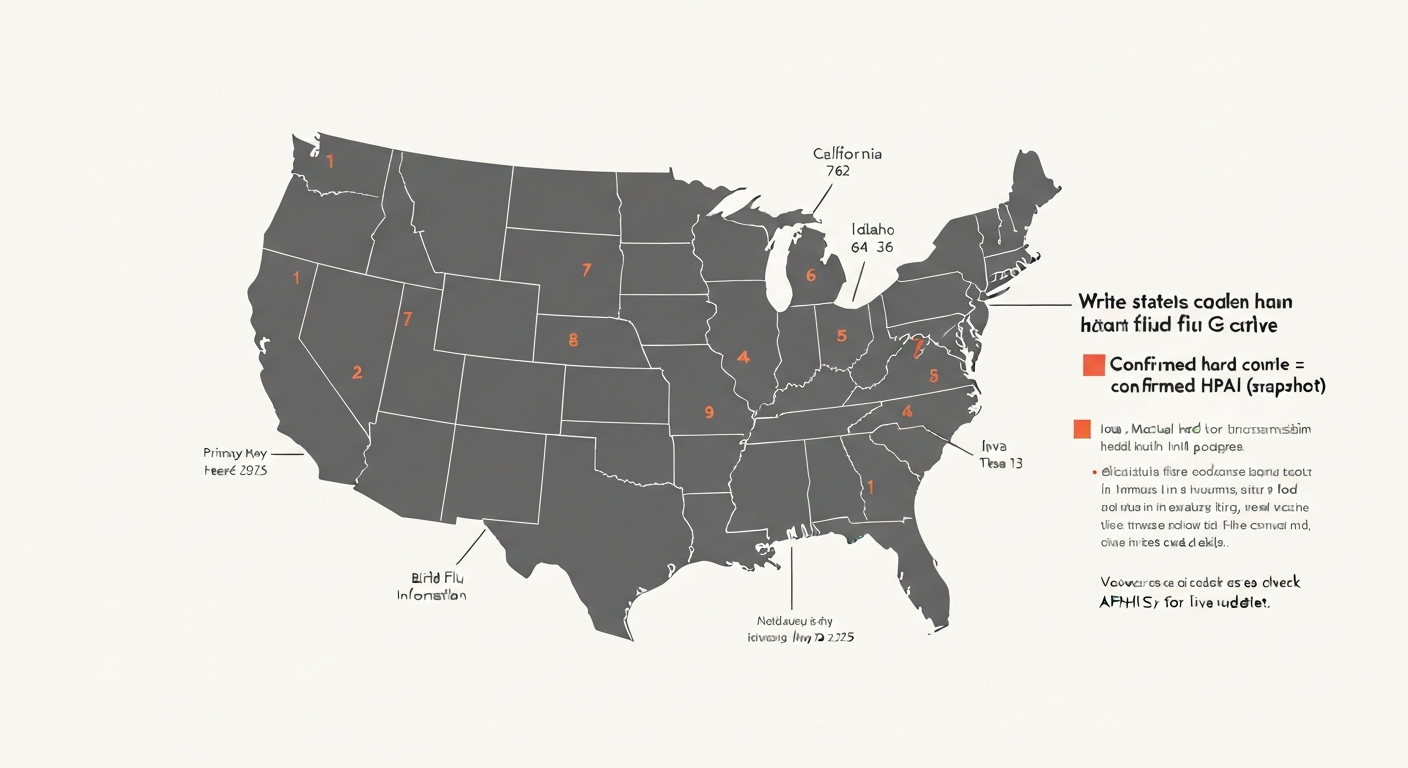
As of mid-2026, USDA APHIS has confirmed HPAI H5N1 detections in dairy cattle herds across at least 16 U.S. states, with California leading all others at 762 confirmed herds as of the May 2025 EFSA snapshot. The other affected states include Colorado, Idaho, Michigan, Texas, Iowa, Utah, Minnesota, New Mexico, South Dakota, Kansas, Oklahoma, Nevada, North Carolina, Ohio, and Wyoming. Because APHIS updates its official livestock map daily, those numbers have likely shifted since that snapshot, checking the APHIS 'HPAI Confirmed Cases in Livestock' page directly gives you the most current tally. Louisiana, as of the most recent official reporting, has not had confirmed HPAI detections in cattle, though the state did report a fatal human H5N1 case in late 2024/early 2025 linked to a separate exposure.
Which States Have Bird Flu in Cows: State-by-State HPAI Map

What this article covers
This piece pulls together everything you need to understand the national picture: which states have bird flu confirmed in cows right now, how those confirmations are made, what Louisiana's specific situation looks like, and how cattle detections differ from poultry and human cases. Whether you're a dairy farmer looking at biosecurity, a veterinarian tracking diagnostics, or simply a concerned person trying to separate fact from rumor, the sections below walk through each layer of the outbreak clearly and without unnecessary alarm.
Definitions you need before diving in
Avian influenza and HPAI
Avian influenza (bird flu) refers to influenza A virus strains that primarily circulate in birds. The subtype responsible for the current U.S. livestock crisis is H5N1, specifically clade 2.3.4.4b, genotype B3.13 (and more recently D1.1 genotypes identified in later samples). The 'H' and 'N' refer to hemagglutinin and neuraminidase proteins on the virus surface, the combination determines both which host species a strain infects and how diagnostic tests are designed. 'Highly Pathogenic' (HPAI) distinguishes strains that cause severe, often fatal disease in poultry from low-pathogenicity forms. In dairy cattle, HPAI H5N1 does not generally cause the mass mortality seen in poultry flocks, but it does cause significant udder disease and milk production loss.
What counts as a confirmed detection in cattle
APHIS uses a three-tier case definition for non-avian species including cattle: Suspect, Presumptive Positive, and Confirmed. A Suspect case is a herd showing compatible clinical signs (sudden milk drop, thickened or discolored milk, reduced feed intake) with no lab results yet. A Presumptive Positive means a NAHLN (National Animal Health Laboratory Network) accredited lab has found a positive PCR result for influenza A matrix gene and H5, before national-level review. A Confirmed case requires the USDA National Veterinary Services Laboratories (NVSL) in Ames, Iowa to verify HPAI H5N1 clade 2.3.4.4b identity using PCR on at least two different gene targets plus genotype determination by genome sequencing. The APHIS livestock map and table count premises at the confirmed level, so one confirmed animal on a farm counts that entire premises as one confirmed herd.
National totals and how to find the freshest numbers
Because this outbreak has been moving fast, any static article, including this one, can only offer a dated snapshot. The authoritative, daily-updated source is the APHIS 'HPAI Confirmed Cases in Livestock' page, which publishes both a cumulative state-by-state table and a 30-day rolling case count. The page was last structurally modified in March 2026, but the underlying data refreshes daily as new confirmations come in from NVSL. For a reliable reference point: by May 18, 2025, USDA had confirmed HPAI H5N1 in dairy cattle in 16 states, covering hundreds of individual herds. EFSA's May 18, 2025 snapshot ("Risk posed by the HPAI virus H5N1, clade 2.3.4.4b genotype B3.13 currently circulating in the US, EFSA (May 2025)") reported USDA had confirmed HPAI H5N1 in dairy cattle in 16 U.S. states and listed state counts (example: California 762 herds; Colorado 64; Idaho 36; Michigan 31; Texas 27; Iowa 13; Utah 13; Minnesota 9; New Mexico 9; South Dakota 7; Kansas 4; Oklahoma 2; and single herds in Nevada, North Carolina, Ohio, and Wyoming) blank" rel="noopener noreferrer">Risk posed by the HPAI virus H5N1, clade 2.3.4.4b genotype B3.13 currently circulating in the US — EFSA (May 2025). California alone accounted for more than 762 confirmed herds, a number that reflected the scale of the San Joaquin Valley dairy industry and the density of herd-to-herd contacts there. For international context, WOAH (the World Organisation for Animal Health) independently tracks U.S. cattle detections through its WAHIS notification system and publishes its own situation reports, which are useful for cross-checking U.S. government figures.
State-by-state confirmed detections: reading the APHIS map
The APHIS interactive map plots confirmed livestock premises across the country. One important caveat the agency itself notes: for privacy and biosecurity reasons, premises locations are displayed at the state capital rather than the actual farm address. This means the map tells you a state has confirmed cases, but not the precise county or facility. For county-level detail, you generally need to check the relevant State Department of Agriculture press releases or situational updates. The map also color-codes states by activity level and distinguishes between cumulative totals and cases confirmed in the past 30 days, which is useful for understanding whether an outbreak in a given state is still active or has been contained.
The table below reflects the May 2025 EFSA-published snapshot of USDA cumulative confirmed herd detections. Treat these as a baseline, current figures from APHIS will differ and should always be the definitive reference.
| State | Confirmed Herds (as of May 2025 snapshot) | Notes |
|---|---|---|
| California | 762 | Largest outbreak by herd count; San Joaquin Valley dairy region heavily affected |
| Colorado | 64 | Second-highest cumulative count |
| Idaho | 36 | Significant dairy production region |
| Michigan | 31 | Early affected state; strong NAHLN surveillance |
| Texas | 27 | First state to confirm bovine HPAI H5N1 in 2024 |
| Iowa | 13 | Major dairy and cattle production state |
| Utah | 13 | Western dairy corridor |
| Minnesota | 9 | Upper Midwest; high dairy density |
| New Mexico | 9 | Adjacent to Texas outbreak region |
| South Dakota | 7 | Northern Plains corridor |
| Kansas | 4 | Central US; adjacent to early Texas cases |
| Oklahoma | 2 | Southern Plains; early involvement |
| Nevada | 1 | Single confirmed herd |
| North Carolina | 1 | Single confirmed herd; East Coast detection |
| Ohio | 1 | Midwest; single confirmed herd |
| Wyoming | 1 | Rocky Mountain region; single confirmed herd |
Given that the outbreak has been ongoing since early 2024 and the APHIS map updates daily, states not on this list may have since recorded detections, and some states above may have recorded additional herds. Always verify at APHIS before making herd-management or reporting decisions.
Where cases have been reported: confirmed, pending, and under-investigation
It helps to understand that 'reported' does not always mean 'confirmed.' At any given time, APHIS tracking includes three categories of status for individual premises. Confirmed means NVSL has verified HPAI H5N1 clade 2.3.4.4b. Presumptive positive means a NAHLN lab has returned a positive PCR result that is awaiting NVSL verification, farms in this category are already subject to movement restrictions. Under investigation means a herd is showing clinical signs consistent with HPAI and samples have been collected but initial results are not yet in. APHIS's public-facing map typically shows confirmed cases; presumptive and under-investigation cases may be reported differently by individual state agencies. If you are tracking a potential outbreak in your state, your State Veterinarian's office is the right contact for real-time information about pending or investigated cases not yet on the federal map.
Louisiana: what the data actually shows
Cattle detections in Louisiana
Louisiana has not had confirmed HPAI H5N1 detections in cattle as of the most recent official reporting. For up-to-date details on where in Louisiana the bird flu has been reported, see LDAF's Animal Disease Control updates and press releases. If you want a quick, current answer to how many cases of bird flu in Louisiana, check the LDAF and APHIS trackers for the latest confirmed-cases totals. The Louisiana Department of Agriculture and Forestry (LDAF) issued guidance on April 5, 2024, at the early stage of the cattle outbreak, explicitly stating there were no reported HPAI detections in Louisiana dairy cattle at that time. That same release announced that LDAF was enhancing protective measures, including restricting Certificate of Veterinary Inspection (CVI) validity for cattle arriving from states with recent confirmed HPAI detections. To confirm Louisiana's current cattle status, the LDAF website and its Animal Disease Control publications are the authoritative sources.
Louisiana's human H5N1 case
Louisiana does have a significant place in the U.S. H5N1 story, but through a human case rather than a cattle detection. The Louisiana Department of Health (LDH) reported a presumptive human H5N1 case in December 2024 that became the first H5N1-related human death in the United States, confirmed on January 6, 2025. LDH reported the first U.S. H5N1‑related human death and stated the current general public health risk remained low (LDH Jan 6, 2025) LDH reports first U.S. H5N1‑related human death; current general public health risk remains low — Louisiana Department of Health (Jan 6, 2025). LDH's investigation found no evidence of person-to-person transmission and emphasized that the general public risk remained low. This human case was linked to exposure to backyard poultry and wild birds, not to infected dairy cattle, an important distinction when assessing cattle-related risk in the state. The human case and the cattle situation are tracked separately and should not be conflated.
How to access Louisiana-specific reports
For ongoing Louisiana cattle monitoring, the LDAF's Animal Disease Control page is the primary state-level source. LDAF publishes press releases for any newly confirmed detections and updates its CVI and movement requirements when affected-state lists change. The Louisiana Department of Health handles the public-health side and publishes its own advisories for any human cases or animal-to-human exposure investigations. Checking both agencies gives you a complete picture of what is happening in the state across both animal health and public health dimensions.
Cattle vs. poultry vs. human cases: why the distinctions matter
These three detection categories are tracked by different agencies, confirmed using different case definitions, and carry different implications for response. Understanding which type of detection you are reading about matters enormously for interpreting news headlines or official advisories.
| Detection type | Lead agency | Reporting system | Case definition basis | Primary response triggered |
|---|---|---|---|---|
| HPAI in cattle (dairy/beef) | USDA APHIS | APHIS HPAI Livestock tracker; WOAH WAHIS | NVSL confirmation of H5N1 clade 2.3.4.4b by PCR + sequencing | Federal Order movement restrictions; herd quarantine; NAHLN testing requirements |
| HPAI in poultry (commercial/backyard) | USDA APHIS | APHIS HPAI Poultry tracker | NVSL confirmation; flock-level case definition | Mandatory depopulation of affected flock; movement standstill |
| Human H5N1 infection | CDC + state health departments | CDC H5N1 case count; state health advisories | PCR confirmation at state or CDC lab; clinical + epidemiological criteria | Contact tracing; antiviral treatment; monitoring of exposed persons |
A confirmed cattle detection does not automatically mean poultry on the same premises are infected, and it does not mean any humans have been infected. Conversely, a human case (as in Louisiana) does not indicate cattle are involved. Each detection type triggers its own distinct investigation and response chain. Media reports that blend these categories, saying a state 'has bird flu' without specifying the affected species, can create unnecessary confusion.
Clinical signs in affected cattle herds
Dairy cattle infected with HPAI H5N1 display a recognizable clinical picture that differs from what the virus does in birds. The hallmark sign at the herd level is a sudden, sharp drop in milk production, sometimes 50% or more within days. Affected cows often produce milk that looks wrong: thickened, clotted, colostrum-like in consistency, or discolored. Individual cows may show reduced feed intake and mild lethargy, and some have clear nasal discharge, though frank respiratory disease is not the dominant presentation. Fever is common in the early stages. Research published in Nature and peer-reviewed journals has shown that the virus achieves extremely high concentrations in mammary secretions, which is why milk and udder secretions are the preferred diagnostic sample in lactating cattle. Mortality in adult dairy cattle from this strain is generally low, though the production and economic losses can be severe.
How cases are counted, tested, and confirmed
The two-step testing pathway
The U.S. diagnostic system for HPAI in livestock runs through two tiers. The first tier is the NAHLN, a network of state and university veterinary diagnostic laboratories. When a herd shows clinical signs compatible with HPAI, a USDA-accredited veterinarian collects samples and submits them to a NAHLN lab. For lactating dairy cows, APHIS testing guidance from May 2024 specifies that milk or udder secretions are the preferred sample, ideally collected from each quarter and pooled per cow. For non-lactating cattle, deep nasal swabs are used. NAHLN labs run PCR assays for the influenza A matrix gene first. If that is positive, they run an H5-specific PCR and, in many labs, a clade 2.3.4.4b confirmation assay. A positive at this stage means the premises is classified as Presumptive Positive and movement restrictions apply immediately.
NVSL confirmation and genotyping
Presumptive positive samples are referred to the USDA NVSL in Ames, Iowa, the national reference laboratory. NVSL applies the full confirmatory protocol: PCR on at least two different gene targets to verify H5 and N1, clade-specific assays, and whole-genome sequencing to determine genotype (such as B3.13 or D1.1). Sequencing also generates data deposited in GenBank, which allows phylogenetic analysis linking cattle isolates to circulating wild-bird and poultry lineages. This genomic record is how researchers confirmed that the cattle virus originated from wild-bird spillover events, with subsequent spread between farms. Once NVSL issues a confirmed result, APHIS logs the premises in the official count and the case appears on the public-facing livestock tracker.
Federal Orders and mandatory reporting
USDA issued Federal Orders beginning April 24, 2024 requiring pre-movement testing of lactating dairy cattle for interstate transport. Subsequent orders expanded mandatory reporting requirements and established the National Milk Testing Strategy, which extends surveillance to raw milk and milk movement. These Federal Orders are the legal backbone of the testing and reporting system, they are why farms must test before moving animals and why positive results flow into federal tracking rather than remaining purely voluntary. Farms that violate Federal Orders face serious consequences, and any veterinarian or laboratory identifying a positive result is required to report it through official channels within defined timeframes (NAHLN labs report positives weekly at minimum under standard agreements).
How the virus is spreading between cattle farms
The original spillover into cattle is believed to have come from wild birds or infected poultry, wild waterfowl are the reservoir for H5N1 globally, and phylogenetic evidence shows U.S. cattle isolates cluster with circulating avian H5N1 lineages. Once the virus established itself in dairy cattle, farm-to-farm spread appears to be driven primarily by the movement of lactating dairy cows, contaminated milking equipment, vehicles, and farm personnel. Milk itself contains extremely high concentrations of viral RNA, making milking parlor hygiene a critical control point. There is also some evidence of mechanical spread via shared equipment or personnel moving between farms without adequate biosecurity. This is why the April 2024 Federal Order targeted interstate movement of lactating cattle as the first mandatory control measure.
Public health risk and food safety
CDC's consistent position throughout this outbreak has been that the risk to the general public is low. The agency recommends that people with direct exposure to infected animals or contaminated materials, including dairy farm workers handling sick cows, raw milk, or contaminated equipment, follow PPE protocols and monitor themselves for symptoms for 10 days after last exposure. Symptomatic exposed individuals should be tested and considered for antiviral treatment. Human H5N1 cases linked to cattle exposure have been documented, predominantly among farm workers, and most have involved eye infections (conjunctivitis) or mild respiratory illness. The Louisiana fatal case was linked to poultry/wild bird exposure and was not associated with the cattle outbreak.
On food safety: FDA has concluded that standard pasteurization inactivates H5N1, and that commercially pasteurized milk and dairy products are safe. Raw (unpasteurized) milk is a different story, because infected cow's milk can contain very high viral loads, consuming raw milk from herds with active HPAI infection carries a real, documented risk. FDA has issued explicit guidance to state and local partners about raw milk hazards during this outbreak, and multiple studies have detected H5N1 RNA and viable virus in retail raw milk samples from affected regions. If you drink raw milk or use raw-milk products, this is a genuine reason to pause during an active outbreak in your area.
Practical steps for farmers and rural residents
For dairy and cattle farmers
- Register with your State Veterinarian's office and stay current on any active Federal Orders or state movement restrictions before transporting lactating dairy cattle.
- Use separate boots, coveralls, and equipment for each barn or milking unit; disinfect between uses. Milking equipment is a confirmed transmission vector.
- Test any newly arriving lactating cattle per APHIS guidance before integration into the herd.
- Report sudden drops in milk production, changes in milk appearance, or unexplained illness in multiple cows immediately to your accredited veterinarian — do not wait for the full herd to show signs.
- Limit farm access to essential personnel and log all visitors, service providers, and vehicles entering the premises.
- Ensure farm workers are aware of HPAI symptoms in humans and have access to appropriate PPE (gloves, eye protection, and respiratory protection when handling sick animals or contaminated milk).
For rural residents and the general public
- Avoid contact with sick or dead wild birds or mammals; report unusual die-offs to your state wildlife agency.
- Do not consume raw milk or raw-milk cheeses, especially if you live in a state with active cattle HPAI detections.
- Pasteurized dairy products are safe — no changes to your diet are needed beyond avoiding raw milk.
- If you work on or visit a farm with a suspected or confirmed HPAI outbreak, follow the farm's PPE requirements and monitor yourself for fever, eye irritation, or respiratory symptoms for 10 days after exposure.
- Contact your local health department if you develop symptoms after animal exposure — do not wait to see if they resolve on their own.
Where to go for the most current data
For a question as time-sensitive as which states have bird flu in cows, no single article can substitute for official real-time trackers. For up-to-date information on what states have bird flu in humans, consult the CDC's human H5N1 case map. For a current, interactive state-by-state map of confirmed cattle detections, see the internal page titled "where is bird flu in the us.". For an up-to-date list of affected states, check the APHIS tracker entry titled what states have the bird flu for current confirmed HPAI detections in cattle. Here are the primary sources worth bookmarking:
- APHIS 'HPAI Confirmed Cases in Livestock' map and table: the daily-updated federal source for state-by-state cattle (and other livestock) confirmed case counts, with a 30-day activity filter.
- APHIS HPAI livestock case definition (Addendum: HPAI H5N1 clade 2.3.4.4b in non-avian species): the formal case definition document specifying Suspect, Presumptive, and Confirmed criteria.
- APHIS NAHLN Testing Guidance for Influenza A in Livestock (May 2024): sample types, pooling rules, PCR workflows, and reporting requirements for veterinarians and labs.
- APHIS Federal Orders page: current and past Federal Orders governing mandatory testing and interstate movement restrictions.
- CDC Interim Recommendations for HPAI A(H5N1): PPE guidance, exposure monitoring protocols, and antiviral decision trees for clinicians and public health responders.
- FDA H5N1 in Dairy Cattle investigation page: milk-safety findings, pasteurization efficacy data, and raw-milk risk communications.
- Your State Department of Agriculture: for county-level detail, active premises under restriction, and any state-specific movement or testing rules not yet reflected in federal updates.
- Louisiana Department of Agriculture and Forestry (LDAF) and Louisiana Department of Health (LDH): for Louisiana-specific animal and human case status respectively.
- WOAH WAHIS notification database: for international cross-checking of U.S. cattle HPAI reports and comparative data from other affected countries.
Keeping perspective: risk, response, and the road ahead
It is reasonable to be concerned about an H5N1 outbreak that has reached hundreds of dairy herds across 16 or more states, this is a genuinely significant animal-health event with real economic consequences for the dairy industry and a documented, if limited, public-health dimension. At the same time, the virus has not acquired efficient human-to-human transmission, pasteurized dairy remains safe, and the federal testing and movement-restriction infrastructure put in place in 2024 is actively working to contain spread. For most people, the practical implications are simple: buy pasteurized milk, stay aware of your state's status, and if you work with cattle, treat biosecurity as non-negotiable. The APHIS tracker, your state veterinarian, and the CDC guidance page are all you need to stay accurately informed as the situation evolves.
FAQ
Which U.S. states have confirmed HPAI (H5N1) detections in cattle right now?
Use USDA APHIS’s “HPAI Confirmed Cases in Livestock” map/table for the authoritative, up‑to‑date state list and recent 30‑day activity; APHIS updates daily and reports herd/premises‑level confirmed cases (see APHIS HPAI Confirmed Cases in Livestock). Older published snapshots (for context) list detections in states including California, Colorado, Idaho, Michigan, Texas, Iowa, Utah, Minnesota, New Mexico, South Dakota, Kansas, Oklahoma, Nevada, North Carolina, Ohio and Wyoming (EFSA snapshot, 18 May 2025), but counts and states can change — always check APHIS for current status.
Where can I find the official, current state‑by‑state counts and map?
Primary authoritative source: USDA APHIS “HPAI Confirmed Cases in Livestock” map and table (daily updates) — this shows cumulative confirmed premises by state and new confirmed cases in the last 30 days and explains that counts are premises/herd‑level (not individual animals). For international confirmation and reports, consult WOAH/WAHIS situation reports.
How does APHIS count and report cases (what does a “case” mean)?
APHIS counts confirmed detections at the premises/herd level: a single confirmed animal on a premise typically results in that premises being reported as a confirmed case. The APHIS livestock page and accompanying metadata explain that mapping locations are approximate (to protect confidentiality) and that the table lists cumulative confirmed premises by state and recent 30‑day activity.
Has Louisiana reported HPAI (H5N1) in dairy cattle? Where in Louisiana is it found?
As of the Louisiana Department of Agriculture & Forestry (LDAF) release on April 5, 2024, LDAF stated there were no reported HPAI detections in Louisiana dairy cattle and issued increased biosecurity guidance. Louisiana Department of Health (LDH) did report a human H5N1 case in December 2024 (later reported fatal Jan 6, 2025) — that human case is distinct from livestock detections. Because status can change, check APHIS plus LDAF and LDH situational updates for the latest Louisiana livestock information.
How many confirmed cattle‑HPAI cases have there been nationally?
APhIS provides cumulative national totals (sum of state‑level confirmed premises) and recent 30‑day counts on its HPAI livestock page. Published snapshots (e.g., EFSA/May 2025) gave earlier cumulative figures, but totals evolve; always use the APHIS live table for current national totals and the last‑30‑day activity indicator.
What’s the difference between detections in poultry, cattle, and humans in reporting and risk?
Reporting: APHIS/State animal‑health agencies report detections in poultry and other livestock (including dairy cattle) as animal health events; CDC and state public‑health agencies report human cases. Risk: poultry and wild birds are the reservoir and primary source; cattle infections represent spillover events. CDC’s assessment (interim guidance) considers general public risk low, but people exposed to infected animals/materials (farmworkers, veterinarians) are at higher risk and require monitoring and precautions.

Get the latest US bird flu locations, outbreak timing, how to check updates, and what to do for safe precautions.
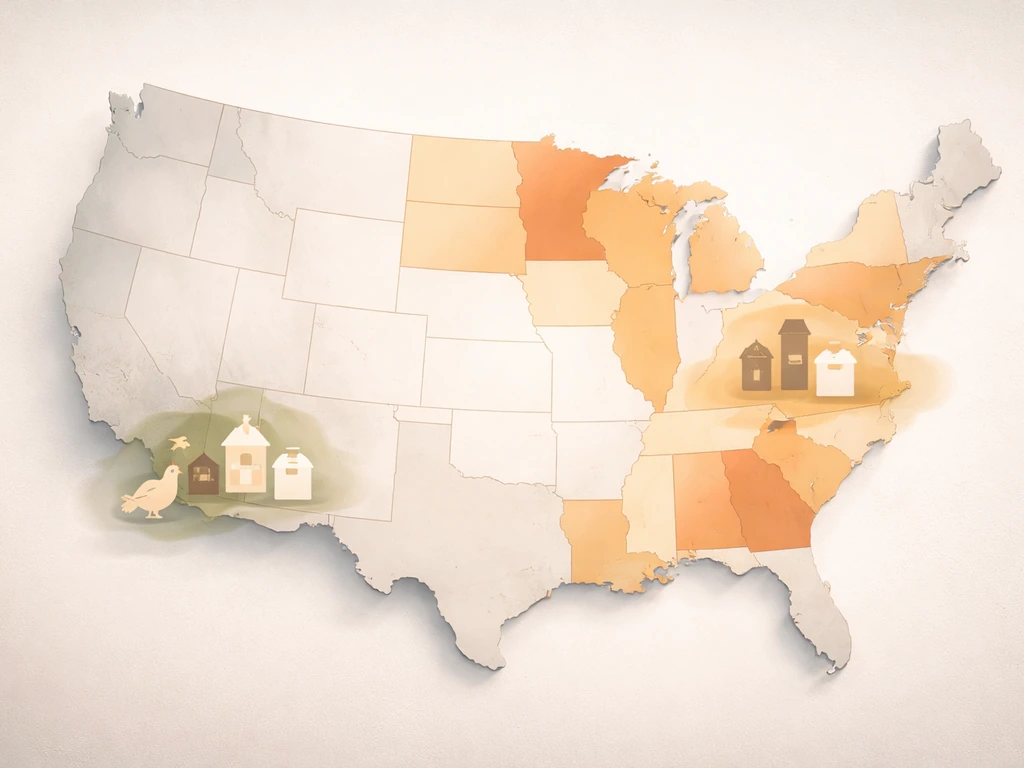
State-by-state guide to current bird flu detections, what counts, total states, and how to verify updates safely.
Current US human bird flu case totals plus deaths, definitions, reporting timeline, and how to interpret risk safely.