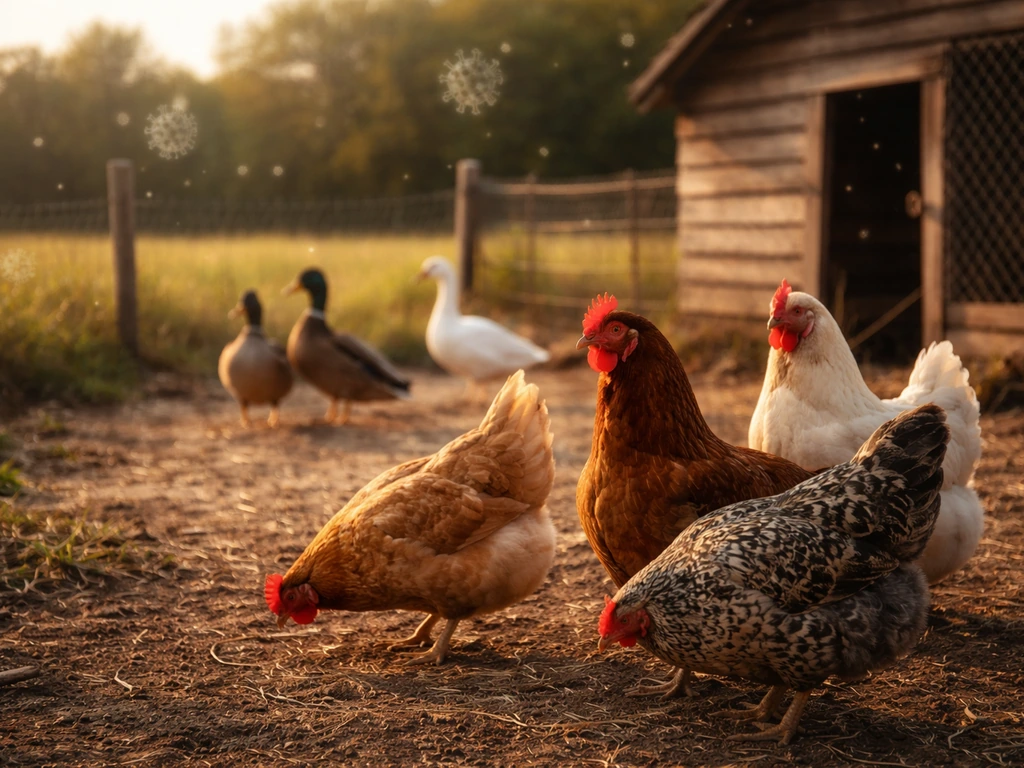
The 'new bird flu' refers to novel strains of avian influenza A virus, most prominently the H5N1 clade 2.3.4.4b lineage and its reassortant relatives (H5N5, H5N9, and others), that have spread pandemically through wild birds and poultry since around 2020 and are now spilling over into mammals, including occasional human cases, at an unprecedented scale. FAO situation updates (Global AIV with Zoonotic Potential | FAO (situation updates)), June 2026, report that H5Nx viruses, notably H5N1 and emerging H5N5/H5N9 variants, are the main HPAI viruses currently causing outbreaks in poultry, wild birds and spillover into mammals across multiple continents. As of mid-2026, WHO, FAO, and WOAH assess the overall public-health risk to the general population as low, but moderate for people with direct occupational exposure to infected birds. There is no confirmed sustained human-to-human transmission.
What Is the New Bird Flu: Clear Guide for Public & Farmers

Quick facts at a glance
Avian influenza A(H5N1) is an influenza A virus that naturally circulates in wild waterfowl and can cause highly pathogenic outbreaks in domestic poultry. The current global wave is driven by clade 2.3.4.4b viruses descended from a lineage first detected in a goose in Guangdong, China in 1996. See the CDC infographic 'Emergence and Evolution of H5N1 Bird Flu (CDC infographic)' for the timeline noting the A/goose/Guangdong/1/1996 lineage was first detected in 1996. Since 2003, WHO has recorded hundreds of laboratory-confirmed human H5 cases across dozens of countries, with deaths most often resulting from severe viral pneumonia. In December 2025, the United States reported the world's first confirmed human H5N5 case, a fatal infection traced to backyard poultry with no onward human spread identified. A joint FAO/WHO/WOAH assessment published in May 2026 confirmed that H5Nx viruses remain the dominant zoonotic influenza threat globally, circulating in poultry, wild birds, and an expanding range of mammal species, while still posing low risk to the general public.
A plain-language explanation for students
Think of influenza A as a large family of viruses. Most family members stay in birds and rarely bother humans. Bird flu is the name given to strains that mostly live in birds, especially wild water birds like ducks and geese. Normally, a bird flu virus cannot easily infect a person because our cells have different 'locks' from bird cells. But occasionally, the virus mutates or swaps genetic pieces with other viruses (a process called reassortment) and gets a new 'key' that fits human cells. When that happens, we call it a novel influenza A virus. Health authorities watch these novel strains very carefully because a virus that can jump from birds to people and then spread easily between people is exactly how a flu pandemic starts. For a simple class-9 explanation, see what is bird flu class 9. That has not happened with the current strains, but the monitoring never stops.
What 'new' or 'novel' actually means in virology
CDC and WHO use the word 'novel' in a precise technical sense: a novel influenza A virus is any influenza A subtype or distinct genetic lineage that has not previously circulated in humans and is therefore not covered by existing population immunity or seasonal vaccines. Under the International Health Regulations (IHR), any confirmed human infection with a novel influenza A virus must be immediately reported to WHO. This reporting requirement exists regardless of severity, because the priority is to catch early signs of a strain that could sustain human-to-human spread. The current H5N1 clade 2.3.4.4b viruses, and variants like H5N5 detected in the U.S. in late 2025, all qualify as novel under this definition, even though isolated human cases have been appearing for years.
Why it's called 'bird flu' and what other names you'll see
The popular name 'bird flu' comes from the fact that the natural reservoir hosts, meaning the animals that carry and maintain the virus over time, are wild birds, particularly waterfowl like ducks, geese, and shorebirds. These birds often carry the virus without showing any illness. The more formal name is avian influenza, and the word 'avian' simply means relating to birds. You may also see it called 'avian flu,' 'HPAI' (Highly Pathogenic Avian Influenza, when the strain causes severe disease in poultry), or 'LPAI' (Low Pathogenic Avian Influenza, when the strain causes mild or no disease in birds). The designation 'H5N1' or 'H5N2' identifies the specific viral subtype. In news coverage, 'bird flu' and 'H5N1' are often used interchangeably, though technically H5N1 is just one of many avian influenza subtypes. If you wonder what is bird flu also known as, it is commonly called avian influenza (or avian flu) and may be labeled HPAI or LPAI depending on severity in birds. For a concise explanation of the name and its origins, see why is it called bird flu.
How the H, N, and clade numbers work
Influenza A viruses are classified by two surface proteins: haemagglutinin (H) and neuraminidase (N). There are 18 known H types and 11 known N types, giving combinations like H5N1, H7N9, or H5N5. The H protein is what the virus uses to attach to and enter a cell; the N protein helps new virus particles escape after replication. Within a given subtype, viruses are further subdivided into clades, which are genetic family branches tracked using HA gene sequencing. The clade system for H5 viruses is maintained jointly by WHO, FAO, and WOAH using numbered labels like 2.3.4.4 and its sub-branch 2.3.4.4b. That b branch is the one causing the current global panzootic (an outbreak spanning multiple species and continents). Within clade 2.3.4.4b, viruses have repeatedly swapped their N gene with other influenza viruses, producing H5N1, H5N6, H5N8, H5N5, and H5N9 variants. Researchers track all of these in near-real time using genomic databases like GISAID and the Nextstrain visualization platform.
Bird flu vs. seasonal human flu: the key differences
People sometimes assume bird flu is just a bad version of the regular flu shot targets every year. The differences are actually quite fundamental, and understanding them helps explain why bird flu gets so much public-health attention even when human cases remain rare.
| Feature | Seasonal Human Flu (e.g., H3N2, H1N1) | Bird Flu (e.g., H5N1 clade 2.3.4.4b) |
|---|---|---|
| Primary reservoir | Humans | Wild waterfowl and domestic poultry |
| Human-to-human spread | Efficient and sustained (that's how epidemics happen) | Not sustained; rare and limited at most |
| Population immunity | Partial, from prior infection or vaccination | Little to none in humans |
| Seasonal flu vaccine covers it? | Yes (updated annually) | No; specific pandemic candidate vaccines exist but are not in routine use |
| Case fatality rate in humans | Typically below 0.1% for seasonal strains | Historically ~60% for H5N1 (though recent cases may be milder; surveillance is incomplete) |
| Main risk group | Very young, elderly, immunocompromised | People with direct, unprotected contact with infected birds or contaminated environments |
| Global spread mechanism | Human travel and social contact | Wild bird migration routes and poultry trade |
| Pandemic potential | Moderate to high if a new strain emerges | High if the virus gains efficient human transmissibility (not occurred yet) |
The most critical practical difference is transmission efficiency. Seasonal flu spreads through respiratory droplets between people in everyday settings. Bird flu, as things currently stand, overwhelmingly requires close, direct contact with infected birds or heavily contaminated environments. That is why the general public's risk remains low, while poultry farmers and veterinarians face a meaningfully higher exposure risk and need stronger precautions.
How bird flu spreads: from wetlands to farms to people
Understanding the transmission chain helps you figure out where the real risks lie and where they don't. The journey of an H5N1 virus from a wild duck to a potential human case follows a fairly predictable ecological pathway, though each step involves a different level of risk.
Step 1: Wild birds as the silent reservoir
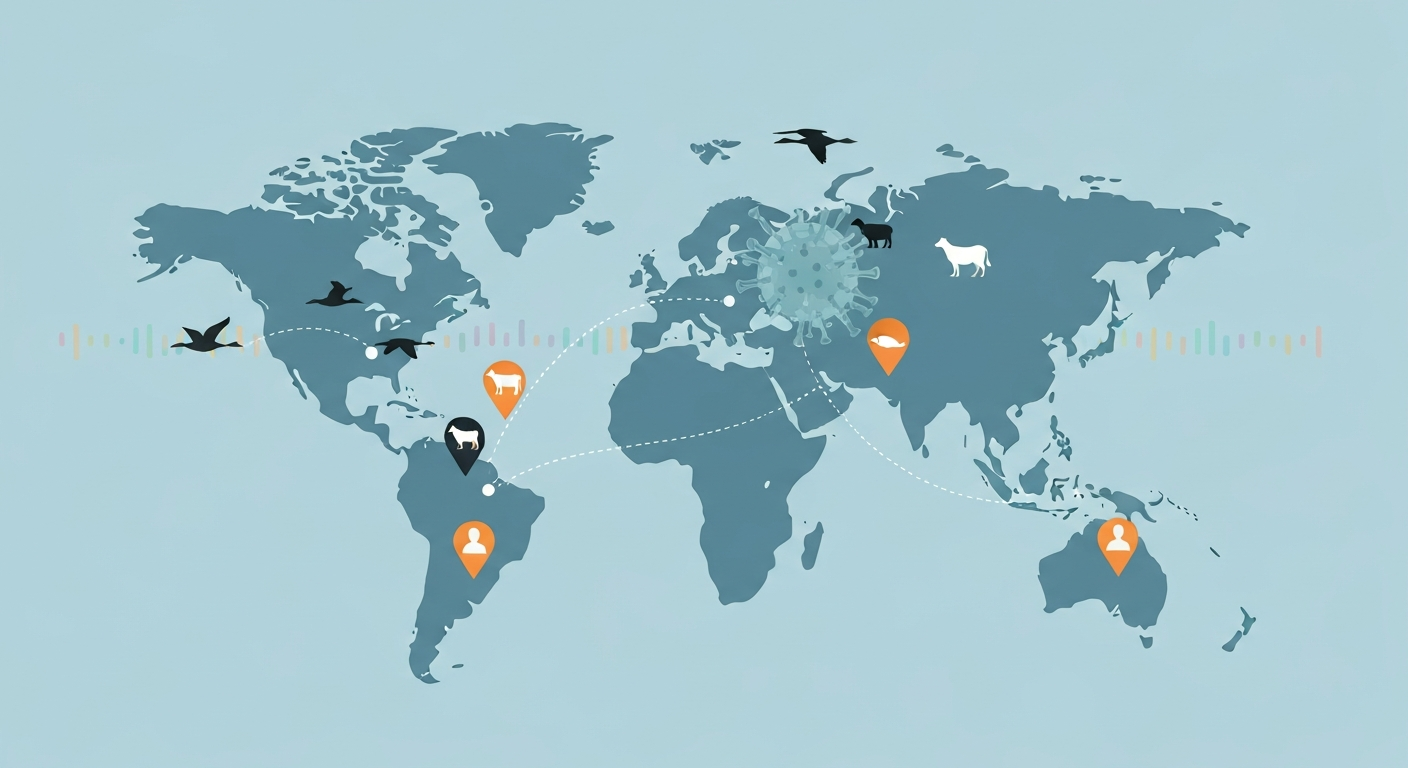
Wild waterfowl, especially migratory ducks, geese, and shorebirds, are the natural hosts of avian influenza viruses. They typically carry the virus in their intestinal tract without becoming visibly sick, shedding it in feces, saliva, and nasal secretions. Because these birds travel thousands of miles along global flyways, they are the primary engine distributing H5Nx viruses across continents. Avian influenza viruses can survive in cool freshwater for days to weeks, which means contaminated ponds and wetlands become infection hotspots for other birds and any animals that share the water.
Step 2: Spillover into domestic poultry
Domestic chickens, turkeys, and ducks are far more vulnerable than wild birds. When a highly pathogenic strain like clade 2.3.4.4b H5N1 reaches a commercial flock, it can kill a large proportion of birds within days. The spillover happens through direct contact with infected wild birds, shared water sources, contaminated equipment or feed, and movement of people between farms without adequate biosecurity. Live-bird markets, where birds from multiple sources mix, are historically important amplification points. Once HPAI establishes in a poultry flock, the viral load in the environment, including in feces, respiratory secretions, and feathers, becomes extremely high.
Step 3: Spillover into mammals
Since 2022, clade 2.3.4.4b viruses have infected an unusually broad range of mammals: dairy cattle in the United States, sea lions in South America, polar bears in the Arctic, foxes and mink in Europe, and domestic cats. These spillovers typically happen when a mammal eats or has close contact with infected birds or contaminated material. Some of these infections have involved genetic changes, such as mutations in the PB2 polymerase gene, that researchers monitor as early warning signs of mammalian adaptation. Critically, most of these mammal infections have not led to onward spread within mammal populations, with a notable exception being the spread among dairy cattle herds in the U.S., which is still being investigated.
Step 4: Rare human infections
Human infections occur almost exclusively through direct, heavy exposure to infected animals or highly contaminated environments, such as handling sick or dead poultry without protective equipment, working in or visiting live-bird markets, or contact with infected dairy cattle. Inhalation of contaminated dust or droplets, direct contact with eyes, nose, or mouth after handling infected material, and possibly exposure to contaminated water are the main documented routes. Incubation periods typically range from one to ten days depending on the subtype and exposure intensity. The good news, which is important to say clearly, is that despite hundreds of confirmed human cases since 2003, there is no confirmed sustained human-to-human transmission of any H5 strain. Person-to-person spread, when it has occurred at all, has been limited to one or two steps in household clusters, not chains extending through communities.
A useful way to visualize transmission is to imagine a chain of contacts: wild bird to pond to domestic flock to farm environment to exposed person. The risk of human infection drops sharply once you remove yourself from the farm or live-bird market environment. For most people going about daily life, cooking poultry, or buying eggs from a supermarket, the chain never reaches them.
What bird flu does to birds and to people
Signs in poultry
In chickens and turkeys, highly pathogenic strains typically cause sudden, severe illness: a sharp drop in egg production, swollen heads and combs, bluish discoloration of the skin, neurological signs like twisted necks or loss of coordination, and death within one to two days of first symptoms. A large flock can collapse within 48 hours. Low pathogenic strains cause milder signs: mild respiratory symptoms, reduced feed intake, a modest drop in egg production. Ducks and geese, even domestic ones, may show fewer and milder clinical signs than chickens even when infected with HPAI strains.
Signs in people
Human cases range widely in severity. Some people who test positive report only conjunctivitis (eye redness and discharge) or mild flu-like symptoms like fever, cough, sore throat, and muscle aches. At the serious end, H5N1 can cause rapidly progressing viral pneumonia, acute respiratory distress, and multi-organ failure. The historically high case fatality rate associated with H5N1 is partly a reflection of surveillance bias: severe cases that end up in hospitals get counted, while milder infections in people who never sought care may not. Recent human cases in the U.S. dairy outbreak context have generally been mild. If you have had contact with sick or dead birds and develop fever, respiratory symptoms, or eye redness within ten days, seek medical attention and tell the healthcare provider about the animal exposure.
Testing and diagnosis
Diagnosis in humans requires laboratory confirmation using reverse transcription PCR (RT-PCR) on respiratory samples, typically a nasopharyngeal swab. Standard rapid flu tests used in clinics can detect influenza A but cannot identify the specific subtype, so a positive rapid test in someone with bird exposure needs follow-up testing at a public health laboratory. In poultry, diagnosis involves RT-PCR, virus isolation, and sometimes sequencing from cloacal or tracheal swabs, feces, or tissue samples. Any farm suspecting HPAI is legally required in most countries to notify animal health authorities immediately. Whole-genome sequencing is increasingly used to determine the exact clade and identify mammalian adaptation markers.
Treatment options and where vaccines stand right now
For humans, antiviral drugs in the neuraminidase inhibitor class, primarily oseltamivir (Tamiflu), are the standard treatment. They work best when started within 48 hours of symptom onset and can reduce severity and duration of illness. Peramivir and zanamivir are alternatives. WHO and CDC recommend that people with confirmed or suspected novel influenza A infections receive antiviral treatment promptly without waiting for lab confirmation. Supportive care for severe cases (oxygen therapy, ventilation) is critical in hospitalized patients.
On vaccines: your seasonal flu shot does not protect against H5 or H7 bird flu strains. However, several pandemic candidate vaccines against H5N1 clade 2.3.4.4b have been developed and stockpiled by governments including the United States. As of mid-2026, these vaccines are not in general public use; they are held in reserve for deployment if sustained human transmission begins. Some workers in high-exposure occupations have received prepandemic H5 vaccines in specific programs. The WHO H5 clade nomenclature system directly informs which candidate vaccine strains are selected and updated, so the genomic surveillance work and the vaccine preparedness pipeline are tightly connected.
Is it safe to eat chicken and eggs?
Yes, with standard food-safety practices. Avian influenza viruses are killed by thorough cooking. Poultry cooked to an internal temperature of 74°C (165°F) and eggs cooked until both whites and yolk are firm are safe to eat. There is no documented case of anyone acquiring bird flu from properly cooked food. The risk in food handling, if any, is theoretical rather than demonstrated, and it applies to handling raw, contaminated poultry in an outbreak zone, not to supermarket products from inspected facilities. Regulatory agencies like USDA and food-safety authorities in affected countries test and monitor commercial poultry supplies. The practical guidance is straightforward:
- Cook chicken and turkey to an internal temperature of at least 74°C (165°F).
- Cook eggs until both yolk and white are fully set; avoid raw or runny egg dishes if you have concerns.
- Wash hands thoroughly with soap and water after handling raw poultry or eggs.
- Avoid cross-contamination: keep raw poultry separate from other foods on surfaces and cutting boards.
- Do not consume meat or eggs from birds that were sick or died without diagnosis.
- Follow guidance from local food-safety authorities if an outbreak is declared in your region.
On-farm prevention and biosecurity
For poultry farmers, biosecurity is the single most effective tool against HPAI. The goal is to break every link in the chain between wild birds and your flock. This is not complicated in principle, though it requires consistent daily discipline.
- Keep birds housed or netted to prevent direct contact with wild waterfowl and their droppings.
- Restrict access to the farm: visitors, vehicles, and equipment from other farms are major introduction risks.
- Implement a strict all-in, all-out system where possible: do not mix birds of different ages or origins in the same space.
- Provide dedicated, washable footwear and outerwear for anyone entering the poultry house; disinfect footbaths at entry points.
- Secure feed and water supplies from wild bird access; cover water troughs and feed stores.
- Monitor your flock daily for sudden drops in egg production, increased mortality, or behavioral changes.
- Report any sudden, unexplained illness or deaths in poultry to your national or regional animal health authority immediately. Early detection saves surrounding farms.
- If you work with or near both poultry and dairy cattle, change clothing and footwear between the two operations.
Personal protective equipment (PPE) is essential for anyone working with potentially infected birds: at minimum, an N95 or equivalent respirator, eye protection (goggles or face shield), gloves, and coveralls. After handling sick birds, remove PPE carefully to avoid self-contamination and wash hands and any exposed skin with soap and water.
Public health response: surveillance, reporting, and what to do if exposed
The global early-warning system for bird flu rests on three pillars: animal surveillance (monitoring wild birds and poultry for HPAI), human epidemiological surveillance (tracking human cases and contacts), and genomic surveillance (sequencing viruses to detect evolution). WHO, FAO, and WOAH coordinate these efforts internationally, and national authorities are required under IHR to report confirmed novel influenza A human cases to WHO within 24 hours.
If you have been directly exposed to sick or dead birds and develop any fever, cough, sore throat, shortness of breath, or eye redness within ten days of that exposure, you should do the following:
- Contact your healthcare provider or local public health department before going to a clinic or emergency room, so they can prepare appropriate precautions.
- Tell them specifically about the nature and timing of your animal contact.
- If you must travel to get care, wear a surgical mask.
- Avoid close contact with others in your household, especially those who are elderly, pregnant, or immunocompromised, while awaiting evaluation.
- Do not self-diagnose based on a standard rapid flu test; subtype confirmation requires a specialized laboratory.
Health authorities in affected countries also conduct active contact tracing around confirmed human cases, and farm workers near outbreak sites are sometimes offered antiviral prophylaxis (oseltamivir preventively) as a precaution. If your local animal health authority declares an HPAI outbreak in your area, follow their specific guidance on movement restrictions and farm protocols.
Separating fact from fear: common myths addressed
Concern about bird flu is entirely understandable given media coverage, but several widespread claims are misleading or simply wrong. Getting these right matters for making sound decisions.
- Myth: 'Bird flu is spreading between people and a pandemic is imminent.' Fact: As of the latest WHO/FAO/WOAH assessment in May 2026, there is no confirmed sustained human-to-human transmission of any H5 strain. The risk level for the general population is assessed as low.
- Myth: 'You can catch bird flu from eating chicken or eggs at a restaurant.' Fact: Properly cooked poultry and eggs are safe. Cooking kills avian influenza virus. No foodborne transmission of bird flu to humans has ever been documented.
- Myth: 'The new bird flu is just a renamed version of COVID-19.' Fact: These are completely different virus families. COVID-19 is caused by a coronavirus (SARS-CoV-2); bird flu is caused by an influenza A virus. They share no meaningful biological similarity.
- Myth: 'If you have chickens in your backyard, you will get bird flu.' Fact: Risk is real but manageable. The key variables are whether your birds are exposed to wild birds and whether you handle sick birds without protection. Good biosecurity dramatically reduces risk.
- Myth: 'The seasonal flu vaccine protects against bird flu.' Fact: It does not. Seasonal flu vaccines target human-adapted H1, H3 strains and influenza B. H5 and H7 avian strains are immunologically distinct.
How to find current, reliable outbreak data
Bird flu is a fast-moving situation and the information landscape changes weekly. For a quick general overview, you can search Google for 'what is bird flu' to find summaries and links to authoritative sources. For authoritative, up-to-date information, go directly to the primary sources rather than relying on news headlines, which often lack critical context:
- WHO Disease Outbreak News (who.int): formal reports on confirmed human cases, including the December 2025 U.S. H5N5 case and any subsequent notifications.
- WHO Cumulative H5N1 Human Case Tables: updated PDFs showing confirmed cases and deaths by country and year since 2003.
- FAO Avian Influenza Global Situation Updates (fao.org): monthly or bimonthly summaries of animal outbreaks, including the June 2026 H5Nx situation report.
- CDC H5N1 Bird Flu Response Updates (cdc.gov): U.S.-specific tracking of human cases, animal outbreaks in dairy and poultry, and guidance documents.
- WOAH (World Organisation for Animal Health, woah.org): official country-reported animal disease events via the WAHIS platform.
- GISAID (gisaid.org) and Nextstrain (nextstrain.org): genomic databases and phylogenetic visualizations for researchers wanting to track clade evolution and emergence.
If you are a farmer, poultry worker, or veterinarian, your national animal health authority is also an essential contact point, because they receive real-time reports of local outbreaks and can advise on testing, movement restrictions, and compensation schemes that vary by country.
What your role determines your next step
The most useful thing you can do right now depends on who you are. If you are a consumer, the main takeaways are cook your food properly, wash your hands, and stay informed through official channels. There is no action needed beyond that in the absence of a local outbreak. If you are a backyard or commercial poultry keeper, review your biosecurity setup now, not after an outbreak is declared in your area. Early action is dramatically more effective than reactive measures. If you are a healthcare provider, make sure your clinical workflow includes an animal exposure question for any patient presenting with influenza-like illness, and know your jurisdiction's reporting pathway for novel influenza A cases. If you are a student or researcher, the FAO and WHO situation reports, GISAID, and Nextstrain together give you the deepest publicly available picture of where this virus is going genetically and geographically.
FAQ
Which international agencies provide the authoritative guidance needed for a public-facing article on the new bird flu?
Use WHO, CDC, FAO, WOAH/OIE and national public‑health agencies. These bodies publish situation reports, risk assessments, case definitions, clinical guidance, and outbreak notifications that are authoritative, regularly updated, and internationally recognized.
What specific WHO/FAO/WOAH documents are essential to consult?
Consult joint public‑health assessments (e.g., the May 2026 FAO/WHO/WOAH assessment), WHO Disease Outbreak News items, WHO cumulative human‑case tables for H5, and technical guidance on surveillance, clinical management, and influenza evolution. These provide current risk characterizations and recommended public‑health actions.
Which CDC resources should be used for case definitions, clinical guidance and testing recommendations?
Use the CDC’s case definition for novel influenza A virus infections, clinical guidance for avian influenza in people, laboratory testing protocols, and consumer food‑safety guidance about handling poultry and eggs. The CDC also provides plain‑language explanatory graphics useful for public audiences.
What genomic and evolutionary data sources are needed to explain the 'new' strain and naming (H#/N# and clades)?
Use sequence databases and visualizers such as GISAID and Nextstrain for up‑to‑date phylogenetic data and clade tracking. Reference the WHO/OIE/FAO H5 clade nomenclature publications and relevant peer‑reviewed genomic studies (e.g., reviews of clade 2.3.4.4b) to explain HA clades, reassortment and genotype emergence.
What peer‑reviewed literature should be cited for transmission pathways and environmental persistence?
Cite recent reviews and primary studies on avian influenza ecology and transmission (wild waterfowl reservoirs, spillover to poultry, environmental persistence in water/feces), including the 2020–2026 reviews and environmental persistence studies that quantify survival times under different conditions.
What surveillance and outbreak data are needed and where to find them?
Use FAO global AIV situation updates, national outbreak reporting portals, WHO cumulative human‑case tables, and WOAH animal‑disease reports. For genomic outbreak tracing, use GISAID and Nextstrain. Always note the date of the data and link to the source for readers to check current numbers.
Why Is It Called Bird Flu? Name, Risk, and Facts
Bird flu name traced to avian influenza in birds, not human contagion; learn transmission, food safety, and prevention.