
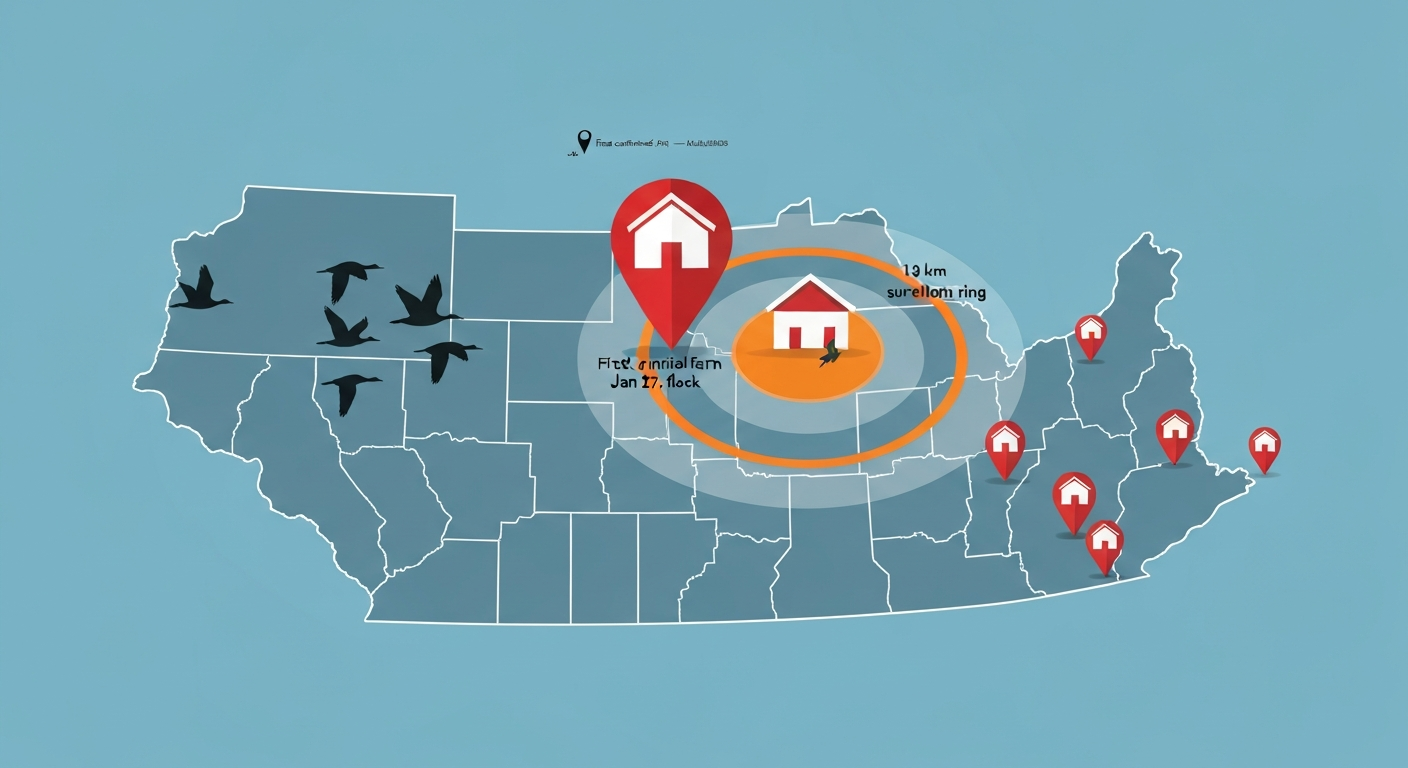
Yes, bird flu (specifically Highly Pathogenic Avian Influenza, or HPAI H5N1) is confirmed in Pennsylvania. The first 2025 detection in domestic poultry was confirmed on January 27, 2025, in a roughly 50,000-bird commercial layer flock in Lehigh County. Since then, the Pennsylvania Animal Diagnostic Laboratory System (PADLS) has tracked additional premises, and the state remains an active area of concern through 2026. If you own birds, work on or near a poultry farm, or simply want to know your risk, this article walks you through exactly what's happening, where to verify it, and what to do.
Is Bird Flu in PA? Current Status, Risks, and What to Do

Sarah Chen
23 Jul 2026
What you'll learn here and what to do right now
This article is built for a range of readers: backyard flock owners worried about their chickens, commercial poultry producers tracking quarantine zones, veterinarians looking for reporting protocols, and residents who just want to understand their actual risk. Here is what you will find below and the immediate steps worth taking before you read further.
- How to verify current confirmed cases in PA using official dashboards and state contacts
- What the confirmation process means and how quickly data gets updated
- How PA's outbreak fits into the broader Mid-Atlantic regional picture
- How the virus spreads between wild birds, domestic flocks, and (rarely) people
- What sick birds and sick people actually look like
- Exactly who to call and what to do if your birds show symptoms
If you think your birds are sick right now, do not wait to read the full article. Call the Pennsylvania Department of Agriculture emergency line at 717-772-2852 (option 1), available 24 hours a day, 7 days a week. If you had direct, unprotected contact with sick birds and are now feeling ill, call your doctor and the PA Department of Health at 1-877-PA-HEALTH (1-877-724-3258).
How to verify current bird flu cases in PA: a step-by-step checklist
Outbreak information moves fast, and no article, including this one, can substitute for checking the live official sources. Here is the exact sequence I recommend, in order of specificity to Pennsylvania.
- Go to the PADLS HPAI Status page (padls.vet.upenn.edu or search 'PADLS Pennsylvania HPAI status'). This page lists active premises, the date of the most recent update, and whether Control Areas are in effect. PADLS updates it regularly, with an example update as recent as April 15, 2026.
- Use the PADLS Control Area Address Checker, linked from the same PADLS HPAI page, to enter your property address and see whether you fall inside an active quarantine or surveillance zone.
- Check the USDA APHIS Confirmed HPAI Detections dashboard (aphis.usda.gov — search 'APHIS HPAI detections'). This is the national hub. Filter by state to see Pennsylvania-specific commercial flock, backyard flock, and wild bird detections. APHIS recommends reviewing the 'last 30 days' filter for the most current picture.
- Download the APHIS CSV datasets if you want granular county-level data. The files include detection date, state, county, species, and production type — useful for farmers who want to map proximity to their operation.
- Check the Pennsylvania Department of Agriculture news page (agriculture.pa.gov) for press releases. The PDA issues official confirmations, quarantine announcements, and Control Area establishment notices that are more detailed than dashboard entries.
- For human health data, go to the Pennsylvania Department of Health H5N1 page (health.pa.gov — search 'avian influenza H5N1') which posts clinician guidance, case counts for humans in PA, and Health Alert Network (HAN) notices.
- Call the PDA at 717-772-2852 if you cannot find current information online or need to confirm a specific county's status. This line handles animal health questions around the clock.
How outbreak maps and case notices actually get updated
There is a meaningful difference between a suspected case and a confirmed one, and understanding that gap helps you interpret what you see on dashboards. When a flock shows signs of HPAI, the farm owner or veterinarian reports to the PDA. PADLS, which is a member of USDA's National Animal Health Laboratory Network (NAHLN), collects samples and runs an initial real-time reverse transcription PCR (rRT-PCR) test. Diagnostic assays for avian influenza virus surveillance and monitoring in poultry, review (Viruses / PMC) summarizes that initial testing typically uses rRT‑PCR targeting the matrix gene with subsequent H5/H7 (or Hx) typing, and that confirmatory testing can include virus isolation and whole‑genome sequencing Diagnostic assays for avian influenza virus surveillance and monitoring in poultry — review (Viruses / PMC). This test targets the influenza matrix gene first, then H5 or H7 subtyping. A non-negative or presumptive-positive result triggers immediate state-level response actions, including quarantine, even before official federal confirmation.
That presumptive result then goes to the USDA National Veterinary Services Laboratory (NVSL) in Ames, Iowa, for official confirmation and whole-genome sequencing. Sequencing can take days to weeks depending on sample quality, but the quarantine clock starts at the presumptive stage. What this means practically: by the time a premises appears as 'confirmed' on the APHIS dashboard, quarantine is already in effect. The dashboard reflects confirmed NVSL results, not suspected cases, so the real-world response is always ahead of what you see publicly. PADLS often posts the PA-specific premises list faster than the national APHIS dashboard updates, which is why I recommend checking both.
County notices and press releases follow a similar chain. PDA issues a press release upon first confirmation in a new county or premises. After that, Control Area maps are published and the address checker is updated. Wild bird detections follow a slightly different path: the Pennsylvania Game Commission (PGC) collects and submits samples from sick or dead wild birds, those go through NAHLN/NVSL testing, and confirmed detections appear on a separate APHIS wild bird detection list. Wild bird detections do not trigger the same farm-level response, but they serve as an important early warning signal.
What's happening in neighboring states and why it matters for PA
Pennsylvania does not sit in isolation. The Mid-Atlantic flyway, one of the major North American bird migration corridors, passes directly through PA and connects it to a cluster of states that have all seen HPAI activity during the 2022-2026 outbreak cycle. Academic analyses of APHIS detection data, including a March 2026 bioRxiv preprint on spatiotemporal clustering of HPAI H5N1, specifically identify the Mid-Atlantic and Great Lakes regions as areas with repeated spillover from wild waterfowl into commercial poultry. New York, New Jersey, Delaware, Maryland, and Ohio are among the states flagged in those analyses. If you're asking whether bird flu is in Massachusetts, read the Massachusetts update titled "is bird flu in Massachusetts.".
For PA residents and farmers, this means a detection in a neighboring state is a legitimate biosecurity signal, not just a news story. Wild birds carrying H5N1 do not observe state lines, and migratory patterns mean that virus circulating in waterfowl populations in New Jersey or Maryland can reach Pennsylvania farms within days. For current Maryland detections and guidance, see our page titled "is bird flu in maryland" which summarizes recent reports and verification steps. Similarly, if you are tracking the situation in nearby states, you may find it useful to follow what is happening in New Jersey, Maryland, Virginia, and North Carolina, which are all part of this same regional outbreak picture. If you want a quick status check for that state, search 'is bird flu in North Carolina' on official state or federal animal health pages to see current detections and advisories. For the latest information on whether bird flu is in Virginia, check the state's official public health or agriculture updates for confirmed detections and guidance. For current New Jersey detections and local guidance, see is bird flu in NJ for up-to-date information.
When you see references to variant naming like 'H5N1 clade 2.3.4.4b,' that is the scientific shorthand for the specific genetic lineage driving the current global outbreak. All confirmed U.S. HPAI detections since 2022 have been this clade. The name tells virologists about the virus's evolutionary history and helps track whether a new introduction from a different geographic origin has occurred. For practical purposes as a flock owner, the clade designation does not change your response protocol, but it explains why outbreak analysts treat Mid-Atlantic detections as part of a connected regional event rather than separate local incidents.
How bird flu spreads: transmission routes and who's actually at risk
Wild birds to domestic flocks
Wild waterfowl, particularly dabbling ducks, geese, and shorebirds, are the primary reservoir for HPAI H5N1. These birds can carry and shed the virus without showing obvious illness, which is part of what makes them so effective at spreading it. The virus moves into domestic flocks through direct contact with wild birds or their droppings, contaminated water sources, or infected material tracked onto a premises by people, vehicles, or equipment. This fomite route, meaning virus carried on surfaces rather than through the air, is one of the dominant farm-to-farm transmission pathways documented in U.S. outbreaks.
Farm to farm
Once HPAI enters a poultry operation, it can spread to neighboring or connected premises through shared personnel, shared equipment, live-bird transport, rendering trucks, and even shared litter or feed supplies. This is why USDA APHIS establishes Control Areas with inner quarantine zones (typically 3 km around an infected premises) and outer surveillance zones (typically 10 km), and requires movement permits for any birds, products, or certain materials leaving those zones. Pennsylvania's response to the January 2025 Lehigh County detection followed this exact framework.
Mammals and people
The current H5N1 clade has shown an expanded host range compared to earlier outbreaks, infecting dairy cattle, foxes, skunks, raccoons, sea lions, and other mammals in the U.S. since 2022. Human infections have occurred in the U.S., primarily in people with direct, close contact with infected animals (dairy cattle or poultry) and without adequate protective equipment. The risk to the general public with no direct animal exposure remains low according to CDC. That said, the risk is not zero for farm workers, and it has shifted the risk calculation enough that CDC has issued specific interim recommendations for monitoring and prophylaxis.
| Exposure scenario | Relative risk level | Primary concern |
|---|---|---|
| General public, no animal contact | Very low | Standard seasonal flu hygiene |
| Visiting farms or live-bird markets | Low to moderate | Avoid touching sick/dead birds; wash hands |
| Backyard flock owners with sick birds | Moderate | Use PPE; call PDA immediately |
| Poultry farm workers, daily exposure | Moderate to elevated | Consistent PPE, monitoring, antiviral access |
| Dairy/cattle farm workers (current outbreak) | Elevated | Eye protection critical; CDC antiviral guidance applies |
| Persons handling sick/dead wild birds | Moderate to elevated | PPE required; report to PGC |
What sick birds look like: signs to watch in your flock
HPAI can move through a flock with devastating speed. In commercial operations, a sudden and unexplained drop in egg production is often the first visible signal, sometimes appearing before any birds are visibly ill. In backyard flocks, where you are more likely to observe individual birds closely, the warning signs can be easier to catch early. The key phrase here is 'sudden and unexplained' because gradual declines from husbandry issues look different from a sharp HPAI-driven drop.
Mild to moderate signs
- Decreased feed and water intake
- Reduced egg production or soft-shelled, misshapen eggs
- Mild respiratory signs: coughing, sneezing, nasal discharge
- Lethargy or reduced activity, birds staying huddled
- Ruffled feathers and apparent depression
Severe signs (HPAI-specific)
- Sudden, unexplained death in multiple birds with no prior signs
- Neurological symptoms: loss of coordination, tremors, twisting of the neck (torticollis)
- Swelling of the head, eyelids, comb, wattles, and hocks
- Purple or blue discoloration (cyanosis) of the comb and wattles
- Diarrhea, often watery and green or white
- Significant drop in mortality rate across the flock within 24 to 48 hours
Any one of these signs in isolation might have a mundane explanation. A cluster of them, especially sudden death combined with neurological signs or rapid flock-wide spread, should be treated as an HPAI emergency until proven otherwise. Do not wait for multiple birds to die. HPAI can kill 90 to 100 percent of an unvaccinated flock within days.
What bird flu looks like in people: symptoms, timeline, and who's most at risk
Human infection with HPAI H5N1 is rare, but it does happen, and it has happened in the U.S. during the current outbreak cycle. The incubation period, meaning the time between exposure and feeling sick, is typically 2 to 5 days but can extend up to 10 days. CDC recommends that anyone with a known exposure be monitored for the full 10 days after their last contact with infected animals.
Symptoms in humans can look a lot like regular influenza, which is exactly what makes clinical differentiation difficult without testing. Common presentations include fever (often high, above 38°C or 100.4°F), cough, sore throat, muscle aches, and fatigue. Eye redness and discharge (conjunctivitis) has been a notably common feature in people exposed through dairy cattle contact in the current U.S. outbreak. In more severe cases, which are less common but documented, H5N1 can progress to pneumonia, acute respiratory distress, and multi-organ involvement.
The people at higher risk are those with direct, unprotected exposure to infected animals: poultry farm workers who handled sick or dead birds without proper PPE, dairy farm workers, people who participated in culling operations without adequate protection, and anyone who handled sick or dead wild birds with bare hands. Children, elderly individuals, and immunocompromised people may face elevated severity if infected, consistent with the pattern seen in other influenza strains. Standard seasonal flu vaccination does not protect against H5N1, though antivirals like oseltamivir (Tamiflu) are effective against H5N1 when started early, and CDC interim guidance supports offering them to exposed individuals even before symptoms appear in high-risk exposure situations.
If your birds are sick: testing, reporting, and your legal obligations in PA
Pennsylvania law requires reportable disease reporting. HPAI is a reportable disease, meaning if you suspect it in your flock, you are legally obligated to report it to the PDA. This is not punitive, it is how the state can mobilize rapid response resources to help you and protect neighboring operations. Here is the step-by-step process.
- Stop moving birds immediately. Do not transport any sick or dead birds off your property. Do not allow visitors into your bird areas. If you have multiple bird areas on your property, limit movement between them as well.
- Call the PDA emergency line: 717-772-2852, option 1. This line is staffed 24 hours a day, 7 days a week. Describe what you are seeing, how many birds are affected, when it started, and any recent visitors, deliveries, or changes on the premises.
- Do not dispose of dead birds yet. PDA will give you guidance on how to hold carcasses safely (sealed bags or containers, kept cool) until a veterinarian or state official can assess them and collect proper samples.
- Limit your own exposure. If you have to handle sick or dead birds before help arrives, use disposable gloves, a face mask or N95 respirator, eye protection, and a dedicated set of boots or boot covers. Wash your hands thoroughly with soap and water afterward. Change your clothes before entering your home.
- Cooperate with sample collection. PADLS-affiliated veterinarians will collect oropharyngeal or tracheal swabs and cloacal swabs from live birds, and tissue samples from dead ones. These go through rRT-PCR testing at PADLS. If the result is non-negative or presumptive positive, it goes to NVSL for confirmation.
- Expect a Control Area to be established. If HPAI is confirmed, PDA will establish a quarantine zone (approximately 3 km) and a surveillance zone (approximately 10 km) around your premises. Movement of birds, eggs, equipment, and certain materials within those zones requires a permit. This is standard protocol, not a penalty.
- If your flock tests positive, depopulation (humane culling) and premises decontamination will be required. USDA and PDA coordinate on indemnity payments for affected flocks, so report early rather than late.
- Report sick or dead wild birds separately. If you are finding sick or dead wild birds near your property, report those to the Pennsylvania Game Commission at 1-833-PGC-WILD or pgc-wildlifehealth@pa.gov. Wild bird reports go through a separate but connected surveillance pathway.
- Monitor yourself. If you had unprotected contact with sick or dead birds, call the PA Department of Health at 1-877-PA-HEALTH (1-877-724-3258) and let them know. They will guide you through the 10-day monitoring protocol and tell you whether antiviral prophylaxis is appropriate for your situation.
Pennsylvania's laboratory infrastructure is substantial. Between July 1, 2024 and June 30, 2025, PADLS processed approximately 672,342 HPAI tests across poultry and cattle as part of the state's expanded surge capacity. That number reflects how seriously the state is taking this outbreak and also means the laboratory pipeline can handle high volumes. Do not let concern about 'overwhelming the system' delay your call.
Biosecurity basics that actually make a difference
Whether you have three backyard chickens or a commercial layer operation, the biosecurity fundamentals are the same in principle, even if the scale differs. The goal is to reduce every possible contact point between your birds and the outside world, especially wild birds and anything that has been near them.
- House birds indoors or in fully enclosed runs during periods of elevated wild bird activity (migration seasons, spring and fall especially)
- Use dedicated footwear for the bird area that never leaves it; keep a boot dip with an approved disinfectant at the entrance
- Limit visitors and require anyone entering bird areas to wear clean clothing and footwear; keep a log of who visits
- Do not share equipment (feeders, waterers, tools) with other flock owners without thorough disinfection
- Keep feed and water sources covered and inaccessible to wild birds
- Control rodents and other wildlife that can carry contaminated material onto your property
- Establish a routine of observing your flock daily so that any behavioral or production changes are caught early
- Know your flock's baseline: normal egg production, normal mortality rate, typical behavior — so you can recognize deviations quickly
Food safety, vaccines, and common myths
Properly cooked poultry and eggs are safe to eat. HPAI does not survive the cooking temperatures used for poultry (165°F or 74°C internal temperature kills influenza viruses). There is no documented case of anyone contracting H5N1 from eating properly cooked food. The food supply in the U.S. goes through a multi-layered inspection system, and HPAI-positive flocks are depopulated and do not enter the commercial food chain. If you have backyard chickens and your flock is not affected, eggs from healthy birds are also safe to eat when fully cooked.
As of mid-2026, there is no licensed H5N1 vaccine available for the general public in the U.S., though candidate vaccines exist and government stockpiles are in development. Seasonal flu shots do not protect against H5N1, though they are still worth getting to reduce the chance of co-infection with seasonal flu strains. For exposed individuals, the antiviral oseltamivir (Tamiflu) is the primary medical countermeasure and is effective when started early. If you work with poultry or cattle and have a confirmed high-risk exposure, talk to your doctor or contact PA DOH about accessing antivirals through established interim protocols.
A few myths worth addressing directly: HPAI does not spread through the air over long distances in outdoor settings, so simply living near a farm with a confirmed case does not put you at meaningful risk. You cannot get bird flu from a neighbor's healthy-appearing flock walking past your yard. And while the virus has infected mammals including cattle, there is no sustained human-to-human transmission of H5N1 documented anywhere in the current outbreak, which is the critical threshold that would change the public risk calculation significantly. Authorities are monitoring for that possibility very closely, and the current risk to the general public in Pennsylvania remains low.
FAQ
Is bird flu (avian influenza) currently present in Pennsylvania?
Yes — Pennsylvania has had confirmed highly pathogenic avian influenza (HPAI/H5) detections in domestic poultry since 2025. State pages (PADLS/PDA) maintain current premises and Control Area listings; check those official pages and the USDA APHIS national dashboard for the latest confirmed detections before assuming local risk.
How can I verify whether there are active HPAI cases near me? (Verification checklist)
Step 1: Check USDA APHIS HPAI Confirmed Detections dashboard for recent national/state/county confirmations. Step 2: Visit Pennsylvania PADLS/PDA HPAI pages (PADLS HPAI status and Control Area/premises lists) and use the PADLS Control Area Address Checker. Step 3: Review county notices and PDA press releases for quarantines or movement restrictions. Step 4: If you need confirmation for a specific address or suspect an exposure, call PDA emergency line 24/7 at 717‑772‑2852 (option 1) or your county extension/animal‑health office. These official sources are updated when labs report presumptive positives and when NVSL confirms results.
What official data sources should I rely on for up‑to‑date information?
Primary authoritative sources: USDA APHIS H5N1/HPAI detections dashboard and commercial/backyard flocks lists; Pennsylvania Animal Diagnostic Laboratory System (PADLS) HPAI status and premises lists; Pennsylvania Department of Agriculture (PDA) press releases and Control Area pages; Pennsylvania Department of Health (PA DOH) H5N1 guidance and clinician resources; CDC HPAI/A(H5) human‑health guidance. Use these first; research preprints and papers can provide context but are secondary.
How are outbreak maps and lists updated (lab confirmation workflow)?
State/NAHLN labs (e.g., PADLS) run rRT‑PCR and report non‑negative/presumptive positives to state animal‑health officials. Those results are shared with USDA NVSL for confirmation and sequencing. APHIS dashboards and PADLS pages are updated as cases are reported and confirmed; APHIS recommends focusing on confirmed cases in the last 30 days for current impact. Timing: rRT‑PCR gives rapid presumptive results; confirmatory virus isolation/sequencing can take days to weeks depending on sample quality.
Which nearby states have reported HPAI detections and why does regional context matter?
Mid‑Atlantic and neighboring states — including New York, New Jersey, Delaware, Maryland and Ohio — have reported HPAI detections during 2022–2026. Regional clustering matters because wild waterfowl migration and local movements of people, equipment and vehicles can spread virus across state lines; check APHIS and PADLS maps for regional trends that affect Pennsylvania risk.
How is HPAI transmitted and what are the main risk routes to poultry and livestock?
Primary reservoir: wild waterfowl and other wild birds. Main transmission routes to domestic animals: direct contact with infected wild birds, contaminated water, and indirect (fomite) transmission via contaminated equipment, vehicles, feed, clothing, boots and shared personnel. Recent outbreaks have also involved spillover into some mammals and dairy cattle, so expanded surveillance and strict biosecurity are emphasized.