
Yes, bird flu happens every year. For a focused FAQ on whether bird flu is coming back, see is bird flu coming back. Avian influenza viruses circulate continuously in wild bird populations around the world, and poultry outbreaks are reported in every calendar year on record. What changes year to year is the scale, the dominant strain, and how much spillover reaches farms or people. Some years produce relatively contained outbreaks; others, like the 2020 to 2024 epizootic driven by clade 2.3.4.4b H5Nx viruses, become global events that affect dozens of countries simultaneously. Understanding why this pattern holds, and what drives the peaks, is the most practical way to put your real risk in perspective.
Does Bird Flu Happen Every Year? Seasonal Patterns & Risks

Sarah Chen
5 Aug 2026
What bird flu actually is: strains, species, and the human connection
Avian influenza (bird flu) is caused by influenza A viruses that are classified by two surface proteins: hemagglutinin (H) and neuraminidase (N). Wild waterfowl, especially ducks, geese, and shorebirds, act as the natural reservoir, carrying low-pathogenic avian influenza (LPAI) strains with few or no symptoms. When certain H5 or H7 strains mutate or reassort (swap gene segments with other influenza viruses), they can become highly pathogenic avian influenza (HPAI), which causes severe disease and mass die-offs in poultry.
Multiple subtypes can infect humans. WHO lists A(H5N1), A(H5N6), A(H7N9), A(H9N2), and several H10 variants as having confirmed zoonotic potential, meaning they can jump from birds to people under certain conditions. A(H9N2) has been detected sporadically in humans since the 1990s and continues to cause occasional infections. A(H7N9) caused a serious outbreak series in China from 2013 onward. The strain dominating global headlines since 2020 is clade 2.3.4.4b H5N1, which has spread across Europe, Asia, Africa, and the Americas in an event researchers are calling a panzootic (a pandemic affecting multiple animal species across multiple continents).
The zoonotic potential is real but, based on current evidence, limited for most people. The CDC is clear that human infections with avian influenza A viruses are uncommon and sporadic, typically tied to direct, unprotected contact with infected birds or heavily contaminated environments. Sustained human-to-human transmission has not been documented in any current strain, though small, limited clusters have occurred rarely.
Why bird flu follows seasonal rhythms
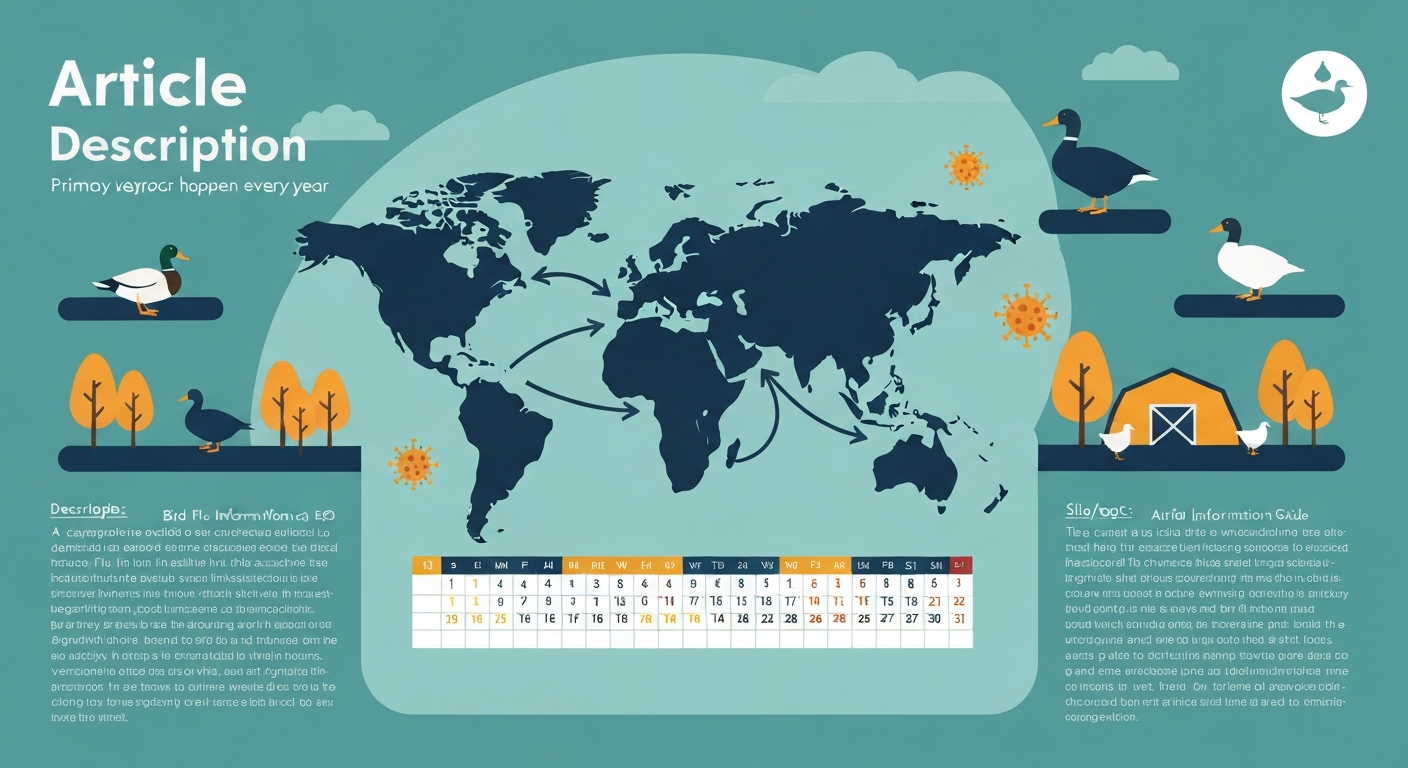
If you look at any multi-year surveillance dataset, you will notice that avian influenza detections cluster in predictable seasonal windows, particularly in temperate Northern Hemisphere regions. A systematic review and meta-analysis of active wild-bird surveillance programs found that autumn, the post-breeding and first-migration season, consistently produces the highest detection rates. The pattern has two main biological drivers: the arrival of large numbers of immunologically naive juvenile birds that have never been exposed to avian influenza, and the mass congregation of migratory species at key stopover and staging sites along major flyways.
Environment matters too. Laboratory studies show that influenza A virus can persist in water for weeks to months when conditions are right: cool temperatures, neutral to slightly alkaline pH, and low salinity markedly prolong infectivity. This means autumn wetlands and winter waterways serve as long-lasting reservoirs, keeping viruses circulating even between direct bird-to-bird contacts. As temperatures rise in late spring and birds disperse to breeding territories, the environmental reservoir shrinks and detection rates typically fall, though the virus does not disappear entirely.
Spring migration adds a second, smaller pulse. Infected birds that overwintered in southern latitudes can carry virus northward, reintroducing it to poultry-dense areas that may have been relatively quiet through summer. This spring wave is generally less intense than the autumn one, but it is why farmers and veterinarians stay alert year-round rather than only in winter.
Ecological and agricultural drivers that keep bird flu going
Migration alone does not explain everything. Several structural factors make avian influenza a recurring problem rather than a self-limiting one.
- Wild bird reservoirs: Ducks, geese, gulls, and shorebirds carry LPAI strains continuously. As long as wild populations exist, so does the viral reservoir.
- Poultry density and farming practices: Commercial farms with large numbers of birds in close quarters provide ideal amplification conditions. A single infected introduction can spread through thousands of birds before detection.
- Live poultry markets: In many parts of Asia and Africa, live-bird markets mix multiple species that would rarely meet in nature. This mixing is a well-documented driver of reassortment (gene swapping) that produces new, potentially more dangerous strains.
- Global trade and movement: Legal and illegal trade in poultry, eggs, and pet birds moves virus across borders. The 2014 North American outbreak was partly attributed to multiple separate introductions, likely via wild birds crossing the Pacific Flyway.
- Shared water sources: Wild birds and domestic birds that use the same ponds, streams, or flooded fields create direct transmission opportunities that are difficult to eliminate on open-range or backyard farms.
- Environmental persistence: As noted above, contaminated water, soil, and equipment can harbor infectious virus, enabling indirect spread even after infected birds are removed.
The interaction between these factors is why bird flu does not simply burn out and disappear. The wild bird reservoir continuously replenishes the viral pool, and wherever that pool touches domestic poultry, outbreaks become possible. Climate shifts that alter migration routes or timing, land-use changes that place farms closer to wetlands, and intensification of poultry production all modify the risk landscape without eliminating it.
Why some years are far worse than others
Acknowledging that bird flu happens every year raises the obvious follow-up: why do some years feel dramatically worse? Several converging factors can amplify what might otherwise be a routine seasonal event into a large-scale crisis.
- Viral evolution: Influenza viruses mutate rapidly, and when a new clade or reassortant emerges that populations have no prior immunity against, it spreads faster and further. The emergence of clade 2.3.4.4b H5Nx around 2020 is the clearest recent example. These viruses proved capable of infecting a far broader range of wild bird species than earlier HPAI strains, which drastically expanded their geographic reach and host range.
- Expanded host range in mammals: Unlike previous HPAI waves, clade 2.3.4.4b viruses have spilled over into diverse mammals, including marine mammals and terrestrial species, at an unprecedented scale. This extended the reach of the 2020-plus wave well beyond what earlier outbreaks managed.
- Weather anomalies: Unusual weather can disrupt normal migration patterns, pushing large numbers of birds into areas they rarely visit, or concentrating them at bottleneck sites for longer than usual. This increases both transmission intensity and geographic spread.
- Surveillance gaps: More outbreaks are detected in years with better surveillance infrastructure, which can make some years appear worse simply because reporting has improved. Conversely, gaps in surveillance in resource-limited regions mean actual outbreak counts are likely underestimates.
- Delayed detection and response: Farm-level biosecurity lapses, slow laboratory confirmation, and delayed culling allow outbreaks that could be contained to expand significantly before control measures take effect.
- Interconnected flyways: When a new strain establishes itself in migratory species along multiple flyways simultaneously, as happened with clade 2.3.4.4b in 2021 to 2022, it spreads to new continents in a single migration season.
The outbreak record: what history and recent data actually show
Looking at the historical record makes the annual pattern undeniable. WOAH's WAHIS global database and FAO's EMPRES-i system track animal disease events in near real-time, and both confirm that avian influenza outbreaks in birds have been reported in every year since systematic global surveillance began. EMPRES‑i and WAHIS data show a large pulse of H5 clade 2.3.4.4 HPAI activity from Jan 2020–Mar 2022: 7,778 H5 outbreaks/events reported globally in that interval with subtype breakdowns (approximately 4,284 H5N1 and 3,221 H5N8) (Global dissemination of H5N1 influenza viruses bearing the clade 2.3.4.4b HA gene and biologic analysis of the ones detected in China (PMC)). Here is a summary of the most significant milestones and recent patterns.
| Period / Event | Key strain(s) | Scale and impact |
|---|---|---|
| 2003 onwards: H5N1 spread from Southeast Asia | HPAI A(H5N1) | H5N1 spread from Southeast Asia to over 60 countries; WOAH/WAHIS data shows ~8,534 H5 HPAI outbreaks and an estimated 389 million poultry dead or culled globally between Jan 2005 and Nov 2022 |
| 2013–2017: H7N9 in China | A(H7N9) | Multiple epidemic waves in China; over 1,500 confirmed human cases recorded by WHO, with roughly 40% case fatality rate in severe cases; prompted large-scale vaccination of Chinese poultry |
| 2014–2015: North American epizootic | HPAI H5N2, H5N8 | Over 50 million commercial chickens and turkeys died or were depopulated across the U.S.; largest agricultural animal disease event in U.S. history at the time |
| Jan 2020 – Mar 2022: clade 2.3.4.4b surge | H5Nx (mainly H5N1, H5N8) | EMPRES-i and WAHIS data document 7,778 H5 outbreaks/events globally in this period; H5N8 dominated early, H5N1 became dominant from late 2021 |
| 2021–2024: Panzootic expands to Americas and beyond | HPAI H5N1 clade 2.3.4.4b | First detection of clade 2.3.4.4b H5N1 in wild birds and poultry across North and South America; unprecedented wild-bird and mammal mortality events; U.S. dairy cattle infected in 2024 |
| Ongoing (2025–2026): continued global circulation | H5Nx clade 2.3.4.4b | FAO April 2026 update reported 763 H5/H5Nx events across 31 countries in a recent reporting period; ECDC documented 19 human avian influenza cases with 3 fatalities between Feb 28 and June 4, 2026 |
On the human side, WHO maintains cumulative tables of laboratory-confirmed human A(H5N1) cases, updated through March 31, 2026. The cumulative record since 2003 shows a relatively small absolute number of confirmed human cases given how widespread the virus is in birds, which reflects the genuine difficulty of the zoonotic jump under normal exposure conditions. That said, the case fatality rate in hospitalized human H5N1 cases has historically been very high, which is why public health agencies take every human case seriously even when total numbers remain low.
How bird flu spreads: from bird to bird, and occasionally to people
Between birds
Within bird populations, avian influenza spreads primarily through respiratory secretions and feces. An infected bird sheds enormous quantities of virus in its droppings, and these contaminate feed, water, soil, equipment, and the air inside poultry houses. Direct contact between birds is the fastest route, but indirect contact via contaminated surfaces, shared water, or contaminated footwear and vehicles moving between farms is equally important. Wild birds that share water sources with domestic flocks create a direct bridge between the wild reservoir and the farm environment. Migratory species carry virus along flyways and deposit it at congregation sites, which is why ecological studies identify migration timing and stopover locations as central to understanding outbreak geography.
Spillover to people
Human infection almost always involves direct, close, unprotected contact with infected live birds, sick or dead poultry, or heavily contaminated environments such as live poultry markets or farm buildings during an active outbreak. The virus enters through the eyes, nose, or mouth, typically via contaminated hands touching the face, inhalation of aerosolized material, or direct mucosal contact. Eating properly cooked poultry or eggs has not been identified as a transmission route, because influenza viruses are inactivated by heat at normal cooking temperatures. The CDC's position, supported by the broader evidence base, is that human infections remain uncommon and sporadic and that sustained human-to-human transmission of current strains has not been observed.
Who is actually at risk
Risk is not evenly distributed. Understanding who faces elevated exposure helps clarify why most people going about their daily lives have very little to worry about, while certain groups need specific precautions.
| Risk group | Why risk is elevated | Key precautions |
|---|---|---|
| Poultry farmers and farmworkers | Daily close contact with potentially infected flocks; exposure to fecal matter, respiratory secretions, and contaminated dust | PPE during flock handling and especially during outbreaks or culling; strict farm biosecurity; report unusual bird deaths promptly |
| Veterinarians and animal health workers | Diagnostic work, sample collection, and treatment of sick birds | Appropriate respiratory protection, gloves, and eye protection; follow agency PPE protocols |
| Live poultry market workers | High-density mixing of species, repeated daily exposure, contaminated surfaces | PPE, frequent handwashing, market hygiene standards; avoid touching face |
| People in regions with active H5N1 or H7N9 circulation | Higher baseline prevalence in local poultry and wild birds increases chance of casual exposure | Avoid contact with sick or dead birds; do not handle wild birds found dead; follow local health authority guidance |
| Hunters and wildlife handlers | Direct contact with wild waterfowl and shorebirds that carry LPAI and sometimes HPAI strains | Wear gloves when handling harvested birds; wash hands thoroughly; do not eat sick birds |
| General public with no bird contact | Minimal direct exposure under normal circumstances | Standard hygiene; no need for special precautions unless local outbreak guidance advises otherwise |
| Immunocompromised individuals | Not specifically more susceptible to acquiring the infection, but potentially more severe if infected | Follow general precautions; seek medical advice promptly if symptomatic after bird exposure |
Geographic location also matters. People living in or traveling to areas with active HPAI outbreaks in poultry, or where H7N9 or H5N6 circulate endemically, face a higher background risk than people in countries currently reporting no active outbreaks. Checking real-time outbreak maps is genuinely useful: WOAH's WAHIS dashboard, FAO's EMPRES-i system, WHO's disease outbreak news, and the CDC and ECDC situation reports all provide regularly updated information. If you are wondering whether bird flu is currently active near where you live or farm, these are the authoritative sources to consult. For a brief, up-to-date summary of current risk levels, see the related page titled: is bird flu bad this year.
Addressing the bigger picture: is this getting worse, and should you be worried?
The honest answer is that the 2020-plus epizootic represents a genuinely more concerning situation than typical annual bird flu activity. Clade 2.3.4.4b H5N1 has done things previous H5 strains did not: it established itself in wild bird populations across every inhabited continent, it infected mammals at unprecedented scale, and it reached U. USDA ERS: Impacts of the 2014–2015 Highly Pathogenic Avian Influenza Outbreak on the U.S. Poultry Sector reports the 2014–2015 HPAI epizootic caused more than 50 million commercial chickens and turkeys to die or be depopulated between December 2014 and June 2015. S. dairy cattle in 2024, a host that had never been meaningfully affected before. Risk assessments from WHO acknowledge these as significant developments warranting close surveillance and preparedness work.
That said, the current global risk to the general public remains low according to WHO's own risk assessments for clade 2.3.4.4b. The virus has not acquired efficient human-to-human transmission. Human cases continue to be linked to direct animal exposure. The ECDC's March to May 2026 report documented 19 human cases across six countries or territories over roughly three months, numbers that underscore both the continued zoonotic risk and the continued rarity of human infection relative to the massive scale of bird outbreaks happening simultaneously.
Questions about whether bird flu is man-made or whether it is natural are worth addressing directly: the evidence consistently points to natural evolutionary processes, driven by the enormous diversity of influenza viruses circulating in wild birds and the opportunities for reassortment that arise when different subtypes infect the same host. There is no credible scientific evidence for deliberate engineering of any current circulating strain. See the brief FAQ 'Is bird flu man made' for a focused summary of the evidence. And bird flu is absolutely real, with documented losses of hundreds of millions of poultry and confirmed human deaths from multiple subtypes over more than two decades. For a concise, plain-language answer to the question is bird flu real, see our FAQ.
Practical steps for the public and for farmers
For the general public
- Do not touch sick or dead wild birds. Report dead wild birds (especially waterfowl) to your local wildlife or agriculture authority.
- Cook poultry and eggs thoroughly. Proper cooking (internal temperature of 74°C / 165°F) inactivates influenza viruses. There is no evidence of human infection through eating properly cooked food.
- Wash hands thoroughly after any contact with live poultry, birds, or bird environments.
- If you develop respiratory symptoms after contact with birds during a known outbreak period, tell your doctor about the exposure immediately. Early antiviral treatment (oseltamivir/Tamiflu) is most effective when started promptly.
- Monitor authoritative sources: WHO disease outbreak news, CDC avian influenza updates, ECDC situation reports, and your national health authority for current guidance.
For poultry farmers
- Implement and maintain strict biosecurity: controlled access points, foot baths, dedicated farm clothing, and vehicle disinfection.
- Prevent contact between domestic flocks and wild birds wherever possible. Cover feed and water sources. Fence or net outdoor ranges during periods of high migratory activity.
- Report unexplained sudden increases in bird mortality or dramatic drops in egg production to your national animal health authority immediately. Early reporting saves flocks and limits spread.
- Follow WOAH and national authority guidance on movement restrictions during outbreak periods in your region.
- Consult your veterinarian or national animal health authority about vaccination options where approved vaccines are available for your country and the circulating strain.
- Train all farm staff in outbreak recognition and PPE use before an outbreak occurs, not during one.
How to check whether bird flu is active right now, near you
The most reliable way to answer 'is bird flu happening now near me' is to go directly to the surveillance databases rather than relying on news headlines alone. WOAH's WAHIS platform publishes real-time outbreak notifications by country, region, and species. FAO's EMPRES-i maps avian influenza events globally and allows filtering by subtype, affected species, and date range. WHO's disease outbreak news covers confirmed human cases and high-risk country situations. For farmers and vets in the United States, USDA APHIS publishes weekly situation reports during active HPAI events. In Europe, ECDC and EFSA publish joint avian influenza situation reports on a regular cycle. Bookmarking two or three of these sources and checking them during migration season is the most practical surveillance habit you can build. If you want a quick check of whether bird flu is active in your area, search the page for “is bird flu near me” to find localized guidance and links to the real-time outbreak maps.
FAQ
Does bird flu happen every year?
Short answer: Yes — avian influenza viruses circulate in wild birds and poultry every year, but the size, location and impact of outbreaks vary. Seasonal patterns and changing virus strains mean some years have many reports (large epizootics/panzootics) while other years have only sporadic detections. Global surveillance (WOAH/WAHIS, FAO EMPRES‑i, WHO) tracks these annual and multi‑year changes.
Why do some years have many more bird‑flu outbreaks than others?
Outbreak size varies because of changing virus strains (emergence of new H5/H7 clades), bird migration and population dynamics (more naive juveniles in some seasons), environmental persistence (cold water preserves virus longer), poultry production practices, and chance introductions. Human responses (biosecurity, culling, vaccination where used) also affect spread and reporting.
When is bird flu most likely to occur (seasonality)?
In temperate regions, detection in wild birds and spillover to poultry often peaks in autumn and early winter (post‑breeding and migration). Seasonal migration, congregation at stopovers, and influx of immunologically naive juveniles drive these peaks. Local timing can differ by hemisphere and flyway.
What have historical and recent trends shown for bird‑flu outbreaks?
Historically there have been intermittent HPAI epizootics (e.g., large 2014–2015 North America event). Since 2020 a global wave of clade 2.3.4.4b H5Nx viruses caused widespread outbreaks across Europe, Asia, Africa and the Americas, infecting many wild birds, poultry and occasionally mammals and humans. Surveillance summaries (WAHIS, FAO EMPRES‑i, peer‑reviewed syntheses) document large pulses of outbreaks and substantial poultry losses in some years.
Can bird flu infect people? How common is that?
Yes, some avian influenza subtypes can infect people (examples: A(H5N1), A(H5N6), A(H7N9), A(H9N2)). Human infections are uncommon and typically sporadic, usually following unprotected close contact with infected birds or contaminated environments. Sustained human‑to‑human transmission has not been documented for the currently circulating H5Nx viruses; human case counts vary year to year and are tracked by WHO and national public‑health agencies.
How is bird flu transmitted (birds to birds, birds to people)?
Main routes: direct contact with infected birds (live or dead), droppings, respiratory secretions or contaminated materials (feed, equipment, clothing). Wild birds can introduce viruses to poultry via shared water or contact. Human infections generally require close unprotected exposure to infected birds or contaminated environments; airborne sustained human spread is not typical for most avian strains.