
For humans exposed to bird flu, the incubation period is typically 2 to 5 days, with most cases developing symptoms within that window. The outer boundary recognized by the WHO is 17 days, but that is genuinely rare. For practical public health purposes, the WHO uses a 7-day monitoring window after last exposure for H5N1 contacts, while the CDC recommends watching for symptoms for 10 days. In poultry, things move much faster: infected birds can start shedding virus and showing clinical signs within just 1 to 3 days. In cats, dogs, and other mammals, incubation is similarly short, often 1 to 2 days in experimental settings. Knowing these timelines matters because they shape when you should seek testing, how long farms need to quarantine exposed flocks, and when an exposed person is truly in the clear.
What is the incubation period for bird flu: timelines

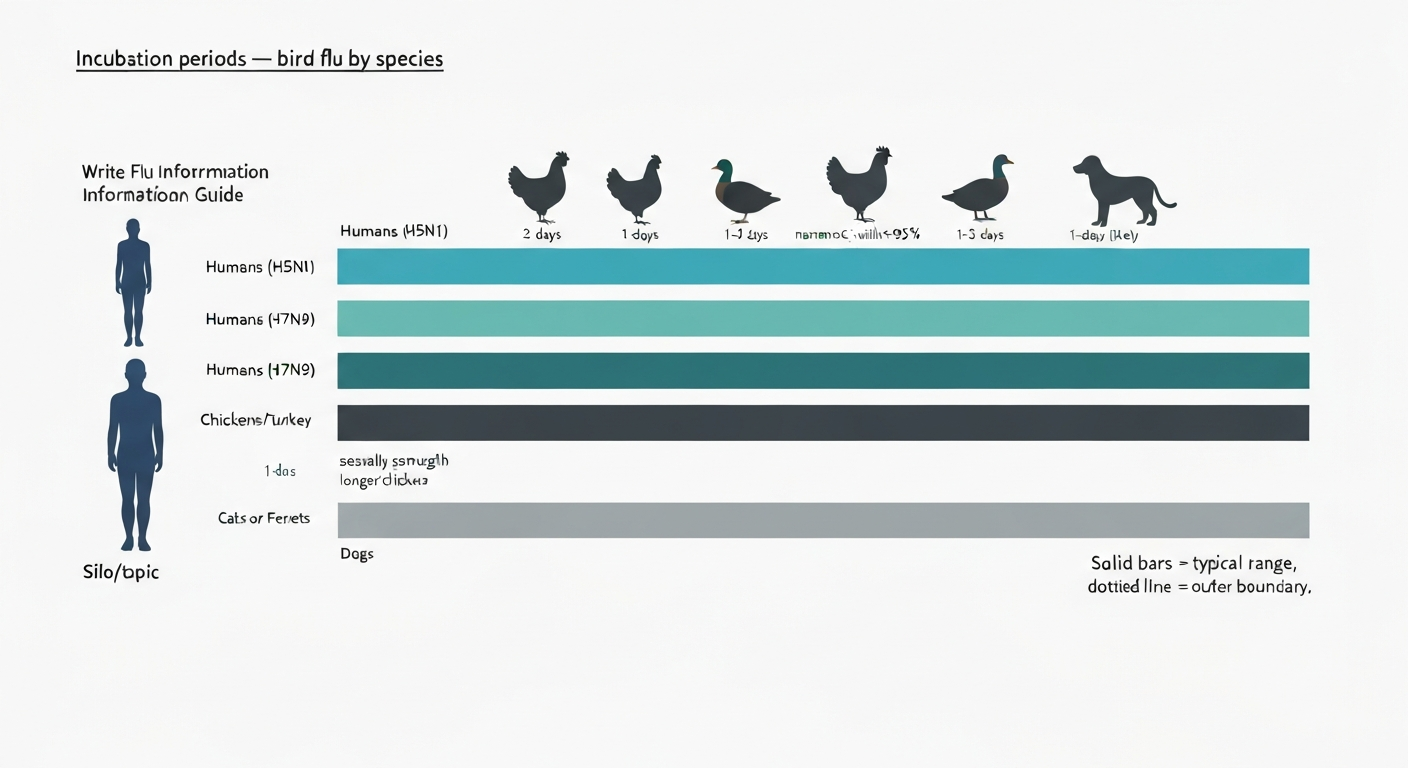
Quick timelines at a glance
Before diving into the science, here is a condensed reference for the key numbers. These are the figures that actually drive public health decision-making and farm biosecurity protocols.
| Species | Typical incubation range | Outer boundary | Monitoring window used in practice |
|---|---|---|---|
| Humans (H5N1) | 2–5 days | Up to 17 days (rare) | 7 days (WHO), 10 days (CDC) |
| Humans (H7N9) | ~3.4 days mean, 95% within ~6.5 days | Not firmly established | Up to 14 days (some guidance) |
| Chickens / turkeys (HPAI) | 1–3 days | Up to ~7 days | Rapid flock culling / quarantine |
| Ducks | Somewhat longer than chickens, variable | Up to ~7 days | Quarantine per national guidelines |
| Cats / ferrets | 1–2 days (experimental) | A few days | Isolate and monitor closely |
| Dogs | Not firmly established; likely 1–3 days | Unknown | Observe for 10 days after exposure |
| Swine / other mammals | Short; varies by strain and dose | Not firmly established | Observe per veterinary guidance |
What 'incubation period' actually means in the context of bird flu
The incubation period is the time between when a person or animal is first exposed to the virus and when symptoms first appear. It sounds straightforward, but measuring it precisely for a zoonotic disease like avian influenza is genuinely tricky. With seasonal flu, you usually know when you were exposed, because someone sneezed on you on the subway. With bird flu, the exposure event is harder to pin down: a farmer might handle infected birds across multiple days, or a child might have a single brief contact they do not even remember. That uncertainty inflates the apparent range in outbreak data.
Epidemiologists distinguish between the latent period (when the virus is replicating but no signs are visible), the incubation period (exposure to first symptoms), and the infectious period (when the host can actually spread the virus to others). These windows overlap but do not match perfectly, and that distinction matters a lot when deciding how long to isolate someone or quarantine a flock. For bird flu in both humans and animals, viral shedding can begin before obvious symptoms appear, which is a key reason why monitoring windows tend to be conservative.
Incubation in humans: what the data actually show
For H5N1, the most extensively studied strain in humans, the WHO's current fact sheet places the typical range at 2 to 8 days, while noting it can extend to 17 days. The 17-day figure comes from field investigations where determining exact exposure was difficult, often because the patient had repeated contact with infected poultry over many days. Peer-reviewed outbreak analyses cluster the median incubation at roughly 3 to 5 days, with a 2005 NEJM review of H5N1 cases finding that most patients developed symptoms within 2 to 4 days of known exposure.
For H7N9, another subtype that caused significant human cases in China between 2013 and 2017, mathematical modeling of confirmed case data estimated a mean incubation of about 3.4 days, with approximately 95 percent of cases becoming symptomatic within 6.5 days. That is actually a bit tighter than the H5N1 range, though both sit notably longer than seasonal influenza, which has a mean incubation of around 2 days.
The practical takeaway from public health agencies reflects this uncertainty honestly. The WHO recommends monitoring H5 contacts for 7 days from the last unprotected exposure. The CDC, taking a more conservative posture during active outbreaks, recommends 10 days of active monitoring. Neither agency is being arbitrary: they are setting windows wide enough to catch the realistic tail of the distribution without making quarantine indefinitely long.
When to seek testing
If you have had a documented exposure to infected or potentially infected birds (or their environments), and you develop fever, respiratory symptoms, eye redness, or body aches within 10 days of that exposure, current CDC guidance says you should be tested and your local public health authority should be notified. CDC's Recommendations for Monitoring and Testing of Individuals Exposed to A(H5N1) Viruses, CDC (2025) advises that persons with exposure within 10 days who develop compatible symptoms should undergo RT‑PCR testing and notify public health authorities Recommendations for Monitoring and Testing of Individuals Exposed to A(H5N1) Viruses — CDC (2025). The preferred test is RT-PCR (reverse transcription polymerase chain reaction), which detects viral RNA in throat swabs. Rapid antigen tests are less reliable for H5N1 specifically, so a negative rapid test is not a clear all-clear if your exposure and symptoms fit the profile. Testing is most productive in the 4 to 8 days after symptom onset, when pharyngeal viral loads tend to be highest.
Incubation in poultry: fast, aggressive, and hard to miss
In chickens and turkeys infected with highly pathogenic avian influenza (HPAI), the incubation period is dramatically shorter than in humans. Experimental and field data consistently show clinical signs and detectable virus shedding beginning within 1 to 3 days of infection, and sometimes within 24 hours. This is one reason why an HPAI outbreak can rip through a flock so rapidly: birds are shedding virus before a farmer notices anything is wrong.
EFSA analyses of AIV (avian influenza virus) in poultry report that RT-qPCR can detect viral RNA from roughly 1 to 2 days post-infection, with detection windows extending to about 7 to 10 days depending on the strain, host species, and assay sensitivity. Ducks are worth singling out here: they tend to shed HPAI virus at lower levels and for longer periods than chickens without always showing severe signs, making them a particularly challenging reservoir from a biosecurity standpoint. Infected birds can be shedding oropharyngeally and cloacally while still appearing healthy.
For poultry farmers, these timelines underscore why biosecurity protocols cannot wait for visible symptoms. If any birds in a flock die suddenly or show neurological signs, respiratory distress, or a sharp drop in egg production, the response should be immediate: isolate, report to your state veterinarian or the USDA, and restrict movement on and off the property. Every hour matters when a flock incubation period is measured in single days.
Incubation in mammals and pets: incomplete data, short windows
Mammals, including domestic cats, dogs, swine, and wild carnivores, can be infected by HPAI H5N1, though human-to-human or pet-to-human transmission has not been established. What is known about incubation in these species comes largely from experimental inoculation studies rather than natural outbreak data, so the numbers carry more uncertainty than those for humans or poultry.
In domestic cats, experimental infection with HPAI H5N1 via direct inoculation or feeding of infected carcasses shows early viral replication detectable within 1 to 2 days, with clinical signs of illness, including fever, lethargy, and respiratory distress, appearing within a few days. Ferret models, which are widely used in influenza research because ferrets respond to flu similarly to humans, show detectable shedding by days 1 to 2 post-inoculation with disease progressing over the following days.
For dogs, the evidence is thinner. Canadian national case definition guidance cites an H5N1 incubation commonly of 1 to 5 days in exposed animals, and a 10-day observation window is a reasonable precaution given the available data. If your dog has had direct contact with wild birds, domestic poultry, or raw poultry products from a known HPAI-affected area, watch closely for respiratory signs, eye discharge, lethargy, or loss of appetite, and contact your veterinarian promptly. How long bird flu lasts in dogs specifically is an evolving area of study, and veterinary guidance continues to be updated as field data accumulates. If you need details on how long bird flu lasts in dogs, see our guide on how long does bird flu last in dogs for typical illness duration and care recommendations.
Swine are a particular concern from a pandemic-preparedness standpoint because pigs can be infected by both avian and human influenza viruses, raising the theoretical risk of genetic reassortment. Field data on incubation in swine infected with avian influenza strains is limited, but experimental studies suggest short incubation periods consistent with other mammalian hosts. Close monitoring of pigs with any known exposure to infected birds is warranted.
Why incubation periods vary: dose, route, strain, and immunity
The incubation period for any infectious disease is not a fixed biological constant. It sits at the intersection of the pathogen and the host, and several concrete factors push it shorter or longer.
- Infectious dose: The amount of virus a person or animal is exposed to matters. A farm worker who handles thousands of infected birds has a much higher exposure dose than someone who briefly passes a backyard flock. Higher doses generally allow the virus to reach infectious thresholds in the body faster, shortening the apparent incubation.
- Exposure route: Inhaling virus particles (respiratory route) tends to produce faster onset than ingesting contaminated material. Direct inoculation in lab settings produces the shortest incubation of all, which is why experimental animal data often looks faster than what is seen in field cases.
- Virus subtype and strain: H5N1 and H7N9 behave differently from each other, and strains within the same subtype vary too. Highly pathogenic variants like the current H5N1 clade 2.3.4.4b have shown aggressive replication kinetics in both birds and mammals. Less pathogenic subtypes generally produce longer, milder courses.
- Host immune status: A person or animal with prior immunity to related influenza strains (through infection or vaccination) may have a faster or more contained immune response, which can alter when and how severely symptoms appear. Immunocompromised individuals may experience longer incubation or atypical presentations.
- Host species: As the table above shows, poultry incubation is far shorter than in humans. This reflects biological differences in receptor distribution, body temperature, immune response, and the evolutionary relationship between the virus and its avian host.
These variables also explain why the range you see quoted (2 to 17 days for human H5N1) is so wide. It is not imprecision in the science: it is an honest reflection of genuine biological variability across different people, exposures, and settings. The mean and median values (3 to 5 days) are far more representative of a typical case than the outer boundary.
How incubation connects to symptom onset and contagiousness
One of the most practically important questions about any infectious disease is whether someone can spread it before they feel sick. For most seasonal influenza strains, the answer is yes, you can be mildly contagious in the 24 hours before symptoms appear. For H5N1 in humans, this is less clear, and for a reassuring reason: human-to-human transmission of H5N1 has been extremely rare and inefficient even in the cases that have occurred. The virus has not (as of mid-2026) acquired the mutations needed for sustained person-to-person spread.
In terms of viral shedding kinetics, the 2005 NEJM review found that viral RNA was detectable in throat swabs from 2 to 15 days after symptom onset, with a median around 5.5 days, and pharyngeal viral loads were highest at roughly 4 to 8 days after illness onset. That is worth emphasizing: peak viral load in the throat occurs several days into illness, not at the very start. This is somewhat different from the pattern with seasonal flu, where the first couple of days tend to be the most contagious.
There is also an important distinction between PCR positivity and actual contagiousness. RT-PCR can detect viral RNA for up to 2 to 3 weeks in some H5N1 cases, but the presence of RNA does not mean live, transmissible virus is present. After antiviral treatment with oseltamivir (Tamiflu), cultivable (viable) virus typically drops off faster than RNA, meaning someone can test PCR-positive while no longer posing a realistic transmission risk. Public health authorities use clinical judgment alongside virologic data to make isolation decisions, not PCR results alone.
In poultry, the pre-symptomatic shedding window is the key driver of rapid flock-to-flock spread. Birds shed oropharyngeally and cloacally during the incubation period, contaminating water, feed, equipment, and shared air. By the time a farmer notices mass illness or death, the virus has typically been circulating for at least a day or two. This is precisely why surveillance, early testing, and strict movement controls are more effective than waiting for visible signs.
How long does illness last, and what does recovery look like?
In humans
Human H5N1 infection has historically been severe, with the WHO's cumulative data showing case fatality rates above 50 percent in confirmed cases, though this almost certainly reflects surveillance bias toward the sickest patients. The clinical course typically begins with high fever (often above 38 degrees Celsius), respiratory symptoms, and rapidly progressing pneumonia in serious cases. Without antiviral treatment, severe cases can deteriorate within days to acute respiratory distress syndrome (ARDS). With early oseltamivir, outcomes are better, though the drug works best when started within 48 hours of symptom onset.
For those who survive, the acute illness phase generally runs 1 to 2 weeks, though recovery of full respiratory function can take considerably longer. Viral RNA may remain detectable by PCR for up to 2 to 3 weeks even as the patient improves clinically. If you are comparing this to the question of how long bird flu lasts overall, the answer depends heavily on severity: mild or asymptomatic cases resolve faster, while severe pneumonia cases may require weeks of recovery.
In poultry
In chickens and turkeys infected with HPAI, the disease course is extremely short and often fatal. Mortality in affected flocks can reach nearly 100 percent within 48 to 72 hours of the first deaths. There is no meaningful recovery period for HPAI-infected poultry: the birds either die rapidly or, in a small number of cases with milder strains, survive with ongoing shedding. Low pathogenic avian influenza (LPAI) strains produce a much milder illness with lower mortality, but they carry the risk of mutating into HPAI under field conditions.
In companion animals and other mammals
In cats, documented H5N1 infections have ranged from severe neurological and respiratory illness to death, with illness progressing over several days. Survivors have been reported but with serious disease courses. In dogs, natural infection data is sparse but suggests illness durations of roughly 1 to 2 weeks when infection occurs, consistent with other mammalian influenza infections. Recovery timelines in dogs depend on severity and whether antiviral treatment is administered under veterinary care.
Practical monitoring steps for people and farms
Understanding incubation windows is most useful when it translates into concrete actions. Here is how to put these timelines to practical use, whether you are a concerned individual, a poultry farmer, or a pet owner.
- After any direct exposure to sick or dead birds (wild or domestic), monitor yourself for symptoms for 10 days. Take your temperature daily if you have had a high-risk exposure. Symptoms to watch for include fever, cough, sore throat, eye redness or discharge, and body aches.
- If you develop symptoms within that 10-day window, contact your local health department before visiting a clinic, so they can arrange appropriate testing and avoid exposing others.
- For poultry farmers: implement biosecurity protocols immediately if any birds show sudden illness or unusual mortality. Do not wait for test confirmation to restrict movement on and off the property. Report to your state veterinarian or the USDA APHIS within hours, not days.
- Pet owners with animals exposed to potentially infected birds should contact a veterinarian promptly. Keep exposed pets away from other animals and humans while monitoring for 7 to 10 days.
- Do not rely on rapid antigen tests for ruling out H5N1. RT-PCR is required for accurate diagnosis. False negatives from rapid tests can create dangerous delays in response.
- Antiviral treatment (oseltamivir) is most effective when started within 48 hours of symptom onset in humans, which means the 2 to 5 day typical incubation window is actually a critical opportunity: if you know you were exposed and you feel sick, act on day one of symptoms, not day three.
A note on vaccines and how they fit into the incubation picture
Vaccines do not change the incubation period of bird flu, but they matter for outbreak planning and personal risk. H5 candidate vaccine viruses have been developed for pandemic preparedness, and some national stockpiles exist, but no H5 vaccine is currently available to the general public for routine use. Poultry vaccines against HPAI are used in some countries as part of outbreak control, though their use is carefully managed because vaccinated flocks can shed virus without showing signs, complicating surveillance. How long any bird flu vaccine lasts in terms of protective immunity is a separate and active area of research, with duration of protection varying by formulation and target strain.
Keeping the risk in perspective
Bird flu has been circulating in wild birds and poultry for decades, with H5N1 first confirmed in humans in Hong Kong in 1997. For a brief timeline of its emergence and major outbreaks, see how long has bird flu been around. The virus has repeatedly demonstrated the ability to infect mammals, including humans, but it has not acquired sustained human-to-human transmission. That distinction is what separates the current situation from a pandemic threat, and it is the single most important context for these incubation timelines. For a broader discussion of epidemic timelines and to explore answers to questions like "when will bird flu end", see the dedicated overview on epidemic duration and control. A 2 to 5 day incubation period in a disease that spreads primarily through direct contact with infected birds is very different from a 2 to 5 day incubation in a disease that spreads person to person as easily as seasonal flu.
Staying informed, following exposure monitoring guidance, and maintaining basic biosecurity on farms and in households with poultry remains the right response: measured, practical, and proportionate. The incubation numbers exist not to alarm you, but to give you a concrete window for action.
FAQ
What is the incubation period for bird flu (avian influenza)?
The incubation period is the time from when someone or an animal is exposed to avian influenza virus until they develop symptoms. For zoonotic avian influenzas that infect people (most commonly H5 and H7 types), the typical incubation in humans is about 2–8 days with most cases clustering around 3–5 days. Rarely longer intervals (reports up to ~17 days) have been documented. Public‑health guidance commonly uses conservative monitoring windows of 7–10 days after last exposure to watch for symptoms. (Sources: WHO, CDC, peer‑reviewed reviews including NEJM.)
How does incubation vary by virus subtype (H5 vs H7) and why does that matter?
Incubation varies somewhat by subtype and study. H7 zoonotic infections have estimated mean incubation ≈3.1–3.4 days with ~95% of cases by ~6–7 days. H5 (notably A(H5N1)) cases typically cluster around 2–5 days but can be reported up to 8 days (and rarely longer). These differences matter because they guide how long contacts are monitored and when testing is most useful; agencies set monitoring windows (usually 7–10 days) based on subtype‑specific evidence. (Sources: WHO, NEJM, peer‑reviewed analyses.)
What are typical incubation periods in poultry and other animals?
Poultry (chickens, turkeys): Highly pathogenic avian influenza (HPAI) often produces very short incubation/latent periods — clinical signs and virus shedding can begin within 24 hours to a few days (commonly 1–3 days), enabling rapid flock spread. Mammals (cats, dogs, ferrets): experimental and field data usually show short incubations (~1–3 days) after direct exposure, but timelines vary by strain, dose, and route of exposure. (Sources: EFSA, animal‑health reviews, experimental studies.)
How long does the illness usually last in people?
Duration varies with severity. Mild to moderate zoonotic avian influenza cases may resolve in about 1–2 weeks. Severe cases (hospitalized or complicated disease) can last longer, sometimes several weeks, and recovery can be prolonged. Antiviral treatment (oseltamivir) can reduce severity and duration if started promptly. (Sources: WHO, NEJM reviews.)
When is an infected person or animal contagious?
Contagiousness often begins around the time of symptom onset and, in some species (especially poultry), can occur before clinical signs. In humans with avian influenza, viral shedding and peak pharyngeal viral loads are commonly highest in the first week after symptom onset (roughly days 4–8 in some reports). PCR may detect RNA longer than viable virus; detection of RNA by PCR does not always equal ongoing contagiousness. Isolation and public‑health guidance are based on clinical course, PCR testing, and local protocols. (Sources: NEJM, WHO, CDC.)
How long should exposed people be monitored or isolate after exposure?
Public‑health agencies typically recommend active monitoring for symptoms for 7 days after the last unprotected exposure for many H5 exposures, with some agencies using up to 10 days for added caution. If symptoms develop during monitoring, prompt testing by RT‑PCR and public‑health notification are recommended. Isolation decisions for confirmed cases follow clinical and virologic guidance from health authorities. (Sources: WHO operational guidance, CDC monitoring recommendations.)},{