NBC News and its local affiliates have been covering bird flu (officially called highly pathogenic avian influenza, or HPAI H5N1) with increasing frequency through 2024 and into 2026, focusing on three main threads: genetic mutations spotted in virus samples from a severely ill patient in Louisiana, a raw pet food recall after indoor cats contracted H5N1, and a seasonal resurgence of bird flu activity tied to wild-bird migration. All three stories are grounded in real events confirmed by the CDC, USDA, and FDA. The good news, repeated consistently across official sources, is that the general risk to the U.S. public remains low. The elevated risk sits squarely with people who have close, unprotected contact with infected animals or contaminated environments, including farm workers, backyard flock owners, and anyone handling raw milk or raw pet food from affected sources.
NBC News Bird Flu: Coverage, Risks, Prevention, and Facts

What NBC News reported on bird flu and why it matters
If you landed here after seeing an NBC headline and felt a jolt of anxiety, that reaction makes sense. The stories were genuinely newsworthy. NBC 6 South Florida reported on CDC findings that H5N1 samples from a severely ill Louisiana patient showed mutations that could potentially make the virus easier to spread to people. NBC Select covered an FDA recall of raw cat food products after two indoor cats in Colorado and New York tested positive for H5N1, almost certainly from contaminated raw poultry-based food. And NBC 5 Dallas-Fort Worth ran a story on seasonal rebounds in bird flu activity, reminding the public to avoid contact with sick or dead wild birds and to stay away from raw milk from cattle in affected herds.
These are not manufactured scares. Each report tracked back to official agency actions: a CDC technical update, an FDA recall notice, and blank" rel="noopener noreferrer">USDA APHIS situation updates. What NBC's coverage sometimes lacked, through no fault unique to that outlet, was the fuller epidemiological context that turns a frightening headline into a useful, actionable story. That is exactly what this article aims to provide. For a sense of how different outlets frame the same events, it is worth comparing NBC's approach to what Fox News and CBS News have reported, as the framing varies noticeably.
How NBC's key claims line up with CDC, USDA, and WHO data
The mutation story
The NBC report on mutations in the Louisiana patient's virus samples was accurate and important. CDC's own June 2024 technical report documented ongoing genetic surveillance of H5N1 clade 2.3.4.4b viruses circulating in the U.S. and noted that monitoring for adaptive mutations, meaning changes that could affect transmissibility or virulence in humans, is a core part of the One Health response. The critical context is that detecting mutations in a single patient sample is not the same as those mutations becoming established in circulating virus populations. As of the updated FAO/WHO/WOAH joint public health assessment from May 18, 2026, there is still no evidence of sustained human-to-human transmission of any current H5N1 strain. That does not mean the situation cannot change, but it does mean the mutation headlines describe a risk being monitored, not a risk that has materialized.
The raw pet food recall
The FDA recall NBC Select covered was real and remains relevant. Two indoor cats with no known outdoor exposure contracted HPAI H5N1 and were linked to raw pet food products. The FDA responded by issuing guidance to raw pet food manufacturers using unpasteurized animal-sourced ingredients and warning consumers about the risk. This tracks directly with what CDC and WHO have said about raw animal-sourced products broadly: the virus can survive in raw, unheated meat and unpasteurized dairy from infected animals. The recall was a public health measure, not a sign that H5N1 had jumped into a new transmission pathway affecting humans directly. However, it underscored a genuine gap in awareness: many pet owners did not know HPAI H5N1 could be transmitted through commercial raw pet food.
The seasonal resurgence story
The NBC DFW report on bird flu rebounding with wild-bird migration aligned with established USDA APHIS data. Wild migratory waterfowl are the primary reservoir for HPAI H5, and outbreak activity in domestic poultry has historically tracked migration seasons. APHIS situation updates through 2024 and 2026 confirmed ongoing detections across poultry flocks, wild birds, and mammalian hosts, including dairy cattle first reported in March 2024, a genuinely new development in the U.S. outbreak picture. The NBC affiliate's practical advice, avoiding sick or dead wild birds and raw milk, was consistent with CDC and WHO guidance.
What the current U.S. risk level actually means for you
The CDC's standing assessment, repeated across multiple updates through 2025 and 2026, is that HPAI A(H5) poses a low risk to the general U.S. public. That assessment is not political reassurance; it rests on surveillance data. The vast majority of U.S. human cases confirmed to date have been in people with direct, often prolonged, unprotected exposure to infected animals, farm workers in contact with infected dairy cattle or poultry, for example. There have been no documented cases of H5N1 spreading from one person to another in the United States or in any sustained way globally as of August 2026. Ferret studies cited in risk assessments show that current 2.3.4.4b clade viruses can transmit by direct animal contact but have not demonstrated efficient airborne (respiratory droplet) transmission, which is the key threshold for pandemic potential.
So what does 'low risk' mean practically? It means a person buying pasteurized milk at a grocery store, eating thoroughly cooked chicken, or walking through a park is not at meaningful risk of contracting H5N1. It means the risk profile looks very different for a dairy farmer hand-milking cows in an affected herd without gloves and eye protection. The risk is real and geographically concentrated, not evenly distributed across the population, and that distinction matters enormously when reading news coverage.
What avian influenza actually is, and how it differs from seasonal flu
Avian influenza is caused by influenza A viruses that primarily infect birds. These viruses are classified by two surface proteins: hemagglutinin (H) and neuraminidase (N). The strains currently generating most of the concern are H5N1 variants within clade 2.3.4.4b, a lineage that has spread widely through wild bird populations globally and has spilled over into mammals, including cattle, cats, and occasionally humans, at an unprecedented scale compared to earlier H5N1 outbreaks.
Seasonal human influenza is caused by H1N1 and H3N2 viruses that have been adapted to spread efficiently between people for decades. The human immune system has significant background immunity to these strains from prior infections and annual flu vaccines. H5N1 is a different matter entirely: it is not adapted for human-to-human spread, most people have no prior immunity to it, and the vaccines designed for it require separate development and stockpiling. The seasonal flu vaccine you get every autumn does not protect against H5N1. This is not a minor technical footnote; it is central to understanding why public health agencies track H5N1 so closely even when current human risk is low.
How bird flu spreads, among birds and to people
Among birds, HPAI H5N1 spreads through direct contact with infected animals, their droppings, feathers, and respiratory secretions, and through contaminated water, feed, and equipment. Wild migratory waterfowl, especially ducks and geese, often carry and shed the virus without becoming visibly sick, making them the silent engine of geographic spread. When the virus reaches domestic poultry, the consequences are far more severe: mortality in affected flocks can approach 100% within days in high-pathogenicity strains.
Human infections have occurred through several routes, all involving some form of direct or close exposure. The most common exposure pathways documented in confirmed U.S. cases include unprotected contact with infected poultry or dairy cattle, exposure to virus-contaminated environments such as barns and milking parlors, and consuming raw unpasteurized milk from infected herds. The raw pet food vector, highlighted in the NBC Select cat food story, represents a variation of the same principle: unheated, unpasteurized animal-sourced material can carry viable virus. There is no documented evidence that properly cooked poultry, eggs, or commercially pasteurized dairy products have transmitted H5N1 to humans. The WHO, CDC, and FDA all state explicitly that pasteurization inactivates the virus and that the commercial pasteurized milk supply is safe.
Symptoms in poultry and in people: what clinical progression looks like
In birds
In domestic poultry, HPAI produces a devastating and rapid illness. Infected flocks typically show sudden, severe drops in egg production, neurological signs including loss of coordination and tremors, respiratory distress, swelling of the head and face, and cyanosis (bluish discoloration) of combs and wattles. Mortality can climb sharply within 24 to 48 hours of clinical signs appearing. This speed and severity is what distinguishes highly pathogenic from low pathogenicity avian influenza strains.
In humans
Human H5N1 infections present across a wide spectrum. Some infections, particularly in the current outbreak among farm workers, have been mild or even asymptomatic, consisting mainly of conjunctivitis (eye redness and discharge) or mild respiratory symptoms. More serious cases follow a progression similar in early stages to severe seasonal flu: fever, cough, shortness of breath, and fatigue, but with faster deterioration to pneumonia and respiratory failure in severe presentations. The median incubation period is approximately four days, which is somewhat longer than the two-to-three-day window typical of seasonal influenza. Historical data across reported laboratory-confirmed H5N1 cases worldwide since 2003 cite a case fatality proportion in the range of 40 to 50 percent, but this figure is known to be biased upward because it captures only recognized, severe cases. Serosurveys in areas with high animal exposure suggest many more subclinical human infections occur than are officially reported, which would push the true infection fatality rate considerably lower.
Testing, diagnosis, and how cases get confirmed
A suspected human H5N1 case typically starts with a clinical assessment by a healthcare provider who asks about animal exposure history. This exposure history is critical: without a known link to infected animals or contaminated environments, H5N1 is not the first thing a clinician reaches for when seeing flu-like illness. When exposure is suspected, nasopharyngeal swabs and, in severe respiratory cases, lower respiratory specimens are collected and sent to state public health laboratories, which then refer positive or inconclusive results to CDC's National Influenza Reference Center for confirmatory testing using reverse transcription polymerase chain reaction (RT-PCR) assays specific to H5.
The reporting chain matters because it shapes the data we see in the headlines. CDC's A(H5) situation updates, updated regularly through early 2025 and beyond, document confirmed U.S. human cases that went through this pipeline. Cases that are mild, go unrecognized, or occur in individuals who do not seek care or disclose animal exposure never enter the official count. This is a structural limitation in surveillance, not a failure of any individual agency, and it is part of why serosurveys (blood antibody studies in exposed populations) are actively being conducted to fill in the picture.
Recent outbreak data vs. assessed human risk
| Outbreak / Event | Affected Species | Geographic Spread (as of Aug 2026) | Assessed Human Risk |
|---|---|---|---|
| HPAI H5N1 in U.S. dairy cattle (first detected March 2024) | Dairy cattle; spillover to farm cats, wild birds | Multi-state; 14+ states confirmed by late 2024, ongoing monitoring through 2026 | Low for general public; elevated for unprotected farm workers and handlers of raw milk |
| HPAI H5N1 in U.S. commercial and backyard poultry (2022–2026) | Domestic chickens, turkeys, backyard flocks; wild waterfowl reservoir | Nationwide; one of the largest U.S. poultry outbreaks on record by flock size | Low; sporadic human cases linked to direct poultry contact with inadequate PPE |
| H5N1 in domestic cats via raw pet food (2024) | Domestic cats (indoor) | Colorado, New York; isolated cases tied to recalled raw food product | Low; no human cases linked to cat-to-human transmission; risk from raw pet food itself |
| H5N1 in wild birds globally (ongoing, clade 2.3.4.4b) | Migratory waterfowl, raptors, seabirds, marine mammals | Worldwide; WOAH Situation Report 81 (May 2026) confirms continued broad geographic spread | Low for general public; risk tied to handling sick/dead wild birds without protection |
| H5N1 severe human case, Louisiana (late 2024) | Human (single confirmed case with animal exposure history) | Single case, Louisiana, USA | Elevated concern due to detected adaptive mutations; no secondary human cases confirmed |
The pattern across these events is consistent: when official sources say the risk to the general public is low, they mean exactly that. Human cases have clustered around specific, definable exposures. There has been no event, as of August 2026, in which H5N1 has spread from person to person in a sustained or community-level way in the United States or globally.
Food safety: what you can and cannot eat safely
This is the question I hear most often from people who are not farmers but are still worried. The answer from every major regulatory and public health body is consistent and reassuring on commercial food products: commercially pasteurized milk is safe. Thoroughly cooked poultry and eggs are safe. The heat required to pasteurize milk and to cook poultry to an internal temperature of 165°F (74°C) inactivates HPAI H5N1. The virus does not survive those temperatures.
What to genuinely avoid: raw (unpasteurized) milk and raw milk cheeses or products from animals in affected herds, raw or undercooked poultry and eggs, and raw pet food products made from unpasteurized animal ingredients, particularly those subject to recall notices. WHO (with PAHO) advises that properly handled and thoroughly cooked poultry, eggs, and commercially pasteurized dairy are not sources of H5N1 infection and explicitly recommends avoiding raw milk and raw milk products from animals in affected herds and avoiding raw or undercooked poultry and eggs WHO (with PAHO) advises that properly handled and thoroughly cooked poultry, eggs, and commercially pasteurized dairy are not sources of H5N1 infection and explicitly recommends avoiding raw milk and raw milk products from animals in affected herds and avoiding raw or undercooked poultry and eggs.. The FDA's recall of certain raw cat food products following the two feline H5N1 cases in 2024 was a practical application of this principle. If you feed your pets raw food, check FDA recall databases and consider the risk, especially in areas with active HPAI detections.
Prevention steps for households and farms
For the general public
- Do not handle sick or dead wild birds with bare hands; use gloves or a plastic bag if removal is necessary and wash hands thoroughly afterward.
- Avoid raw (unpasteurized) milk and any raw dairy products, especially during active HPAI outbreaks in your region.
- Cook poultry and eggs thoroughly; 165°F internal temperature is the standard.
- Check the FDA's recall database periodically if you use raw pet food products.
- If you work around poultry or livestock and develop flu-like symptoms or eye irritation, tell your healthcare provider about your animal exposure history immediately.
- The seasonal flu vaccine will not protect against H5N1, but getting it reduces the chance of co-infection with seasonal influenza and simplifies clinical diagnosis.
For farmers and farm workers
- Follow USDA APHIS biosecurity protocols, including isolation of new birds for 30 days before introduction to existing flocks and rigorous equipment decontamination between operations.
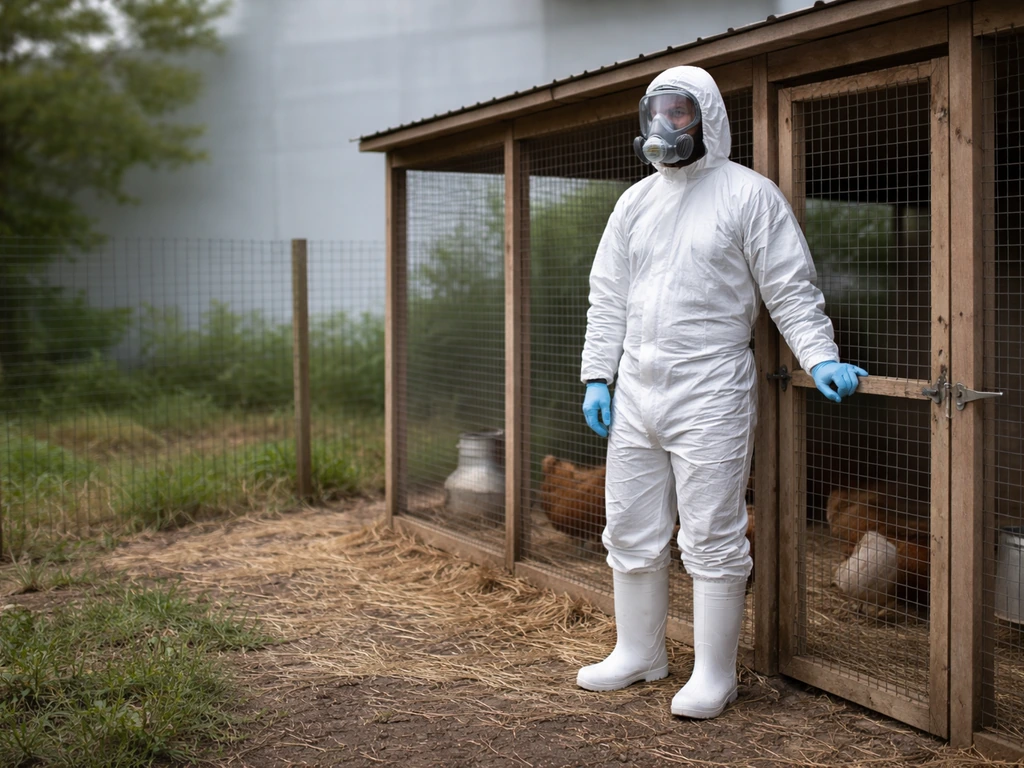
- Use appropriate personal protective equipment (PPE) when working with potentially infected animals: N95 respirators or better, goggles or face shields, gloves, and coveralls. Eye protection is particularly important given the conjunctivitis cases documented in dairy workers.
- Report any unusual mortality or illness patterns in poultry or cattle to your state veterinarian immediately. Early reporting triggers APHIS testing and indemnity programs.
- Follow APHIS requirements for lactating cattle movement, including the interstate movement testing guidance updated in January 2026.
- Participate in the National Milk Testing Strategy if operating a dairy in or near an affected region.
- Do not allow unauthorized visitors into poultry or livestock housing areas during active outbreaks.
What to do if you think you have been exposed
If you have had direct, unprotected contact with a sick or dead bird, infected livestock, or their environments and you develop any symptoms within 10 days, including fever, cough, shortness of breath, eye redness, or runny nose, contact a healthcare provider and mention the exposure. Do not simply assume it is seasonal flu and wait. The antiviral oseltamivir (Tamiflu) and similar neuraminidase inhibitors are effective against H5N1 and are most effective when started early in illness. CDC guidance supports antiviral treatment and chemoprophylaxis (preventive antiviral use) for exposed individuals under certain conditions, typically coordinated through state health departments.
Vaccines: what exists and what does not
There is no commercially available H5N1 vaccine for the general public as of August 2026. The U.S. government maintains stockpiles of candidate H5N1 vaccines developed against prior clades, and work on clade 2.3.4.4b-specific vaccines has been underway. The existing seasonal flu vaccines, which are widely available and recommended annually, do not provide cross-protection against H5N1. Several pharmaceutical companies have advanced H5N1 vaccine candidates through clinical trials, and both mRNA-based and traditional egg-based candidate vaccines are in development or stockpile assessment. If the risk level were to escalate significantly, the public health infrastructure for a targeted vaccination campaign exists in principle, but deployment at scale would take time. For now, the actionable vaccine-related step for most people is simply to get their annual seasonal flu shot, not because it protects against H5N1, but because it protects against the strains that are actually circulating in the community right now.
A note on media coverage: NBC, Fox, CBS, and science outlets
NBC's coverage of bird flu has generally been factual and agency-sourced, but like most broadcast and digital news, it operates under headline pressure that can make an ongoing, manageable public health situation read as a fresh emergency every time a new data point emerges. The mutation story from Louisiana, for example, was important and worth reporting, but without the context that mutation detection is routine in surveillance work and that the specific mutations noted had not been demonstrated to produce human-to-human transmission, a reader could easily overestimate the immediate danger. Comparing NBC's framing with that of other outlets, including Fox News and CBS News on the same events, can be instructive for calibrating what is new information versus what is repackaged concern. Science-focused outlets, covered separately in related content on this site, often provide better epidemiological context but reach a smaller audience. For deeper analysis, see our science news on bird flu.
It is also worth briefly addressing the fictional and satirical corners of bird flu discourse. Searches like 'Big Bird has bird flu' reflect the way social media and popular culture process public health anxiety through humor or fictional framing. And dramatized scenarios, like those in the 2006 TV film 'Fatal Contact: Bird Flu in America,' present a worst-case pandemic outcome that does not reflect the current epidemiological reality. Understanding where fiction ends and evidence begins matters, especially when anxious readers are trying to sort genuine risk from cultural noise.
Where to find reliable, up-to-date information
The most reliable sources for current H5N1 data are updated frequently and are publicly accessible. CDC's A(H5N1) Bird Flu Response Update page is the clearest central hub for U.S. human case counts, exposure categories, and guidance updates. USDA APHIS publishes poultry and livestock detection maps and situation updates, including the National Milk Testing Strategy results. The FDA's avian influenza in dairy cattle investigation page tracks milk safety findings and recall notices. At the global level, WOAH's situation reports (the most recent available being Situation Report 81 from May 2026) and the FAO/WHO/WOAH joint public health assessments provide the broadest synthesis of animal and human event data. When a news headline concerns you, tracing it back to one of these primary sources typically answers the most pressing questions within a few minutes. For a concise explainer, see Fatal contact: Bird flu in America, ending explained, which summarizes what ‘fatal contact’ means and how the outbreak trajectory could resolve Fatal contact: Bird flu in America — ending explained.
FAQ
What did recent NBC News coverage report about bird flu?
NBC-affiliated outlets reported several developments: CDC researchers identified mutations in some H5N1 samples from a severely ill patient; detections of HPAI H5N1 in domestic cats linked to recalls of some raw pet foods; and a seasonal rebound in bird‑flu detections tied to wild‑bird migration. Reporting repeated public‑health advice to avoid contact with sick/dead wild birds, handle raw animal products carefully, and follow state and federal guidance.
Is NBC’s reporting accurate and how should it be placed in context?
NBC’s stories reflect real surveillance findings and public‑health actions documented by CDC, USDA/APHIS and FDA. Those agencies report ongoing genetic monitoring, sporadic animal‑to‑human spillovers, and targeted recalls/testing. Context: authorities say overall risk to the general U.S. public remains low, but risk rises with close, prolonged, or unprotected exposure to infected animals or contaminated materials.
What is avian influenza (H5N1) and how is it different from seasonal flu?
Avian influenza A(H5) viruses primarily circulate in birds and are genetically distinct from human seasonal influenza strains. Seasonal flu transmits efficiently human‑to‑human; current H5N1 viruses have caused animal outbreaks and occasional animal‑to‑human infections but have not shown sustained human‑to‑human transmission. Clinical severity and detection patterns differ from seasonal flu.
How does H5N1 spread between animals and to people?
Primary transmission is bird‑to‑bird through direct contact, respiratory secretions, and contaminated environments. Spillover to mammals (including domestic animals) occurs via contact with infected birds, contaminated feed/water, or contaminated environments. Human infections to date are mostly linked to close, unprotected contact with infected animals or contaminated materials (including in some events raw milk or raw pet foods).
Can people catch H5N1 from eating poultry, eggs, or milk?
Properly handled and thoroughly cooked poultry and eggs and pasteurized dairy are not considered sources of H5N1 infection. Pasteurization inactivates the virus; regulatory testing of commercial pasteurized milk has supported its safety. Raw (unpasteurized) milk and raw animal‑sourced pet foods can pose a risk if sourced from infected animals and should be avoided during outbreaks.
What are typical symptoms of H5N1 in humans and how severe can it be?
Reported symptoms range from asymptomatic or mild respiratory illness to severe pneumonia and multi‑organ disease. Historically reported case‑fatality ratios among confirmed H5N1 cases have been high, but those numbers are biased because milder or undetected infections are often missed. Severity varies by virus clade, host factors, and exposure circumstances.