
Yes, bird flu (specifically Highly Pathogenic Avian Influenza, or HPAI H5) has been confirmed in Maryland. Interim Guidance on the Use of Antiviral Medications for Treatment of Human Infections with Novel Influenza A Viruses Associated with Severe Human Disease, CDC notes that CDC interim clinical guidance (updated pages) recommends prompt antiviral treatment (oseltamivir) for suspected/probable/confirmed human infection with novel influenza A viruses associated with severe disease, and provides recommendations for post‑exposure prophylaxis (PEP) and laboratory testing algorithms for persons with relevant animal exposures Interim Guidance on the Use of Antiviral Medications for Treatment of Human Infections with Novel Influenza A Viruses Associated with Severe Human Disease — CDC. The Maryland Department of Agriculture (MDA) has documented multiple confirmed or presumptive HPAI H5 detections in both wild birds and poultry flocks across several counties, including Queen Anne's, Caroline, Dorchester, Montgomery, Worcester, Anne Arundel, and Cecil. The situation is active and ongoing as of 2026, meaning flock owners, hunters, and anyone who handles birds in Maryland should be paying attention. For the general public, the CDC's current assessment is that the risk remains low, but that low risk is not zero, and certain groups face meaningfully higher exposure. This article walks you through how to check the current status yourself, what it means for your household or farm, and exactly what to do if you encounter sick or dead birds.
Is Bird Flu in Maryland: How to Check Current Status

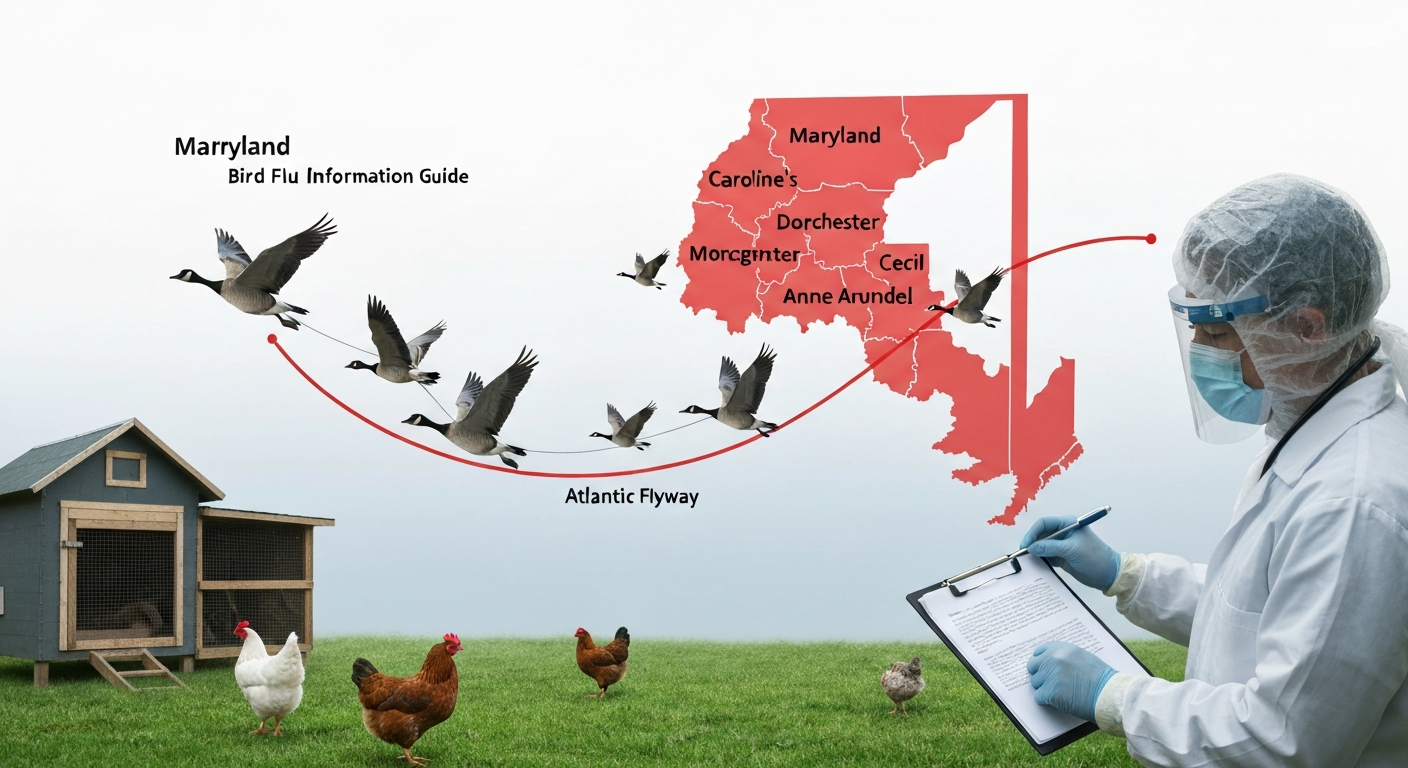
Is bird flu in Maryland right now?
The short reality is that HPAI H5 has established a recurring presence in Maryland, driven largely by the state's position along the Atlantic Flyway, one of North America's major wild-bird migration corridors. Wild waterfowl, particularly dabbling ducks and Canada geese, carry the virus asymptomatically and deposit it in waterways, fields, and wetlands that domestic birds and livestock share. Because this virus has been circulating in North America since 2021 and shows no sign of disappearing, Maryland residents should treat HPAI not as a one-time emergency but as an ongoing animal-health issue that requires steady vigilance, especially on farms and backyard flocks.
The outbreak picture also extends to Maryland's neighbors. Check current detections in Pennsylvania (search: is bird flu in PA) to assess nearby cases and how they affect Maryland's risk. See our Is bird flu in Virginia page for current detections and state-specific guidance. For information on detections and guidance in a neighboring state, see the resource on is bird flu in north carolina (UUID 5ab742cf-c6eb-4a64-8181-36f730029deb). Confirmed detections have been documented in Virginia, Pennsylvania, New Jersey, North Carolina, and Massachusetts, all of which share wild-bird populations and, in some cases, live-poultry trade networks with Maryland. Movement of birds, vehicles, and people across state lines means that a flare-up in any adjacent state is directly relevant to Maryland's risk level.
How to check Maryland's current outbreak status yourself
Official data is publicly available and updated frequently. Rather than relying on news headlines, you can go directly to the authoritative sources. Here is a step-by-step process for verifying the current situation in Maryland.
- Go to the USDA APHIS 'Confirmations of Highly Pathogenic Avian Influenza in Commercial and Backyard Flocks' page. Use the interactive dashboard to filter by state (select Maryland) and sort by date detected. The 'date detected' column reflects NVSL (National Veterinary Services Laboratories) confirmatory test dates, so these are official, confirmed cases, not preliminary or suspected ones. Check both the flock table and the wild-bird detection map separately, as they are listed on different APHIS pages.
- On the APHIS 'Detections of Highly Pathogenic Avian Influenza in Wild Birds' page (last updated July 31, 2026), use the interactive map filters to show detections in Maryland. Toggle between the 'all-time' and 'past 30 days' views to understand whether detections are recent or historical. Filter by species to see which bird types are currently carrying the virus in the state.
- Visit the Maryland Department of Agriculture's Avian Influenza page (mda.maryland.gov). MDA publishes county-level affected-flock listings, press releases for new detections, and biosecurity guidance. This is the most Maryland-specific resource available and is updated when new premises are affected.
- Check the Maryland Department of Health (MDH) avian influenza page for any public-health advisories, human exposure guidance, or raw-milk testing orders. MDH issued a joint mandatory testing order for regulated raw milk from Maryland dairy farms on December 31, 2024, reflecting state-level concern about HPAI in livestock.
- Visit the CDC's 'Current Situation: H5N1 Bird Flu in People' page for the national human-case count, updated risk assessment, and any new clinical or laboratory guidance. If the national risk level or human case count has changed significantly, CDC updates this page promptly.
- If you want a regional picture, the same APHIS dashboards let you filter by neighboring states. Comparing Maryland's data alongside Pennsylvania, Virginia, New Jersey, North Carolina, and Massachusetts gives you a sense of the regional pressure on Maryland's wild-bird and domestic-flock populations.
One important note on reading these dashboards: APHIS distinguishes between wild-bird detections, commercial and backyard flock confirmations, and livestock/mammal cases. These are separate categories with separate dashboards. A detection in a wild bird does not automatically mean a nearby poultry flock is infected, but it does raise the local risk level. Always cross-reference both categories when assessing your area.
Avian influenza basics: what it is and how it differs from seasonal flu
Avian influenza is caused by influenza A viruses that primarily circulate in birds. All influenza A viruses are classified by two surface proteins: hemagglutinin (H) and neuraminidase (N). The strain currently causing concern globally and in Maryland is HPAI A(H5N1), belonging to clade 2.3.4.4b, which emerged in North America in 2021 and has since spread across every continent except Australia. 'Highly Pathogenic' (HPAI) refers to the virus's ability to cause severe or fatal disease in poultry, and is defined by specific molecular markers (multiple basic amino acids at the HA cleavage site) or experimental mortality thresholds. A related category, Low Pathogenic Avian Influenza (LPAI), causes milder illness in birds and is handled differently from a regulatory standpoint.
Seasonal human flu (H1N1, H3N2) and avian flu are both influenza A viruses, but they differ in important ways. Seasonal flu is well-adapted to human-to-human transmission through respiratory droplets. HPAI H5N1 is primarily an animal virus, and while it can infect humans who have direct, sustained contact with infected animals or contaminated environments, it has not developed the ability to transmit efficiently between people. That distinction is the main reason the global public-health risk to the general population is currently assessed as low by the CDC, WHO, FAO, and WOAH in their joint May 2026 assessment.
| Feature | Seasonal Human Flu | HPAI H5N1 (Bird Flu) |
|---|---|---|
| Primary host | Humans | Wild and domestic birds; expanding to mammals |
| Human-to-human transmission | Efficient (airborne/droplet) | Not documented in sustained chains |
| Risk to general public | Moderate to high (seasonal epidemic) | Currently low (per CDC/WHO/FAO/WOAH) |
| Risk to exposed workers/farmers | Moderate | Low to moderate depending on mitigation |
| Available human vaccine | Yes (annual seasonal vaccine) | Candidate vaccines exist; not in routine use |
| Antiviral treatment | Oseltamivir (Tamiflu), others | Oseltamivir recommended; prompt use critical |
| Severity in birds | Varies; LPAI mild | HPAI causes high mortality in poultry |
What bird flu looks like in birds: wild, backyard, and commercial flocks
Wild waterfowl (ducks, geese, shorebirds) are the natural reservoir for HPAI H5 and often carry and shed the virus without showing symptoms. That makes them the silent transmission vector: a healthy-looking mallard can contaminate a pond, field, or feeder visited by your backyard chickens. In contrast, HPAI hits domestic poultry hard and fast. The virus can sweep through a commercial flock in days.
In backyard and commercial poultry, the signs documented by Maryland and federal guidance include the following:
- Sudden, unexplained death, often in multiple birds over a short period
- Severe and rapid drop in egg production, or misshapen and soft-shelled eggs
- Respiratory signs: nasal discharge, coughing, sneezing, labored breathing
- Lethargy, reduced appetite, and huddling behavior
- Diarrhea, often watery and green or white in color
- Neurological signs: incoordination, head tremors, circling, or inability to stand
- Swelling of the head, neck, or wattles
- Discoloration (cyanosis) of combs and wattles, turning purple or dark blue
The critical rule of thumb from MDA is this: if you experience an unexplained increase in bird deaths or see multiple birds with these symptoms at the same time, treat it as a potential HPAI event until proven otherwise. Time matters. Early reporting can contain an outbreak before it spreads to neighboring premises.
In raptors and scavengers (eagles, hawks, vultures, crows), HPAI can also cause neurological signs and death. These birds become infected by consuming infected carcasses, which is why dead eagles or hawks near wetlands or poultry areas in Maryland have prompted testing events in recent years.
Human symptoms and who is realistically at higher risk
Human infection with HPAI H5N1 is uncommon but serious when it does occur. The CDC's current human-case tracking shows a small number of U.S. cases, most linked to direct animal contact. The good news is that casual contact with wild birds or consumption of properly cooked poultry and pasteurized dairy does not place you at meaningful risk. The higher-risk population is specific and identifiable.
People at elevated risk include poultry farm workers, veterinarians and veterinary technicians, wildlife biologists and rehabilitators, hunters who handle harvested waterfowl, dairy farm workers, and anyone involved in responding to or depopulating an infected flock. These individuals have close, prolonged, or unprotected contact with birds or contaminated environments, which is the exposure pathway that drives human cases.
In humans, HPAI H5N1 symptoms can range from mild to severe. They typically appear within 2 to 5 days of exposure and may include:
- Fever (often high, above 38°C / 100.4°F)
- Cough, sore throat, and shortness of breath
- Muscle aches, headache, and fatigue
- Eye redness (conjunctivitis), which has been a feature in some recent U.S. cases
- Diarrhea, nausea, and vomiting in some cases
- In severe cases: pneumonia, acute respiratory distress, and multi-organ failure
If you have had direct contact with sick or dead birds in the past 10 days and develop any of these symptoms, do not go to an emergency room or clinic without calling ahead. Contact the Maryland Department of Health or your healthcare provider first and tell them about the animal exposure. This allows the facility to prepare appropriate infection-control measures and expedite influenza A subtyping, which is how novel avian strains get identified.
How bird flu spreads: transmission routes and practical risk
Understanding how HPAI H5 actually moves from birds to other birds, and occasionally to humans, helps you calibrate your personal risk accurately. The virus spreads through several overlapping routes.
Wild birds to domestic flocks
Wild waterfowl shed HPAI H5 virus in their feces, saliva, and nasal secretions. Domestic birds become exposed through direct contact with wild birds, or indirectly through shared water sources, contaminated soil, and feed that wild birds have accessed. In Maryland, the Chesapeake Bay watershed and Eastern Shore wetlands create extensive habitat overlap between migrating waterfowl and backyard or commercial poultry. This is the dominant transmission pathway for flock infections.
Fomites: equipment, vehicles, and people
Fomites are inanimate objects that carry infectious material. Boots, clothing, equipment, feed bags, egg trays, and vehicles can all carry HPAI virus particles from an infected premises to a clean one. Farm-to-farm spread via fomites is well-documented in HPAI outbreaks and is the reason biosecurity protocols focus heavily on cleaning and disinfection at farm entry points, not just bird contact.
From animals to humans
Human infection requires close contact with infected animals or heavily contaminated environments, typically involving direct handling of sick or dead birds without adequate personal protective equipment (PPE), exposure to concentrated respiratory secretions or feces in enclosed spaces, or ingestion of raw, unpasteurized animal products from infected animals. The mandatory raw-milk testing order issued by Maryland in December 2024 reflects real concern about this last pathway: HPAI H5 has been detected in dairy cattle, and raw milk from infected cows can carry live virus.
Human-to-human transmission
This is the critical boundary that determines whether HPAI becomes a pandemic threat. As of the May 2026 WHO/FAO/WOAH joint assessment, there is no evidence of sustained human-to-human transmission of currently circulating HPAI H5 viruses. Individual cases linked to animal contact do not appear to have generated secondary human cases. That status can change, which is why surveillance is ongoing, but it is the central reason the global risk assessment remains low for the general public.
Food safety: what is and is not safe to eat and drink
Properly cooked poultry and eggs are safe to eat. Cooking poultry to an internal temperature of 165°F (74°C) inactivates HPAI H5 virus. Hard-cooked eggs are similarly safe. CDC, USDA, and the European Food Safety Authority all concur on this point. Normal grocery-store poultry and eggs come from regulated commercial facilities with active HPAI surveillance, and a flock with confirmed HPAI is depopulated and removed from the food supply, not processed for consumption.
Pasteurized milk is safe. Pasteurization effectively inactivates HPAI H5 virus, and commercial milk sold in Maryland has been pasteurized. Raw (unpasteurized) milk is a genuine concern. Maryland issued a mandatory testing order for regulated raw milk from dairy farms on December 31, 2024, precisely because HPAI has been detected in dairy cattle herds and raw milk from infected cows can harbor live virus. If you consume raw milk or raw-milk products, check that the producer has current negative test results, or consider switching to pasteurized alternatives during periods of active dairy-cattle HPAI circulation.
Vaccine options and clinical guidance
There is currently no commercially available HPAI H5N1 vaccine for routine use in the general public in the United States. Several candidate vaccines have been developed and stockpiled by the federal government as part of pandemic preparedness planning, and research into mRNA-based H5 vaccines is advancing. If the human risk profile were to change, the U.S. has the infrastructure to begin a targeted vaccination campaign, but that step has not been taken as of August 2026.
For treatment, the CDC's interim clinical guidance is clear: oseltamivir (Tamiflu) should be started as promptly as possible for any suspected, probable, or confirmed human infection with novel influenza A viruses associated with severe disease. Do not wait for laboratory confirmation before beginning treatment. Oseltamivir is also recommended for post-exposure prophylaxis (PEP) for people with significant unprotected exposure to infected animals, a decision made in consultation with public-health authorities.
For clinicians: CDC and Maryland health authorities urge expedited influenza A subtyping for hospitalized patients who test positive for influenza A but cannot be subtyped using standard diagnostic panels. Unsubtypeable influenza A in a patient with relevant animal exposure should be reported immediately to the state health department and CDC. This is how novel avian strains get detected early, and early detection is the foundation of effective outbreak response.
Biosecurity steps for Maryland poultry owners and farmers
If you own backyard chickens, ducks, or other poultry in Maryland, or operate a commercial operation, these are the concrete actions that reduce your flock's exposure risk. MDA and USDA APHIS biosecurity guidance converges on the following:
- Register your flock with the Maryland Department of Agriculture. Registration allows MDA to contact you quickly during a regional outbreak and is required for commercial operations. Backyard flock owners are strongly encouraged to register as well.
- Keep wild birds out of your poultry area. Use covered runs, enclosed housing, and bird-proof feed storage. Prevent access to open water sources that wild waterfowl use.
- Establish a footbath with an approved disinfectant at the entrance to your poultry area. Change the solution regularly and require all visitors and workers to use it.
- Use dedicated footwear and clothing for the poultry area. Do not wear farm boots into your home or other non-farm areas.
- Restrict access to your flock. Limit visitors, and ask anyone who has been on another poultry farm within 48 hours to change clothes and footwear before entering.
- Clean and disinfect equipment, crates, and vehicles that enter the premises. Pay particular attention to wheel wells and undersides of vehicles.
- Monitor your flock daily. Know your birds' normal behavior, appetite, and egg production so you can detect changes quickly.
- Do not share equipment between premises without thorough disinfection.
- Properly contain and dispose of dead birds and manure to prevent attracting scavengers.
What to do if you find sick or dead birds in Maryland
Finding a dead bird, or several dead birds, in Maryland is not automatically an HPAI emergency. Single bird deaths from window strikes, predators, or other causes are common. The trigger for concern is pattern: multiple dead birds of the same or different species in the same location, dead wild waterfowl or raptors near wetlands, or any unexplained deaths in your poultry flock. Here is the decision process and who to call.
If you find dead or sick wild birds
- Do not handle the birds with bare hands. If you must move a carcass, use gloves and a plastic bag inverted over your hand. Avoid touching your face.
- Note the location, species if identifiable, and approximate number of birds.
- Report to the Maryland Department of Natural Resources (DNR) Wildlife Hotline or your local DNR regional office. DNR coordinates wild-bird sampling and testing in Maryland.
- If you have already handled the birds without protection, wash hands thoroughly with soap and water, monitor yourself for flu-like symptoms over the next 10 days, and contact the Maryland Department of Health if symptoms develop.
- Do not submit dead wild birds to a veterinarian unless directed by DNR or MDA. Proper sample handling and chain of custody matter for HPAI testing.
If you find sick or dead birds in your backyard flock or farm
- Isolate the affected birds immediately. Separate sick birds from healthy ones and restrict access to the area where dead birds were found.
- Do not move birds, eggs, equipment, or people off the premises until you have consulted with MDA. Movement restrictions are critical to preventing spread.
- Call the Maryland Department of Agriculture Emergency Hotline at 410-841-5810. MDA has veterinarians on call for exactly this scenario.
- You can also contact your accredited veterinarian to collect and submit samples for testing. MDA will coordinate with USDA APHIS and NVSL for confirmatory testing.
- While awaiting guidance, implement maximum biosecurity: no visitors, dedicated PPE for anyone entering the flock area, no removal of manure, litter, or equipment.
- If MDA confirms HPAI on your premises, a quarantine will be placed on the farm. Depopulation (euthanasia) of the affected flock is the standard federal and state response, and USDA indemnity programs exist to compensate producers for eligible losses.
- Dispose of carcasses only under MDA direction. Approved methods include on-site composting, burial, or incineration depending on scale and local regulations. Do not dump carcasses in waterways or fields, as this spreads the virus.
Decision points: when to isolate, report, and seek human health guidance
| Situation | Immediate action | Who to contact |
|---|---|---|
| Single dead wild bird, no unusual circumstances | Do not handle; leave in place or bag and dispose normally | No report needed unless raptor or waterfowl cluster |
| Multiple dead wild birds (3 or more), especially waterfowl or raptors | Do not handle without gloves; document location and species | Maryland DNR Wildlife Hotline |
| Unexplained deaths in backyard flock (2+ birds in 24–48 hours) | Isolate flock, restrict movement on and off premises | Maryland Department of Agriculture: 410-841-5810 |
| Commercial flock showing HPAI clinical signs or mass mortality | Immediate lockdown of premises, contact MDA and your vet | Maryland Dept. of Agriculture + accredited vet |
| Person handled sick/dead birds without PPE | Wash hands, monitor for symptoms 10 days | Maryland Dept. of Health if symptoms develop |
| Person develops fever or respiratory symptoms after bird exposure | Call ahead before visiting clinic or ER | MDH / healthcare provider (mention animal exposure) |
| Raw milk consumer in area with dairy-cattle HPAI activity | Confirm current negative test results from producer | MDH consumer advisory line or your healthcare provider |
Maryland in regional context: why neighboring states matter
Maryland sits at a geographic crossroads that amplifies its HPAI exposure. The Atlantic Flyway funnels tens of millions of migratory birds through the state each spring and fall, many of them stopping in the Chesapeake Bay wetlands and Eastern Shore agricultural areas where poultry density is among the highest on the East Coast. Wild birds do not respect state lines, and confirmed detections in Virginia to the south, Pennsylvania to the north, and New Jersey and Delaware to the northeast all represent ongoing pressure on Maryland's bird populations.
From a trade and movement perspective, live-poultry transport between Maryland, Pennsylvania, Virginia, and other regional states is regulated and surveilled, but the interconnected nature of the supply chain means that a producer in any of these states managing an HPAI event could have had recent contacts with Maryland operations. The same applies to poultry equipment, vehicles, and personnel. Monitoring the APHIS dashboards for the full mid-Atlantic region, not just Maryland in isolation, gives you a far more accurate picture of the risk environment your flock or business operates in.
Key contacts and resources for Maryland
- Maryland Department of Agriculture (MDA) Emergency Hotline: 410-841-5810 (poultry and livestock disease reporting)
- MDA Avian Influenza page: mda.maryland.gov (county-level flock listings, press releases, biosecurity guidance)
- Maryland Department of Health (MDH) Avian Influenza page: health.maryland.gov (human exposure guidance, raw milk testing orders, public advisories)
- Maryland Department of Natural Resources (DNR) Wildlife Hotline: for wild-bird death reporting
- USDA APHIS HPAI dashboard: aphis.usda.gov (confirmed commercial/backyard flock cases, wild-bird detections, livestock cases — filter by Maryland and date)
- CDC H5N1 Bird Flu Current Situation page: cdc.gov (human case counts, risk assessment, clinical guidance)
- CDC Antiviral Guidance page: interim guidance on oseltamivir treatment and post-exposure prophylaxis for novel influenza A
FAQ
Is bird flu currently present in Maryland? Where can I verify up‑to‑date detections?
Check real‑time, authoritative dashboards and Maryland agency pages: (1) Maryland Department of Agriculture (MDA) Avian Influenza page for county‑level affected flock listings and state press releases: https://mda.maryland.gov/Pages/AvianFlu.aspx; (2) USDA APHIS HPAI dashboards (filter by state, host, and date) for confirmed commercial/backyard flock and wild‑bird detections: https://www.aphis.usda.gov/livestock-poultry-disease/avian/avian-influenza/hpai-detections/commercial-backyard-flocks and https://www.aphis.usda.gov/livestock-poultry-disease/avian/avian-influenza/hpai-detections/wild-birds; (3) Maryland Department of Health (MDH) HPAI and milk testing notices: https://health.maryland.gov/phpa/OEHFP/OFPCHS/Milk/Pages/Avian-Influenza.aspx. APHIS notes that dashboard “date detected” is the NVSL confirmatory test date — use filters to avoid double counting.
How do I interpret the official data (what counts as a confirmed case)?
USDA APHIS and the National Veterinary Services Laboratories (NVSL) perform confirmatory testing. APHIS dashboards indicate NVSL‑confirmed detections; state press releases may report presumptive findings earlier. WOAH/USDA diagnostic standards define HPAI based on pathotype or molecular features (e.g., HA cleavage site). For clarity use APHIS NVSL‑confirmed entries and the MDA/MDH updates for Maryland‑specific actions. APHIS dashboard links: https://www.aphis.usda.gov/; WOAH avian influenza page: https://www.woah.org/en/disease/avian-influenza/.
What is avian influenza (bird flu) and how is it different from seasonal human influenza?
Avian influenza (AI) refers to influenza A viruses that primarily infect birds. Highly pathogenic avian influenza (HPAI) strains can cause severe disease and high mortality in poultry. Seasonal human influenza viruses are adapted to humans and typically spread person‑to‑person. Some avian influenza A(H5) strains are zoonotic (can infect people) but, to date, circulating HPAI A(H5) viruses have not shown sustained human‑to‑human transmission. For public‑health context see CDC: https://www.cdc.gov/bird-flu/situation-summary/inhumans.html and WHO/FAO/WOAH joint assessments: https://www.who.int/publications/m/item/updated-joint-fao-who-woah-public-health-assessment-of-recent-high-pathogenicity-avian-influenza-a%28h5%29-virus-events-in-animals-and-people.
What signs should I look for in wild birds and in my poultry flock?
Typical HPAI signs in birds include sudden death, severe drops in egg production or misshapen eggs, respiratory signs (nasal discharge, coughing, sneezing), reduced appetite/lethargy, diarrhea, and neurological signs (incoordination). Wild birds may be found dead or exhibiting weakness. Report sudden increases in unexplained bird deaths. Maryland guidance: https://health.maryland.gov/phpa/OIDEOR/CZVBD/Shared%20Documents/2404_PHA_HPAI-FAQ.pdf and MDA: https://mda.maryland.gov/Pages/AvianFlu.aspx.
What symptoms should humans watch for after exposure to birds or poultry?
People with close, prolonged, or unprotected exposure to infected birds may develop influenza‑like illness: fever, cough, sore throat, muscle aches, shortness of breath; severe disease can occur. If you develop respiratory symptoms after direct contact with sick/dead birds, contact your healthcare provider and mention the exposure. CDC human‑case guidance: https://www.cdc.gov/bird-flu/situation-summary/inhumans.html and clinical testing/treatment guidance: https://www.cdc.gov/bird-flu/hcp/clinicians-evaluating-patients/interim-guidance-treatment-humans.html.
How is bird flu transmitted to domestic poultry, other animals, and people?
Primary reservoirs are wild waterfowl. Transmission to poultry is via direct contact with infected wild birds or indirectly through contaminated feces, water, equipment, clothing, vehicles, and aerosols in enclosed houses. Mammals and rarely humans can be infected through close contact with infected animals or contaminated environments. Person‑to‑person sustained transmission has not been observed for currently circulating H5 strains. See CDC and peer‑reviewed summaries: https://www.cdc.gov/bird-flu/ and https://wwwnc.cdc.gov/eid/article/22/7/15-2032_article.