Bird flu and regular seasonal flu are both caused by influenza A viruses, but that shared family tree is roughly where the similarity ends. Seasonal flu spreads easily from person to person, causes mostly upper respiratory illness, and kills tens of thousands of Americans each year largely through sheer volume of infections. Bird flu, by contrast, rarely infects humans at all, but when it does it tends to hit hard, driving pneumonia, respiratory failure, and case-fatality proportions that dwarf those of any seasonal strain. The core difference comes down to three things: which receptors the virus targets in your body, how efficiently it moves between people, and whether your immune system has any prior familiarity with it. For a focused explanation of the difference between bird flu and influenza A, read the dedicated overview.
How Is Bird Flu Different From Regular Flu, Quick Guide

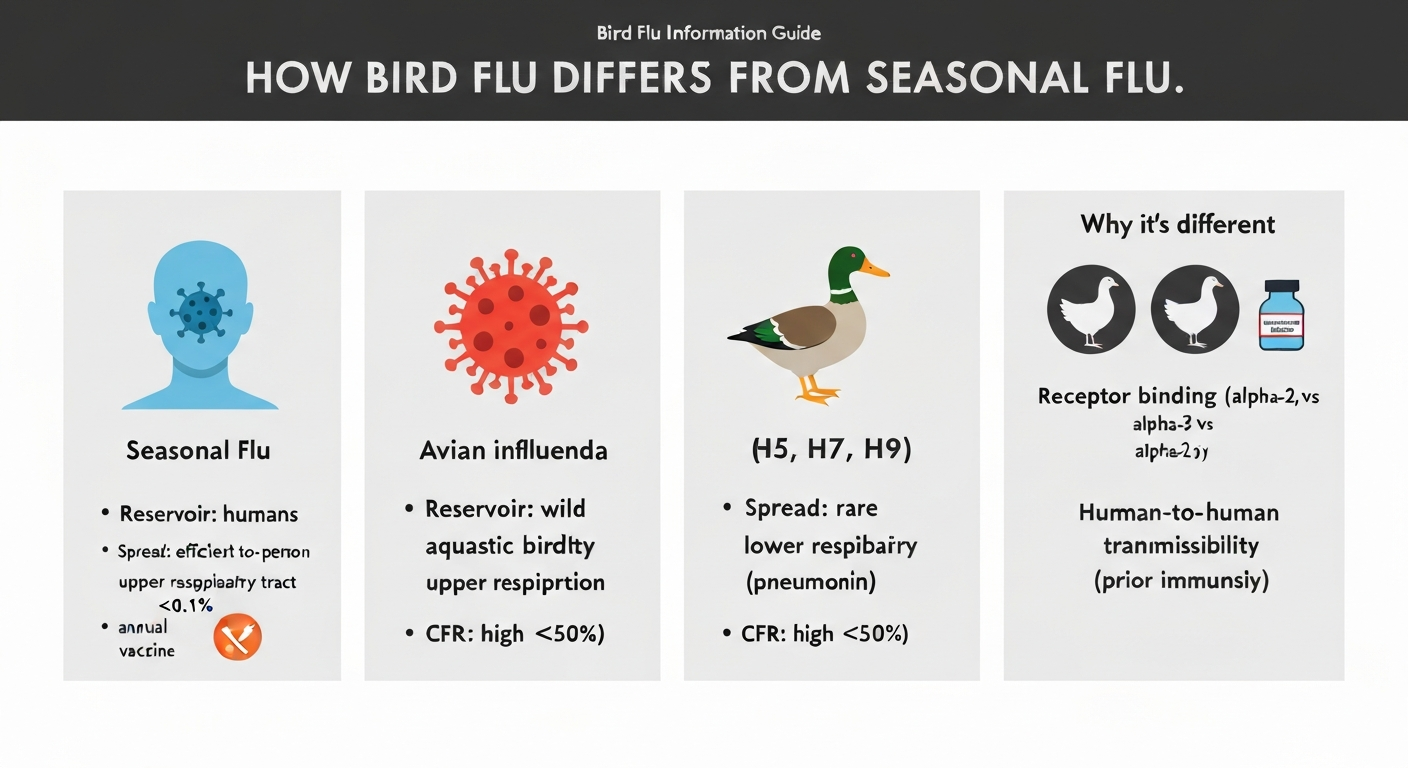
Quick summary: how bird flu differs from seasonal flu
| Feature | Seasonal Flu | Bird Flu (Avian Influenza) |
|---|---|---|
| Virus types involved | Influenza A and B | Influenza A only (zoonotic subtypes) |
| Primary reservoir | Humans | Wild aquatic birds; domestic poultry |
| Common subtypes in humans | H1N1, H3N2 (A); B/Victoria, B/Yamagata (B) | H5N1, H7N9, H9N2 and related subtypes |
| Human-to-human spread | Efficient; R0 ~1.2–1.3 | Rare and not sustained; R0 <1 in humans |
| Typical illness site | Upper respiratory tract | Lower respiratory tract (pneumonia, ARDS) |
| Aggregate case-fatality proportion | <0.1% (estimated) | ~50% for H5N1; ~39% for H7N9 (confirmed cases) |
| Seasonal vaccine available | Yes, updated annually | Limited; experimental/stockpile vaccines only |
| Antiviral treatment | Oseltamivir, baloxavir | Same antivirals; prompt use is critical |
| Food-safety risk | None from poultry | Eliminated by cooking to 165°F (74°C) |
What is bird flu and why is it a zoonosis?
Avian influenza, or bird flu, is an infection caused by influenza A viruses that naturally circulate in wild birds, most notably dabbling ducks, geese, swans, and shorebirds. These wild waterfowl are the long-term natural reservoir, meaning the virus has co-evolved with them over millennia and typically causes them little harm. The trouble starts when those viruses jump into domestic poultry, where they can become highly pathogenic, and occasionally into people who have close contact with infected birds. For a clear answer to what type of flu bird flu is, see the section on influenza virus types explaining that bird flu is caused by influenza A viruses and their H/N subtypes what type of flu is bird flu.
The term 'zoonosis' simply means an infection that moves from animals to humans. Bird flu qualifies because almost every confirmed human case traces back to direct or indirect contact with infected birds or contaminated environments, not from catching it from another person. That distinction is crucial for understanding both the risk and the way it is managed. Unlike measles or COVID-19, bird flu currently cannot run through a crowd on its own. For a clear comparison of COVID-19 and avian influenza, see is covid-19 bird flu. It requires an animal source.
One reason influenza A is so good at crossing species is its segmented genome. The virus carries eight separate RNA segments rather than one continuous strand. When a bird and a human influenza A virus infect the same cell simultaneously, those segments can mix and reassort, potentially producing a hybrid virus with new properties. This process, called antigenic shift, is the mechanism behind every influenza pandemic in recorded history. It is also why virologists watch avian strains so closely.
Influenza virus types: A, B, and C explained
There are four influenza virus types, designated A, B, C, and D. For human health, types A and B do most of the damage. Both circulate every winter and together account for seasonal flu epidemics. Type C causes only mild respiratory illness and is rarely tracked by public health systems. Type D primarily infects cattle and has not been shown to cause illness in people.
Influenza A is the one that keeps pandemic planners up at night, and for good reason. It is the only type with a truly broad host range: it infects humans, birds, pigs, horses, seals, and more. It is the only type known to have caused pandemics (1918, 1957, 1968, and 2009 all involved influenza A). And it is the only type that carries the HA/NA subtype diversity described below. Influenza B infects mainly humans and has genetic lineages rather than subtypes. It causes real illness every year, but it lacks the animal-reservoir breadth that makes influenza A a pandemic threat.
H and N subtypes: what H5, H7, and H9 actually mean
Every influenza A virus is classified by two surface proteins: hemagglutinin (HA) and neuraminidase (NA). Hemagglutinin is the protein the virus uses to latch onto and enter host cells. Neuraminidase is the enzyme that helps newly made virus particles escape from an infected cell to infect the next one. So far, scientists have identified 18 distinct HA subtypes (H1 through H18) and 11 NA subtypes (N1 through N11). Any combination is theoretically possible, giving the A type enormous diversity.
When you see 'H5N1,' that tells you the virus carries hemagglutinin subtype 5 and neuraminidase subtype 1. The subtypes that have most commonly infected humans are H5 (mainly H5N1 and H5N6), H7 (especially H7N9), and H9 (H9N2). H5N1 has drawn the most concern globally because of its wide geographic spread in birds and its roughly 50 percent case-fatality proportion among laboratory-confirmed human cases documented by WHO between 2003 and March 2026. H7N9 caused around 1,500 to 1,600 confirmed human cases in China between 2013 and 2017 with a reported aggregate case-fatality proportion near 39 percent. H9N2 infections in people tend to be milder, with a very low reported fatality rate, though H9N2 is widespread in poultry and acts as a genetic donor to more dangerous strains.
It is worth untangling the vocabulary here because 'subtype,' 'strain,' and 'clade' get used interchangeably in news coverage but mean different things. A subtype is the blank" rel="noopener noreferrer">HA/NA antigen combination (H5N1). A strain is a specific virus isolate, usually named in the format A/host/location/number/year(H#N#). A clade groups viruses that share closely related HA gene sequences, which matters for tracking evolutionary lineages and vaccine matching. When people ask how many strains of bird flu exist, the honest answer is: dozens of officially classified subtypes, and within each subtype, a large number of distinct strains evolving continuously. For a plain-language guide to common avian subtypes and strains, see what strain is bird flu.
How bird flu reaches humans
The most common route is direct contact with infected birds or their secretions. Outbreak investigations of both H5N1 and H7N9 consistently implicate live-bird markets, backyard flocks, and poultry farms as the primary exposure settings. Transmission evidence: human infections with avian influenza are most often associated with direct or indirect exposure to infected poultry or contaminated live‑bird‑market environments; environmental sampling and outbreak investigations (H7N9/H5 events) implicate live‑bird markets and contaminated aerosols/surfaces as exposure sources Environmental sampling and outbreak investigations (H7N9/H5 events) implicate live‑bird markets and contaminated aerosols/surfaces as exposure sources.. People become infected by touching sick or dead birds, handling contaminated cages and surfaces, or breathing in aerosols in heavily contaminated environments. Environmental sampling from live-bird markets has confirmed virus on surfaces, in water troughs, and in airborne particles near infected animals.
The biology behind this limited human exposure is worth understanding. Avian-adapted HA proteins preferentially bind to a type of receptor called alpha-2,3-linked sialic acid. These receptors are common in bird intestinal and respiratory tracts and also exist in the human lower respiratory tract (deep in the lungs). Human-adapted HAs, like those on seasonal flu viruses, preferentially bind alpha-2,6-linked sialic acids, which are abundant in the human upper airway (nose, throat, upper bronchial passages). This receptor mismatch is the single biggest reason most avian viruses cannot infect humans efficiently through casual contact and, when they do infect, tend to go straight to the lungs rather than causing the runny-nose-and-scratchy-throat presentation we associate with ordinary flu.
Indirect exposure also matters. Contaminated water, soil, or equipment on farms can carry the virus. People who butcher or process infected birds without protective equipment are at elevated risk. Eating properly cooked poultry or eggs, however, has never been documented as a route of human infection. The virus is heat-sensitive and is inactivated when poultry reaches an internal temperature of 165°F (74°C).
Food safety and handling guidance
- Cook all poultry to an internal temperature of at least 165°F (74°C) throughout.
- Cook eggs until both the white and yolk are firm; avoid runny or raw eggs from flocks in affected areas.
- Wash hands with soap and water for at least 20 seconds after handling raw poultry or eggs.
- Use separate cutting boards for poultry and other foods; sanitize surfaces after use.
- Do not handle dead or sick wild birds with bare hands; use gloves or a plastic bag as a barrier.
- During declared outbreaks in your area, follow guidance from local agricultural or public health authorities about sourcing eggs and poultry.
Human-to-human spread and the pandemic question
This is where bird flu is most meaningfully different from both seasonal flu and COVID-19. Seasonal influenza spreads so easily because it has evolved to replicate in the human upper airway, where sneezing and coughing launch large quantities of virus into the air at close range. Systematic reviews estimate the basic reproduction number (R0, the average number of people one infected person infects in a fully susceptible population) for seasonal flu at around 1.2 to 1.3. For early SARS-CoV-2, that figure was roughly 2 to 3. For avian influenza viruses circulating in humans, the R0 is currently below 1, meaning these viruses are not self-sustaining in human populations.
That does not mean human-to-human transmission has never happened. Investigations of H5N1 family clusters found evidence of limited household transmission, with secondary attack rates in one analyzed cluster estimated at roughly 29 percent among close household contacts. But crucially, those chains of transmission stopped at one or two steps and never seeded wider community spread. No avian influenza strain has yet acquired all the mutations needed for efficient, sustained human-to-human transmission, though that possibility is exactly what pandemic preparedness planning is built around.
The pandemic risk is real but not imminent in any specific sense. Virologists watch for several key changes: mutations in the receptor-binding site of HA that improve alpha-2,6 sialic acid binding, changes that improve replication in the upper airway, and reassortment events that could combine avian surface proteins with a human-adapted viral backbone. None of the currently dominant strains in birds have acquired all of these features simultaneously, which is why global health agencies classify the current public health risk to the general population as low to moderate depending on the subtype.
How bird flu looks in birds versus people
Disease in poultry and wild birds
Influenza A viruses in birds are classified as either low-pathogenic avian influenza (LPAI) or highly pathogenic avian influenza (HPAI), based on how severely they sicken chickens in a laboratory test. Wild waterfowl are the natural reservoir and often carry LPAI viruses without showing obvious illness. But when HPAI strains like H5N1 reach domestic poultry, the results can be catastrophic. Infected chickens and turkeys may show sudden death with little prior warning, severe respiratory distress, neurological signs, swollen heads, cyanosis (blue discoloration) of the comb and wattles, and sharp drops in egg production. Mortality in affected flocks can approach 100 percent within days.
Disease progression in humans
Human infections with H5N1 and H7N9 typically begin with fever, cough, and myalgia (muscle aches) that initially look like ordinary flu. The difference emerges within a few days: patients often develop severe pneumonia with rapid oxygen desaturation, requiring hospitalization and frequently intensive care. Acute respiratory distress syndrome (ARDS), septic shock, and multi-organ failure are well-documented complications. The median time from symptom onset to hospitalization in H7N9 cases was roughly 5 to 6 days in studies from China; many patients required mechanical ventilation.
By contrast, seasonal flu in otherwise healthy adults causes predominantly upper respiratory illness: sore throat, nasal congestion, cough, fever, and fatigue. Serious complications (pneumonia, hospitalization, death) do occur, especially in elderly adults, young children, pregnant women, and people with underlying health conditions, but they represent a small fraction of overall infections. The CDC estimates the 2024-25 flu season caused millions of illnesses, hundreds of thousands of hospitalizations, and tens of thousands of deaths in the United States. Those totals are significant, but the per-infection risk of death remains well below one percent.
When to seek medical attention
- Seek care promptly if you develop fever, cough, or breathing difficulty within 10 days of contact with sick or dead poultry, wild birds, or live-bird markets.
- Tell your healthcare provider about any bird or animal exposure so they can consider avian influenza testing.
- Do not wait to see if symptoms improve on their own — early antiviral treatment (ideally within 48 hours of symptom onset) is associated with better outcomes.
- If you work on a poultry farm with a confirmed HPAI outbreak, contact your occupational health service or local public health authority for guidance on monitoring and prophylaxis.
Severity and mortality: bird flu, seasonal flu, and COVID-19 compared
Comparing these three is complicated by the fact that bird flu case counts are tiny compared to seasonal flu and COVID-19, and surveillance is imperfect (mild or asymptomatic bird flu cases likely go undetected, which means the true case-fatality proportion may be lower than the laboratory-confirmed figures). With that caveat, the differences in documented severity are stark.
| Virus | Global cases (approximate) | Case-fatality proportion (reported) | Efficient human spread? | Vaccine available? |
|---|---|---|---|---|
| Seasonal influenza A/B | Hundreds of millions annually | <0.1% estimated | Yes (R0 ~1.2–1.3) | Yes, annual update |
| SARS-CoV-2 (COVID-19) | Hundreds of millions (pandemic) | ~1–3% early pandemic; lower with variants/vaccination | Yes (R0 ~2–3 original strain) | Yes, updated versions available |
| Avian H5N1 | ~1,000 confirmed since 2003 | ~50% among confirmed cases | No (R0 <1) | Stockpile/experimental only |
| Avian H7N9 | ~1,500–1,600 (China 2013–2017) | ~39% aggregate; ~48% among hospitalized | No (R0 <1) | Stockpile/experimental only |
| Avian H9N2 | Low hundreds globally | ~1% or lower | No (R0 <1) | Not available |
The key takeaway from that comparison is that the high case-fatality proportions of H5N1 and H7N9 reflect genuine biological severity, not just statistical artifact. These viruses cause severe lower respiratory disease in a high proportion of people they infect. What prevents them from being a current large-scale public health emergency is precisely their inability to spread efficiently between people. If that barrier were ever overcome through mutation or reassortment, the calculus would change dramatically, which is why surveillance and rapid response matter so much.
Diagnosis, antivirals, and vaccine options
Diagnosing avian influenza in a person requires laboratory testing, most commonly RT-PCR (reverse transcription polymerase chain reaction) on a respiratory sample. Standard rapid flu tests used in clinics can detect influenza A but cannot distinguish between seasonal strains and avian strains. A positive rapid test in someone with poultry exposure needs follow-up confirmatory testing at a public health laboratory.
Treatment relies on the same neuraminidase inhibitors used for seasonal flu, primarily oseltamivir (Tamiflu) and, in some settings, zanamivir. The polymerase inhibitor baloxavir also has activity against influenza A. For seasonal flu, these antivirals are most effective when started within 48 hours of symptom onset, and the same principle applies to avian influenza, where early treatment has been associated with better clinical outcomes. Because avian influenza can be severe, clinicians treating suspected cases typically start antivirals empirically rather than waiting for confirmatory results.
Seasonal flu vaccines do not protect against avian influenza subtypes because the HA proteins are too antigenically different. However, governments and international health agencies have developed and stockpiled candidate vaccines against H5N1 and some H7 subtypes for use in a pandemic scenario. These are not available to the general public as routine vaccines. Some countries have offered targeted vaccination of poultry workers during active outbreaks, but coverage remains limited globally. The standard annual flu shot you get every fall is designed around the H1, H3, and B strains expected in circulation that season and has no meaningful cross-protection against H5 or H7.
Farm biosecurity and prevention for poultry keepers
If you keep poultry, whether a backyard flock of a dozen chickens or a commercial operation with tens of thousands of birds, biosecurity is your frontline defense. HPAI outbreaks have resulted in the culling of hundreds of millions of birds globally, with devastating economic consequences for farmers. Most farm introductions trace back to contact with wild birds or contaminated equipment, vehicles, and people moving between premises.
- Prevent contact between your flock and wild birds: use covered runs, netting, and housing that blocks waterfowl access to feed, water, and bedding.
- Implement a strict biosecurity perimeter: designate clean and dirty zones, require foot baths and clothing changes before entering poultry housing.
- Control vehicle and visitor access: clean and disinfect any vehicle entering the farm; limit non-essential visitors during outbreak periods.
- Source birds and equipment from reputable, disease-free suppliers; quarantine new birds for at least two weeks before introducing them to your flock.
- Report unusual illness or sudden unexplained deaths in your flock immediately to your veterinarian and state animal health official. Early reporting allows rapid testing and containment.
- Workers showing flu-like symptoms after handling sick birds should seek medical attention and report the occupational exposure to their healthcare provider.
- Keep records of flock health, mortality rates, egg production, and feed/water consumption; baseline data helps identify deviations early.
Current outbreak monitoring and risk assessment
As of mid-2026, HPAI H5N1 clade 2.3.4.4b continues to circulate widely in wild birds and domestic poultry across multiple continents. Sporadic human infections are reported, primarily in agricultural workers with direct poultry exposure. WHO, CDC, ECDC, and national veterinary agencies publish updated situation reports, and the risk to the general public without bird contact remains classified as low. The risk to people with occupational or recreational exposure to poultry and wild birds is higher, but still considered low to moderate rather than high, precisely because sustained human-to-human transmission has not emerged.
Monitoring systems include mandatory reporting of HPAI in poultry through national veterinary channels, human case reporting to WHO through International Health Regulations, and participatory wildlife surveillance programs. If you want to track current case counts, the WHO Global Influenza Programme and the USDA APHIS poultry outbreak database publish regularly updated maps and case tallies. Keeping an eye on those resources, rather than relying on news headlines, gives a more accurate picture of actual risk levels in your region.
Myth-busting: common misconceptions worth addressing
- Myth: Eating chicken or eggs can give you bird flu. Fact: Properly cooked poultry (165°F / 74°C internal temperature) and fully cooked eggs carry no risk. No human infection has ever been linked to eating cooked food.
- Myth: Bird flu is just like COVID-19. Fact: They are entirely different virus families. COVID-19 is caused by a coronavirus; bird flu is caused by an influenza A virus. Their transmission biology, treatment, and vaccines are all different.
- Myth: Getting your annual flu shot protects you from bird flu. Fact: Seasonal flu vaccines target currently circulating human strains (H1, H3, B lineages) and offer no meaningful protection against H5N1 or H7N9.
- Myth: Bird flu spreads easily between people. Fact: No avian influenza strain has achieved sustained human-to-human transmission. R0 values in human populations are currently below 1.
- Myth: All bird flu is equally dangerous. Fact: H9N2 infections in people are typically mild with very low fatality rates, while H5N1 and H7N9 are associated with severe illness. Subtype and individual health factors both matter.
FAQ
How is 'bird flu' different from 'regular' seasonal flu at the virus type level?
'Bird flu' refers to infections caused by avian influenza viruses, which are influenza A viruses. Seasonal human flu is caused mostly by influenza A and B. Only influenza A viruses are classified into HA/NA subtypes (e.g., H5N1, H7N9) because of their hemagglutinin (H) and neuraminidase (N) surface proteins; influenza B has lineages rather than HA/NA subtypes. Influenza A’s broad host range and segmented genome also make it the type responsible for zoonotic spillovers and historical pandemics.
What do subtype, strain, and clade mean (e.g., H5N1, H7N9)?
Subtype = specific HA/NA combination (H#N#). Strain = a particular virus isolate, often named A/host/location/number/year (provides a unique identifier). Clade = a genetic grouping of related viruses within a subtype based on HA gene sequence. Public-health agencies use these names to track spread and genetic changes.
Which avian influenza subtypes have infected humans before?
Human infections have most often involved H5 (e.g., H5N1), H7 (e.g., H7N9), and H9 (e.g., H9N2). Other subtypes (H5N6, H10N8, etc.) have caused sporadic human cases. Frequency and severity vary by subtype and viral lineage.
Why are wild birds important for avian influenza?
Wild aquatic birds (ducks, geese, swans, shorebirds) are the natural reservoir for influenza A viruses. These wild-bird viruses circulate widely and can spill into domestic poultry, where they sometimes adapt, amplify, and cause outbreaks that may expose people.
How do transmission routes differ between bird flu and seasonal flu?
Bird flu infections in humans are most often linked to direct contact with infected birds, contaminated surfaces, or environments (live-bird markets, farms). Seasonal flu transmits mainly between people via respiratory droplets, aerosols and fomites in community settings. Sustained human‑to‑human transmission is common for seasonal flu but rare for avian influenza strains.
Can bird flu spread easily between people like seasonal flu or COVID‑19?
No — most avian influenza A viruses do not spread efficiently between humans. Biological factors (avian HA preference for α2,3-linked sialic acid receptors in the lower respiratory tract) limit upper-respiratory infection and easy respiratory spread. Documented human‑to‑human transmission has been rare and usually limited (household contacts, short chains), with no sustained community transmission for known avian A zoonoses to date.